
Multiway Pots: Playing Against Two or More Opponents
Why hands lose value multiway, how bluffs stop working, and simple rules for betting, sizing and pot control when three or more players see the flop.
By PokerLevelUp Team,
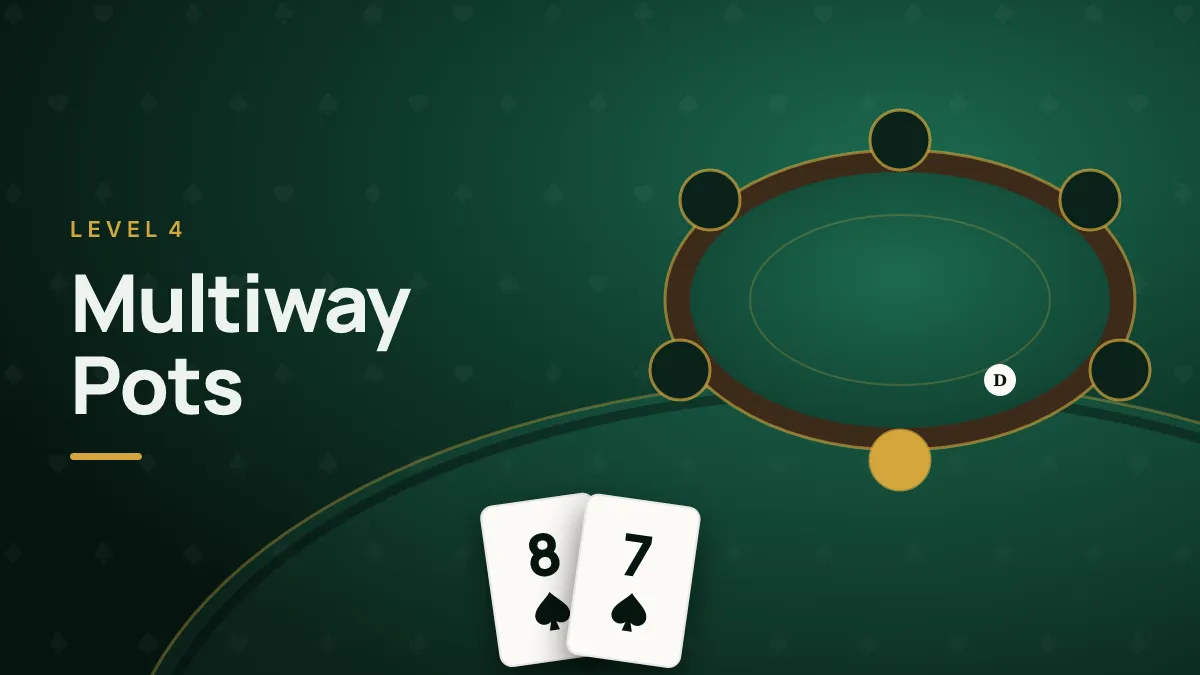
Most strategy advice — including most of this course — assumes you’re heads-up after the flop. But at low stakes, and especially in live games, pots with three, four or five players are everywhere. Multiway pots follow different rules: strong hands lose value, bluffs stop working, and the player who adjusts wins far more than the one who plays every flop like a heads-up spot.
Key takeaways
- Every extra opponent shrinks your equity: aces fall from about 85% heads-up to about 56% against four random hands.
- Bluffs need every opponent to fold, so they work far less often multiway.
- Bet for value with stronger hands, and use bigger sizes on wet boards to charge the many draws.
- Hands that make the nuts — suited connectors, small pairs, suited aces — gain value multiway; one-pair hands lose it.
- Be careful when you're 'sandwiched' between a bettor and players still to act.
Your equity shrinks with every opponent
The more hands you’re up against, the less often your hand wins. From our odds calculator, all-in preflop against random hands:
| Your hand | vs 1 opponent | vs 2 | vs 3 | vs 4 |
|---|---|---|---|---|
| A♠A♦ | 85% | 73% | 64% | 56% |
| K♦J♣ | 61% | — | 34% | — |
| 8♠7♠ | 48% | 34% | — | — |
Two lessons:
- Even aces lose almost half the time five-handed. One pair — even a big one — becomes a medium-strength hand.
- Hands like 8♠7♠ hold their share better. Against two opponents, 34% is slightly more than a third of the pot — and when suited connectors win, they usually win big pots with straights and flushes. Offsuit high cards like K-J mostly make one pair, which is exactly what multiway pots punish.
Check your own examples in the odds calculator: it handles up to four players, and you can leave a hand blank to deal it randomly.
Bluffs rarely work
A bluff only wins if everyone folds. If each opponent folds 60% of the time (and, for simplicity, independently):
| Opponents | Chance all fold |
|---|---|
| 1 | 60% |
| 2 | 36% |
| 3 | 22% |
A half-pot bluff needs folds 33% of the time. Heads-up it’s comfortably profitable; against three opponents it loses money. So in multiway pots:
- C-bet much less as a bluff — see Continuation Betting.
- Semi-bluff with strong draws (they still win when called), not with air.
- Save pure bluffs for heads-up pots and for boards where the story is very strong.
Value betting: stronger hands, bigger sizes
Multiway, the bar for a value bet goes up — someone often has a good hand — but the reward goes up too, because more players can call.
- Top pair with a good kicker is still a value bet on dry boards, but on wet boards it’s often a one-street hand.
- Two pair or better: bet, and bet bigger on wet boards. With several opponents, there are more draws to charge.
- Draws to the nuts gain value. When they hit, several opponents may pay you off (big implied odds).
- Non-nut draws lose value: another player may be drawing to the better flush or straight.
Charging draws in a four-way pot
No-Limit Hold'em · live · 1/2 · 300 stacks
Preflop
Pot 3
- UTG limps, HJ limps
- Hero raises to 12 on the button (4bb plus 1bb per limper)
- SB folds; BB, UTG and HJ all call
Flop
Pot 49
J95- Everyone checks to Hero
- Hero bets 35 (about 70% of the pot): an overpair on a wet board with three opponents — many flush draws, straight draws and pairs will call
- UTG calls, BB and HJ fold
Turn
Pot 119
2- UTG checks, Hero bets 80, UTG folds
Preflop: choose hands that play well multiway
When you expect a multiway pot — live games with lots of limpers, or when you call a raise with players behind — adjust your hand selection:
- Better: small and medium pairs (set value), suited connectors, suited aces — hands that make the nuts.
- Worse: offsuit broadways (K-J, Q-J, A-T offsuit) and weak offsuit aces — hands that make dominated one-pair hands.
If you have a strong hand and want to play fewer opponents, raise bigger: see isolation raises in Preflop Raising Basics and squeezes in 3-Betting.
Position in multiway pots
Position matters even more with several players:
- Last to act is the best seat by far — you see every other player’s action first.
- Sandwiched (one player bets, you’re next, and others are still to act behind you) is the worst. A call can be squeezed or raised by a player behind you. Continue only with hands that are comfortable facing a raise.
- Out of position against several opponents, check most of your range and let the betting come to you.
Pot control with one pair
In Pot Control you learned “big pot, big hand”. Multiway, it applies twice over. With top pair and three opponents:
- bet once for value and protection if the board is safe;
- if you face a raise — or a bet and a call in front of you — you’re usually beaten or facing a big draw. Fold more often than you would heads-up.
Next up: a full review of a 3-bet pot, street by street — Hand Review: Ace-King in a 3-Bet Pot.
Finished this lesson?
Mark it complete to track your Level 4 progress.
Practise with a free tool
Keep going
Ready for the next level?
Up next in Level 4 — Advanced:
Hand Review: Ace-King in a 3-Bet Pot on a Low BoardGet the weekly level-up
One short email a week: a new lesson, a hand to think about and a tool tip. No spam, unsubscribe any time.
By subscribing you agree to our privacy policy.
Related lessons
Live Poker: Tells, Straddles and Live Game Adjustments
How live cash games differ from online poker: bigger sizes, straddles, limped pots, reading physical and timing tells — and hiding your own.
Game Selection: Choosing Tables You Can Beat
Your win rate depends on who you play against. How to spot profitable tables, choose seats, pick formats, times and sites, and when to leave a game.
Blockers and Card Removal
How the cards in your hand change your opponent's range: counting blocked combos, choosing bluffs with blockers, value betting and preflop blockers.