
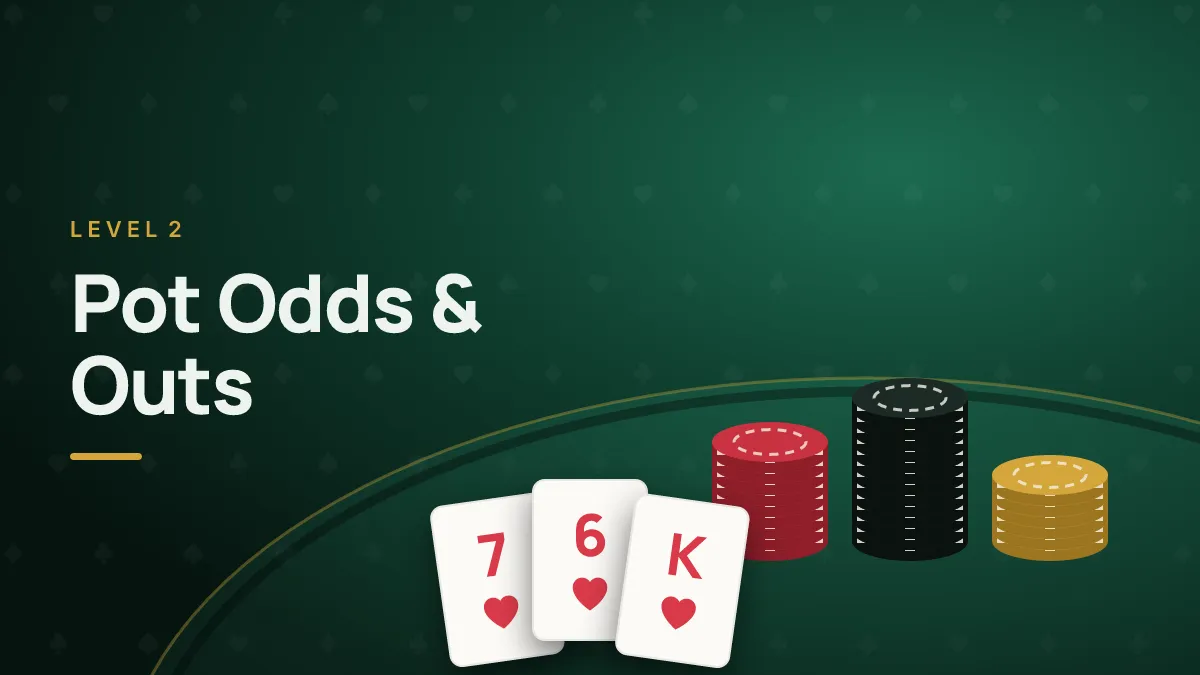
You’re on the turn with a flush draw. Your opponent bets. Should you call? Guessing gets expensive. Pot odds give you a clear, quick answer based on two numbers: how much you have to pay and how often you’ll win. The maths is simpler than it looks, and once you’ve practised it a few times you’ll be able to do it at the table in seconds.
Key takeaways
- Pot odds compare the cost of a call with the size of the pot you could win.
- Required equity = amount to call ÷ (pot after your call).
- Outs are the unseen cards that improve your hand to the likely winner.
- Rule of 2 and 4: multiply your outs by 2 for one card to come, or by 4 for two.
- If your equity is higher than the equity you need, calling is profitable in the long run.
What are pot odds?
Pot odds are the ratio between the size of the pot and the cost of your call. If the pot is 100 and your opponent bets 50, the pot is now 150 and it costs you 50 to call. You’re risking 50 to win 150 — pot odds of 3 to 1.
The more useful way to express this is as the equity you need to break even:
Required equity = amount to call ÷ (pot including the bet + your call)
In the example: 50 ÷ (150 + 50) = 50 ÷ 200 = 25%. If you’ll win the hand more than 25% of the time, calling makes money over the long run. If you’ll win less often, it loses money.
Common bet sizes
You’ll face the same few bet sizes again and again, so it’s worth learning the required equity for each:
| Opponent bets… | You need to win at least… |
|---|---|
| ¼ pot | 16.7% |
| ⅓ pot | 20% |
| ½ pot | 25% |
| ⅔ pot | 28.6% |
| ¾ pot | 30% |
| Full pot | 33.3% |
| 2× pot | 40% |
Notice that even a pot-sized bet only asks you to win one time in three. That’s why folding too often to big bets is a costly habit.
Counting your outs
Your outs are the unseen cards that will improve your hand to the likely winner. Counting them is straightforward:
Flop
There are 13 hearts in the deck. You can see four of them (two in your hand, two on the board), so nine hearts are left. You have 9 outs.
Common draws and their outs:
| Draw | Example | Outs |
|---|---|---|
| Flush draw | A♥ 5♥ on K♥ 7♥ 2♣ | 9 |
| Open-ended straight draw | 9♠ 8♠ on T♦ 7♣ 2♥ | 8 |
| Gutshot straight draw | 9♠ 8♠ on J♦ 7♣ 2♥ | 4 |
| Two overcards | A♠ K♦ on 9♣ 6♥ 2♦ | 6 |
| Flush draw + open-ended straight draw | 9♥ 8♥ on T♥ 7♥ 2♣ | 15 |
| Pocket pair to a set | 5♣ 5♦ on K♠ 9♥ 2♣ | 2 |
From outs to equity: the rule of 2 and 4
You don’t need a calculator at the table. The rule of 2 and 4 gets you close enough:
- One card to come (flop to turn, or turn to river): multiply your outs by 2.
- Two cards to come (flop to river, when you’re all-in on the flop): multiply your outs by 4.
With 9 outs on the turn: 9 × 2 ≈ 18% (exact: 19.6%). With 9 outs on the flop when you’re all-in: 9 × 4 ≈ 36% (exact: 35.0%).
Here are the exact numbers for the most common draws:
| Outs | Flop → turn | Turn → river | Flop → river |
|---|---|---|---|
| 2 | 4.3% | 4.3% | 8.4% |
| 4 | 8.5% | 8.7% | 16.5% |
| 6 | 12.8% | 13.0% | 24.1% |
| 8 | 17.0% | 17.4% | 31.5% |
| 9 | 19.1% | 19.6% | 35.0% |
| 12 | 25.5% | 26.1% | 45.0% |
| 15 | 31.9% | 32.6% | 54.1% |
The rule of 4 slightly overestimates big draws — with 15 outs it says 60%, but the truth is 54%. For most decisions, it’s close enough.
Putting it together: should you call?
Compare the equity you need with the equity you have:
- Work out the required equity from the bet size.
- Count your outs and turn them into equity with the rule of 2 and 4.
- If your equity is higher, call. If it’s lower, fold — unless implied odds change the picture (more on that below).
Flush draw on the turn
No-Limit Hold'em · 6-max
Flop
Pot 60
K72- BB bets 30
- Hero calls
Turn
Pot 120
9- BB bets 40 (one-third pot)
- Hero thinks: calling 40 to win 200 → needs 20% equity
- Nine outs × 2 ≈ 18% (exact 19.6%)
Implied odds: the money you’ll win later
Pot odds only consider the money in the pot right now. Implied odds add the extra chips you expect to win on later streets when you hit your hand.
In the quiz above, you’re a little short of the equity you need. But if you can reasonably expect your opponent to pay off a decent bet on the river when you make your straight, the call can become profitable. You can estimate how much extra you’d need to win with this formula:
Extra needed = (call ÷ your equity) − pot − call
With a 30 call and 17.4% equity: 30 ÷ 0.174 − 120 − 30 ≈ 22. If you’ll win at least about 22 more on average when you hit, calling is fine. Our pot odds calculator works this out for you.
Implied odds are best when:
- your draw is well hidden (a gutshot is harder to see than a four-flush board),
- you’re drawing to the nuts, so you won’t lose a big pot when you hit,
- stacks are deep enough to win more later, and
- your opponent is the type who pays off.
Practise until it’s automatic
The first few times, pot odds feel slow. That’s normal. Here’s a routine that works:
- Learn the table of common bet sizes above — it covers most spots.
- Memorise the outs for the six common draws.
- Play with the pot odds calculator for ten minutes, predicting the answer before you press calculate.
- Check real match-ups in the odds calculator — for example, a flush draw against top pair.
Then drill it in the pot odds trainer and the outs trainer until the numbers come instantly.
Next up: how to enter the pot the right way — Preflop Raising Basics.
Finished this lesson?
Mark it complete to track your Level 2 progress.
Practise with a free tool
Keep going
Ready for the next level?
Up next in Level 2 — Solid Basics:
Preflop Raising Basics: Open Sizes, Limpers and IsolationGet the weekly level-up
One short email a week: a new lesson, a hand to think about and a tool tip. No spam, unsubscribe any time.
By subscribing you agree to our privacy policy.
Related lessons
Aggression and Fold Equity: Why Betting Wins
Why betting and raising beats checking and calling: the two ways to win, how to calculate fold equity, and a worked semi-bluff example with real numbers.
Expected Value: Thinking in the Long Run
What expected value (EV) is, how to calculate it for calls, bets and all-ins, why results and decisions are different things, and why money in the pot isn't yours.
Starting Hands in Texas Hold'em: Which Hands to Play
Which two-card hands are worth playing, which to fold, and why position changes everything. Includes range charts and the mistakes to avoid.