
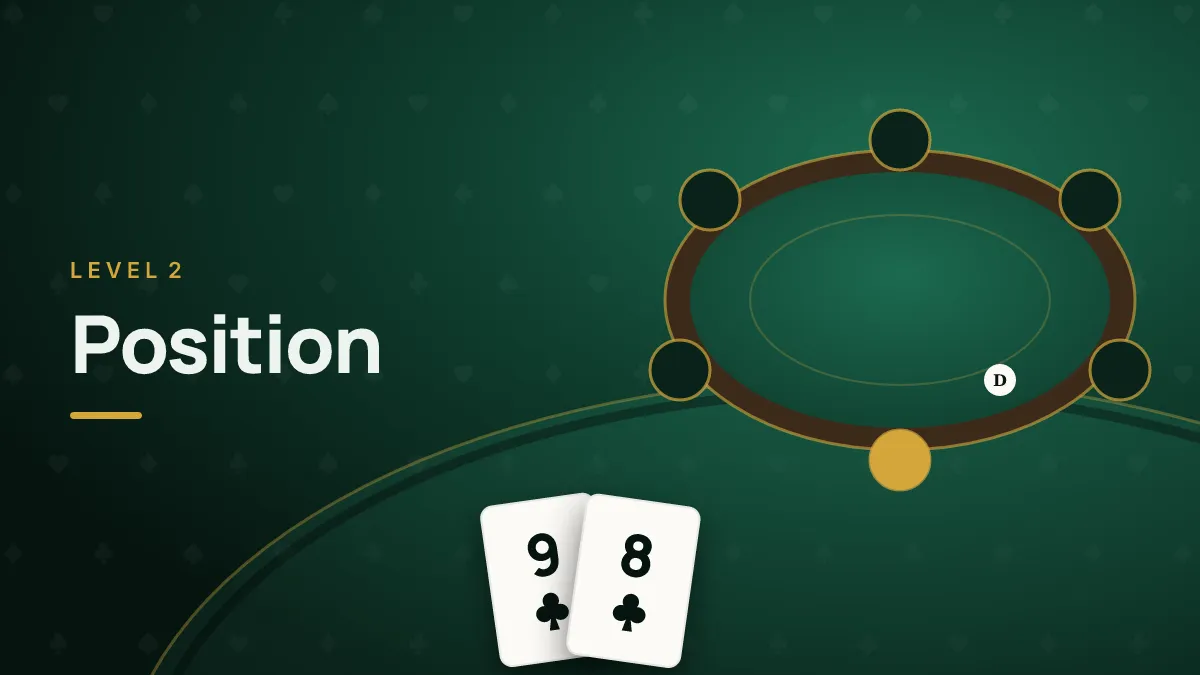
Ask any experienced player for one piece of advice and there’s a good chance you’ll hear: play more hands in position. Position is simply the order in which players act — but because poker is a game of incomplete information, acting last is a genuine, measurable advantage. In this lesson you’ll learn the name of every seat, why the button is the most profitable seat at the table, and how to use position to make easier decisions.
Key takeaways
- Being 'in position' means you act after your opponent on the flop, turn and river.
- The button is the best seat because it acts last on every post-flop street.
- Early seats need tighter ranges; late seats can play many more hands.
- Position gives you information, control of the pot size and more ways to win.
The seats at the table
Seats are named relative to the dealer button. At a six-handed (6-max) table, moving clockwise from the first player to act before the flop:
| Seat | Short name | Also called | Position type |
|---|---|---|---|
| Under the gun | UTG | Lojack (in 6-max) | Early |
| Hijack | HJ | Middle position | Middle |
| Cutoff | CO | — | Late |
| Button | BTN | The dealer | Late |
| Small blind | SB | — | Blind |
| Big blind | BB | — | Blind |
At a full-ring table (nine players), three more early seats are added in front of the hijack — usually called UTG, UTG+1 and UTG+2 (or middle position), followed by the lojack, hijack, cutoff and button.
Why acting last is so powerful
1. You get information first
Every action tells you something. When your opponent checks, they’re often showing weakness; when they bet big, they’re often strong. Acting after them means you make your decision with that information — while they had to act without knowing what you’d do.
2. You control the size of the pot
In position, you decide whether the betting on each street ends small or grows. With a medium-strength hand you can check behind to take a free card or keep the pot small. With a strong hand you can bet to build it. Out of position, your opponent makes that choice for you.
3. You realise more of your equity
Equity realisation is how much of your hand’s raw winning chance you actually turn into winnings. Out of position, you’ll often be bet off your hand before you see the turn and river. In position, you see more cards cheaply and get to showdown more often. That’s why the same hand is worth more on the button than in the small blind.
4. Bluffs work better
When your opponent checks to you twice, their range is often weak — and you’re the one who can bet last. Many of the easiest pots in poker are won by the player in position betting when everyone else has shown weakness.
The same hand, two different seats
Out of position: a tough spot
No-Limit Hold'em · 6-max · 100bb
Preflop
Pot 1.5bb
- Folds to the BTN, who raises to 2.5bb
- Hero calls from the small blind
- BB folds
Flop
Pot 6bb
1062- Hero checks with a gutshot straight draw
- BTN bets 4bb
- Hero has to guess: call without knowing what's coming on the turn, or fold
In position: easy choices
No-Limit Hold'em · 6-max · 100bb
Preflop
Pot 1.5bb
- Folds to Hero on the button, raises to 2.5bb
- SB folds, BB calls
Flop
Pot 5.5bb
1062- BB checks
- Hero can bet to win the pot now, or check behind and see a free turn
Turn
Pot 5.5bb
7- BB checks
- Hero has made a straight and now bets for value, knowing the BB has shown weakness twice
Adjusting your ranges by position
Because early seats have more players behind them and play out of position more often, they need stronger hands. Late seats can profit with a much wider range. A rough guide for a six-handed game where the action folds to you:
| Seat | Share of hands to open | Typical hands added |
|---|---|---|
| UTG | ~12–15% | Pairs, strong aces, suited broadways |
| Hijack | ~17–20% | More suited aces, KJo, suited connectors |
| Cutoff | ~24–28% | All pairs and suited aces, more offsuit broadways |
| Button | ~35–45% | Most suited hands, many offsuit hands |
| Small blind | ~28–40% | Depends heavily on the big blind’s tendencies |
Compare these ranges on the grid with the preflop charts tool, and revisit starting hands if the groups aren’t familiar yet.
The blinds: the toughest seats
The small blind and the big blind lose money for almost everyone over time — including professionals. That’s expected: you’re forced to put money in, and you’ll be out of position after the flop in nearly every hand. Your goal in the blinds is to lose as little as possible, not to win.
- Small blind: you’re out of position against everybody. Many players prefer raising or folding here rather than calling.
- Big blind: you already have a big blind invested and close the action preflop, so you get a good price to call. You can defend with a wide range — especially against a button raise — but play carefully after the flop.
Relative position
So far we’ve talked about your seat relative to the button. Relative position is your seat relative to the player who’s likely to take the lead. If an aggressive player tends to bet, sitting to their left lets you see their action before you decide — in every hand. In live games, if you get the choice of seat, try to sit to the left of the most aggressive players and the right of the most passive ones.
Putting position to work
- Open more hands the closer you are to the button. Tighten up in early seats.
- Be careful calling raises out of position. A re-raise or a fold is often better than a call from the small blind.
- Attack the blinds from the cutoff and button. They’ll be out of position against you.
- When a player checks to you twice, consider betting. Their range is often capped and weak.
- Use position to control the pot. Check behind with medium hands; bet your strong hands and your best bluffs.
Next up: once you’re in a hand, how do you decide whether a call is worth it? That’s what pot odds are for.
Finished this lesson?
Mark it complete to track your Level 2 progress.
Practise with a free tool
Keep going
Ready for the next level?
Up next in Level 2 — Solid Basics:
Pot Odds and Outs: The Maths Behind Every CallGet the weekly level-up
One short email a week: a new lesson, a hand to think about and a tool tip. No spam, unsubscribe any time.
By subscribing you agree to our privacy policy.
Related lessons
Starting Hands in Texas Hold'em: Which Hands to Play
Which two-card hands are worth playing, which to fold, and why position changes everything. Includes range charts and the mistakes to avoid.
Preflop Raising Basics: Open Sizes, Limpers and Isolation
How much to raise before the flop online and live, why limping loses money, how to punish limpers with isolation raises and how to steal the blinds.
3-Betting and Facing Raises: Call, Re-Raise or Fold
When someone raises before you: when to call, when to 3-bet for value or as a bluff, how big to make it, and how to respond when your own open gets 3-bet.