
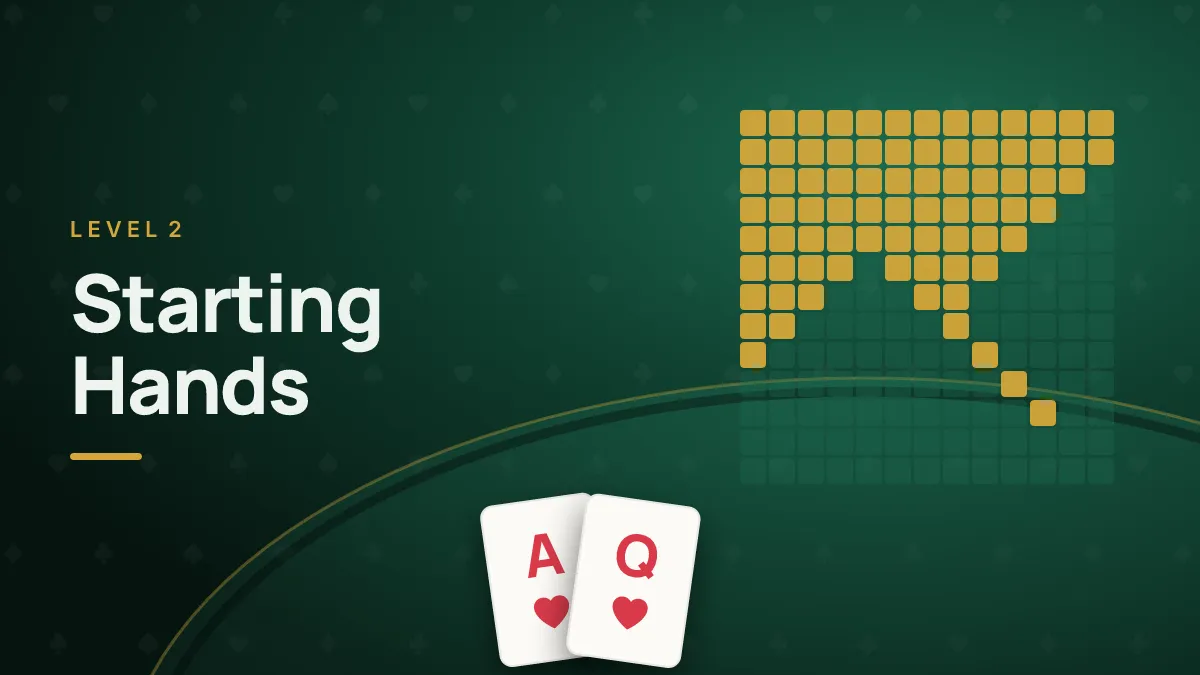
The single fastest way to improve at poker is to play fewer, better hands. Most new players lose chips before the flop by calling with hands that look pretty but make second-best hands. This lesson gives you a simple framework for deciding which hands to play, and shows you how that decision changes with your seat at the table.
Key takeaways
- There are 169 distinct starting hands in Hold'em. Most of them should be folded most of the time.
- Strong starting hands are high, paired, suited and connected — and ideally several of these at once.
- Play tighter in early position and wider on the button.
- When you enter a pot first, raise. Don't limp.
What makes a starting hand strong?
You only get two cards, so there are only a handful of things that can make them good. The best hands tick several boxes:
- High cards. Aces, kings and queens make top pairs that win at showdown. High cards also make strong kickers.
- Pairs. A pocket pair is already a made hand before the flop, and it can turn into a well-disguised set (three of a kind) about one time in eight on the flop.
- Suitedness. Two cards of the same suit can make flushes. Being suited adds only a few percentage points of equity, but those points matter because flushes win big pots.
- Connectedness. Cards close in rank, like 9-8, make straights more often.
AQ Ace–queen suited ticks three boxes: high cards, suited and fairly connected.
K7 King–seven offsuit ticks only one. It looks playable, but it rarely wins a big pot.
The starting-hand grid
Poker players organise all 169 starting hands on a 13×13 grid:
- Pairs run diagonally from AA in the top-left to 22 in the bottom-right.
- Suited hands (marked s) are above the diagonal.
- Offsuit hands (marked o) are below it.
There are 1,326 possible two-card combinations in total: each pair can be dealt 6 ways, each suited hand 4 ways, and each offsuit hand 12 ways. That’s why an offsuit hand like AKo comes up three times as often as AKs.
Here’s what a tight, solid opening range looks like from the earliest seat at a six-handed table:
Under the gun (6-max) — a strong starting range164 combos · 12.4% of hands
Notice how few offsuit hands make the cut. Suited hands and pairs make up most of the range because they can win big pots after the flop.
Hand groups, from strongest to weakest
You don’t need to memorise 169 hands. Thinking in groups is enough to start with:
| Group | Hands | How to play them |
|---|---|---|
| Premium | AA, KK, QQ, AK | Raise from any seat. Happy to re-raise. |
| Strong | JJ, TT, AQ, AJs, KQs | Raise from any seat. Proceed carefully against big re-raises. |
| Medium pairs | 99–66 | Raise from most seats. Hoping to flop a set or win with an overpair. |
| Suited aces | A9s–A2s | Great in late position. Make the nut flush. |
| Suited broadways | KJs, KTs, QJs, QTs, JTs | Good from middle and late position. |
| Suited connectors | T9s, 98s, 87s, 76s | Best in late position with deep stacks. |
| Offsuit broadways | KQo, KJo, QJo, ATo | Playable in late position; dangerous early. |
| Small pairs | 55–22 | Mostly for late position, or cheaply against loose opponents. |
| Everything else | K7o, Q5s, J3o, 94s… | Fold — except sometimes from the button or the blinds. |
Why position changes everything
The same hand can be a clear raise on the button and a clear fold under the gun. The reason is simple: the more players left to act behind you, the more likely one of them has a better hand, and the more often you’ll have to play the rest of the hand out of position.
Compare the tight range above with a typical button range:
Button (6-max) — a much wider range466 combos · 35.1% of hands
That’s nearly three times as many hands. The next lesson on position explains exactly why the button can play so many more of them profitably. You can explore and edit ranges for every seat with our preflop charts tool.
Raise or fold: don’t limp
When nobody has entered the pot before you, the default is raise or fold. Just calling the big blind — “limping” — is one of the most common beginner leaks:
- A raise can win the blinds straight away.
- A raise builds a pot when you have a strong hand.
- A raise gives you the initiative, which makes it easier to win the pot after the flop with a bet.
- Limping invites several opponents in cheaply, which makes your good hands harder to play.
A standard open raise online is about 2 to 2.5 big blinds. In live games, where players call more often, 3 to 5 big blinds is common.
The danger of domination
A hand is dominated when an opponent’s hand shares one of your cards and has a better other card. Dominated hands make second-best pairs — and second-best pairs lose big pots.
King–jack runs into ace–king
No-Limit Hold'em · 6-max · 100bb
Preflop
Pot 1.5bb
- UTG raises to 2.5bb
- Hero calls in the hijack
- Everyone else folds
Flop
Pot 6.5bb
K72- UTG bets 3bb
- Hero calls — top pair feels great
Turn
Pot 12.5bb
4- UTG bets 8bb
- Hero calls
River
Pot 28.5bb
9- UTG bets 20bb
- Hero calls
This is why KJo, QJo and ATo are folds against an early-position raise. The hands that call or raise an early opener — AK, AQ, KQ, strong pairs — dominate them. Against an opener from the button, the same hands become much better, because the button raises many weaker hands.
Common starting-hand mistakes
A simple plan to start with
- Raise the premium and strong groups from any seat.
- Add medium pairs, suited aces and suited broadways from the hijack onwards.
- Open wide on the button: most pairs, suited aces, suited connectors and good offsuit broadways.
- Fold everything else when you’re first to act.
That plan alone will put you ahead of most casual players. As you move through Level 2 and into Level 3, you’ll learn how to adjust it to your opponents and stack sizes. Use the odds calculator to check any match-up you’re unsure about — for example, how often KJ wins against AK (about a quarter of the time).
Next up: why the same hand can be a raise in one seat and a fold in another — Position in Poker.
Finished this lesson?
Mark it complete to track your Level 2 progress.
Practise with a free tool
Keep going
Ready for the next level?
Up next in Level 2 — Solid Basics:
Position in Poker: Why Your Seat MattersGet the weekly level-up
One short email a week: a new lesson, a hand to think about and a tool tip. No spam, unsubscribe any time.
By subscribing you agree to our privacy policy.
Related lessons
Position in Poker: Why Your Seat Matters
Why acting last is such a big advantage, the name of every seat at the table, and how to adjust your hand selection and betting to your position.
Preflop Raising Basics: Open Sizes, Limpers and Isolation
How much to raise before the flop online and live, why limping loses money, how to punish limpers with isolation raises and how to steal the blinds.
3-Betting and Facing Raises: Call, Re-Raise or Fold
When someone raises before you: when to call, when to 3-bet for value or as a bluff, how big to make it, and how to respond when your own open gets 3-bet.