
Blog
How to Play Pocket Jacks: Preflop, 3-Bets and Overcards
Pocket jacks are the fourth-best starting hand but one of the hardest to play. How to play JJ preflop, against 3-bets and 4-bets, and on flops with overcards.
By PokerLevelUp Team · · 6 min read
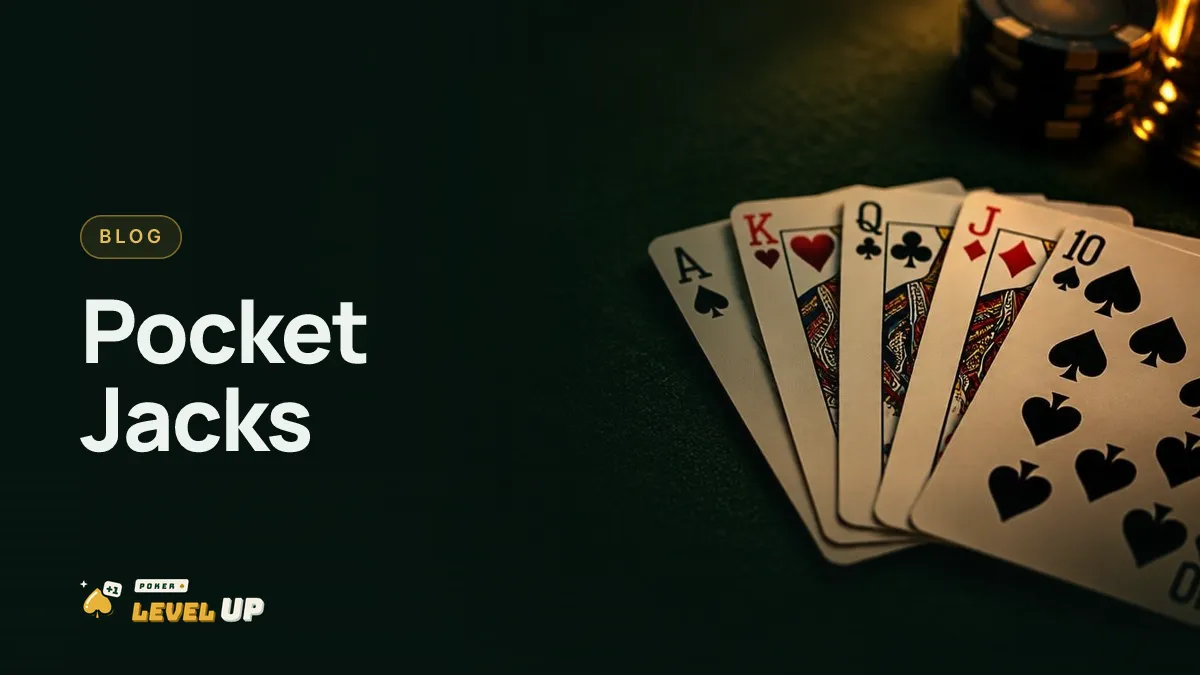
Pocket jacks have a reputation. Players joke that there are only three ways to play them and all of them are wrong. The truth is simpler: J-J is a very strong hand that’s awkward in two specific spots — when someone puts in a lot of money before the flop, and when an overcard lands on the flop. Get those two right and jacks become one of your most profitable hands.
How strong are pocket jacks?
Against a single random hand, J♠J♥ wins 77.5% of the time. Only A-A, K-K and Q-Q do better. The trouble is what happens when the money goes in:
| Opponent’s hand or range | J♠J♥ equity |
|---|---|
| A random hand | 77.5% |
| Two overcards, e.g. A♦K♣ | 57.3% |
| One overcard, e.g. A♦9♣ | 71.9% |
| A smaller pair, e.g. T♦T♣ | 81.3% |
| A bigger pair (Q-Q, K-K or A-A) | 19–20% |
| Q-Q+ and A-K | 36.7% |
| K-K+ and A-K suited | 28.0% |
Jacks crush everything below them and are a small favourite against A-K — but against a tight range of big hands they’re in bad shape. That’s the whole story of how to play them.
All equities are exact, calculated with our odds calculator. Ranges are weighted by the number of combinations of each hand.
Preflop: raise first in, from every seat
When nobody has entered the pot, raise with J-J from any position. It’s in every opening range on our preflop charts, including under the gun. Don’t limp — you want to build a pot and thin the field, because jacks do much better against one opponent than several:
| Opponents (random hands) | J♠J♥ equity |
|---|---|
| 1 | 78% |
| 2 | 61% |
| 3 | 49% |
| 4 | 40% |
If players have limped in front of you, raise bigger — about 4 big blinds plus 1 for each limper — to isolate. See preflop raising for sizes.
Facing a raise: usually 3-bet
When someone opens in front of you, J-J is almost always strong enough to 3-bet.
- Against a late-position open (cutoff, button, small blind): 3-bet for value. Their range is wide, and jacks are well ahead of it.
- Against a tight early-position open: 3-betting is still standard, but calling is fine too, especially in position. Calling keeps their weaker hands in and avoids a tough decision against a 4-bet.
- In a multiway pot (an open and a call in front): 3-bet bigger, or you’ll play a bloated pot out of position against several players.
Facing a 3-bet: call or 4-bet?
This is the first tricky spot. You open, and someone re-raises. Your choice depends on who 3-bet and how deep you are.
- Against a wide 3-bettor (someone 3-betting 10% or more, often from the blinds or button): their range includes plenty of hands jacks beat — smaller pairs, A-Q, A-J, suited broadways. Against a range like T-T+, A-Q+ and some bluffs, jacks have around half the equity or better, so you can call or 4-bet.
- Against a tight 3-bettor (Q-Q+ and A-K only): you have about 37%. Calling to see a flop is usually better than 4-betting, because 4-betting only gets action from hands that beat you or flip with you.
- Short-stacked (under about 40 big blinds): getting all-in with jacks is almost always right. There’s too little behind to fold profitably, and even the tight range gives you enough equity with the dead money in the pot.
Facing a 4-bet: often a fold, deep
You 3-bet with jacks and your opponent 4-bets. At 100 big blinds, most players’ 4-bet ranges at low and middle stakes are very strong — often K-K+ and A-K, sometimes Q-Q.
Against K-K+ and suited A-K, jacks have only 28%. If you call a 4-bet and then face an all-in, you’re usually putting in a lot of money as a big underdog.
Fold jacks to a 4-bet when:
- The player is tight and rarely 4-bets.
- You’re deep (100 big blinds or more).
- They’re in early position, where 4-bet ranges are strongest.
Continue when the player is aggressive, you’re shorter, or you’ve seen them 4-bet light before. Our exploitative play lesson covers adjusting to specific players.
On the flop: the overcard problem
At least one ace, king or queen comes on the flop 57% of the time. That’s the moment jacks become hard to play.
Low, dry flops (e.g. 8♣4♦2♠): You’re usually well ahead. Bet for value — worse pairs, draws and overcards will call. See value betting.
One overcard (e.g. K♣7♦3♠): Slow down. You still beat plenty of hands, but a lot of the range that calls a preflop raise has a king. Against one opponent, a small c-bet or a check to control the pot is usually best. The pot control lesson shows how.
An ace on the flop: In a 3-bet pot, an ace is especially bad news because A-K and A-Q are in most 3-betting ranges. Check and be prepared to fold to strong pressure.
Two overcards or a coordinated board (e.g. Q♥T♥9♣): Jacks are now a bluff-catcher at best. Play small pots and don’t pay off big bets. The board texture lesson explains why.
Flopping a set: It happens about 1 time in 8.5 (see flop odds). Build the pot — a set of jacks is almost always the best hand.
A worked hand
You open J♠J♥ to 2.5 big blinds from the cutoff. The button calls; the blinds fold. The pot is 6.5 big blinds, and you both have 97.5 left.
Flop: A♦8♣4♥. The ace is bad for you — the button calls with plenty of aces (A-J, A-T, suited aces). But they also call with lots of hands jacks beat: smaller pairs, broadway cards without an ace, suited connectors. A small c-bet of about a third of the pot folds out many of the hands with outs against you and keeps the pot small. If you’re raised, fold.
Turn: 2♠, you bet and they call. Now check. Their calling range is weighted to aces and pairs; betting again mainly gets action from hands that beat you.
River: 7♦. Check again. Call a small bet; fold to a large one from a player who rarely bluffs.
The goal all hand is the same: win a medium pot when you’re ahead, lose a small one when you’re behind.
Common mistakes with jacks
- Limping or flat-calling everything. Jacks want a heads-up pot — raise.
- Going broke deep against a tight 4-bet. Against K-K+ and A-K you’re a big underdog.
- Pretending the overcard didn’t come. Betting three streets on K-high or A-high boards gets called by kings and aces, not by the hands you beat.
- Folding too much when short. With under about 40 big blinds, jacks are a get-it-in hand against most opponents. The push/fold charts show how strong they are at short stacks.
Quick questions
Are pocket jacks better than A-K? Against A-K head to head, yes: 57% to 43%. Against a range of big hands, A-K does slightly better, because it blocks A-A and K-K and isn’t crushed by Q-Q.
Should I ever fold jacks before the flop? Yes — deep-stacked, facing a 4-bet or a 5-bet all-in from a tight player. Folding jacks unopened is always a mistake.
What about pocket queens and tens? Q-Q follows the same logic with fewer overcards (only aces and kings). T-T is a little weaker and meets an overcard on most flops, so play it more like a medium pair when the money gets deep.
Practise preflop decisions in the preflop trainer and review your jacks hands with the method in session reviews. The full picture on starting hands is in Starting Hands in Texas Hold’em.
#strategy#preflop#starting-hands#postflop
Practise what you just read
Get the weekly level-up
One short email a week: a new lesson, a hand to think about and a tool tip. No spam, unsubscribe any time.
By subscribing you agree to our privacy policy.