
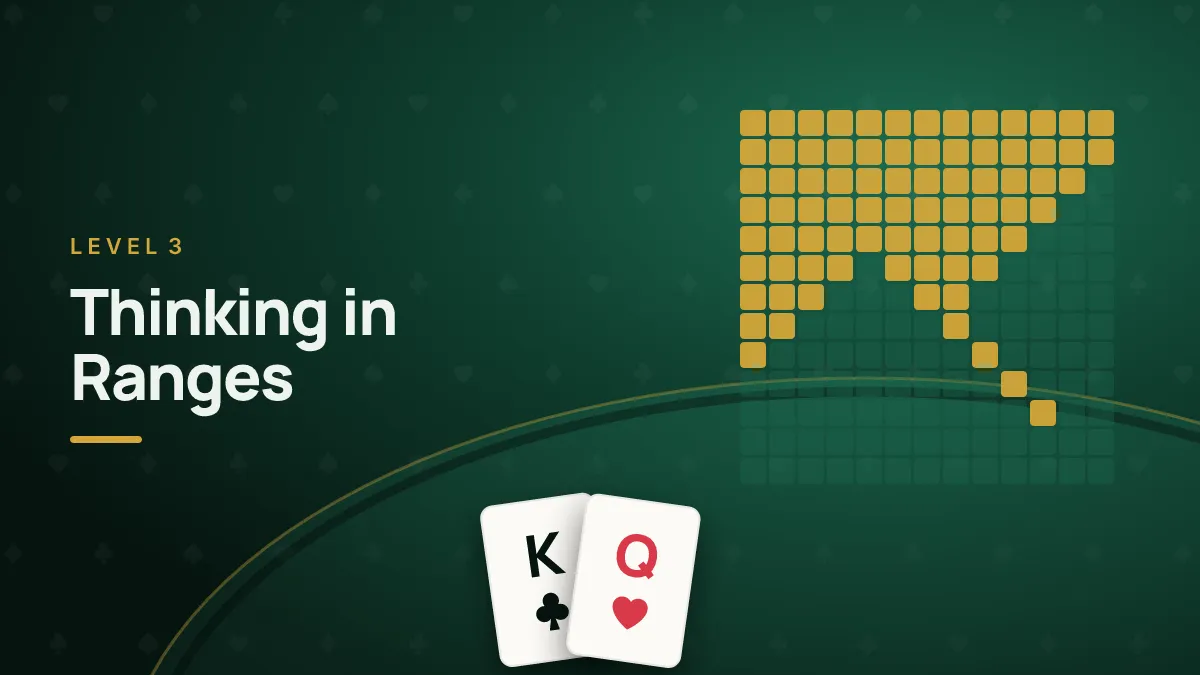
“I put him on ace-king.” Every beginner says it, and it’s the habit that separates beginners from winning players. Your opponent almost never has one hand — they have a range: every hand they could hold, given everything they’ve done so far. Thinking in ranges turns hand reading from guesswork into something you can reason about, count and get better at. This is the foundation of everything in Levels 3 and 4.
Key takeaways
- A range is every hand a player could have in a spot — not a single guess.
- Each pocket pair has 6 combinations, each suited hand 4 and each offsuit hand 12.
- Cards you can see (on the board or in your hand) remove combinations from your opponent's range.
- Narrow the range on every street using each action and the board.
- Compare how many value combos and bluff combos they have to decide whether to call.
From one hand to a range
Imagine a tight player raises from under the gun. What do they have? Not “ace-king” — they have something from their UTG opening range, which might look like this:
A typical UTG opening range (6-max)164 combos · 12.4% of hands
On every street, their actions remove some of these hands and keep others. Your job is to follow that process — and it starts with counting.
Counting combinations
Not all hands are equally likely. There are more ways to be dealt ace-king than pocket aces:
| Hand type | Combinations | Example |
|---|---|---|
| Pocket pair | 6 | A♠A♥, A♠A♦, A♠A♣, A♥A♦, A♥A♣, A♦A♣ |
| Suited non-pair | 4 | A♠K♠, A♥K♥, A♦K♦, A♣K♣ |
| Offsuit non-pair | 12 | every other suit pairing |
| Any non-pair (e.g. AK) | 16 | 4 suited + 12 offsuit |
So a range of “AA, KK or AK” isn’t three equal possibilities — it’s 6 + 6 + 16 = 28 combinations, and more than half of them are AK.
Removing cards you can see
Every card on the board or in your hand is a card your opponent can’t have. This is called card removal, and it changes the counts a lot.
- If a king is on the board, KK has only 3 combinations left (three kings remain, which pair up three ways), and AK has 12 (4 aces × 3 kings).
- If you hold an ace, your opponent has only 3 combinations of AA.
A useful rule: with one of the pair’s cards visible, a pair drops from 6 combinations to 3. With two visible, only 1 is left.
Narrowing a range street by street
Each action tells a story. Consider a hand:
- Preflop: a solid player opens from the cutoff. Range: roughly the top 25–30% of hands.
- You call on the button. Flop K♦ 9♣ 4♠. They bet small. Most of their range can bet here, so it doesn’t narrow much.
- Turn 7♥. They bet again, bigger. Now they’re representing a real hand: kings, sets, some strong draws — and some bluffs.
- River 2♣. They bet the size of the pot.
By the river, a thoughtful player’s range might be value hands — sets and two pair — plus a few bluffs, such as straight draws that missed.
Using combos to make a decision
Let’s finish that hand. You hold K♣ Q♥ — top pair with a good kicker, but it only beats bluffs. The final board is K♦ 9♣ 4♠ 7♥ 2♣. You narrow their river range to:
| Hand | Why they have it | Combinations |
|---|---|---|
| 99 | Set | 3 (the 9♣ is on the board) |
| 77 | Set made on the turn | 3 (the 7♥ is on the board) |
| 44 | Set | 3 (the 4♠ is on the board) |
| K9 | Top two pair | 6 (K♦ is on the board and you hold K♣, so only K♠ and K♥ remain, × 3 nines) |
| Value total | 15 | |
| JTs | Missed gutshot (needed a Q) | 4 |
| QTs | Missed gutshot (needed a J) | 3 (your Q♥ removes Q♥T♥) |
| T8s | Missed open-ender (needed a 6 or J) | 4 |
| Bluff total | 11 |
They bluff 11 times out of 26: about 42%. Facing a pot-sized bet, you need 33% equity to call (you call 1 pot to win 3). Your hand beats all the bluffs and none of the value, so your equity is about 42% — a profitable call.
Notice how sensitive this is. Drop the T8s bluffs (a player who wouldn’t barrel that draw) and it’s 7 bluffs against 15 value combos — just 32%, a marginal fold. Small changes to your read of their bluffs swing the decision, which is why counting beats guessing.
Notice how much your own cards mattered: holding a king and a queen removed value combos (K9) and bluff combos (QT). You’ll study this effect in detail in Blockers and Card Removal.
Your own range matters too
Your opponent is reading you the same way. If you only ever bet the river with the nuts, a thinking player will fold everything but their best hands. Asking “what does my range look like here?” helps you choose bets that are hard to play against — and it’s the doorway to GTO fundamentals in Level 4.
Practise ranges
- Open the preflop charts and count the combos in each opening range.
- In your next session, write down one opponent’s range after each street of a hand you’re not in, then compare it with what they show.
- Use the odds calculator to check your hand against a few hands from the range.
Next up: the most common bet in poker, and how to use it well — Continuation Betting.
Finished this lesson?
Mark it complete to track your Level 3 progress.
Practise with a free tool
Keep going
Ready for the next level?
Up next in Level 3 — Winning Player:
Continuation Betting: When and How Much to C-BetGet the weekly level-up
One short email a week: a new lesson, a hand to think about and a tool tip. No spam, unsubscribe any time.
By subscribing you agree to our privacy policy.
Related lessons
Pot Control: Playing Medium-Strength Hands
How to play hands that are good but not great: when to check, when to bet small, how to bluff-catch, and why turning medium hands into bluffs costs money.
Starting Hands in Texas Hold'em: Which Hands to Play
Which two-card hands are worth playing, which to fold, and why position changes everything. Includes range charts and the mistakes to avoid.
Continuation Betting: When and How Much to C-Bet
When the continuation bet works, when to check instead, and how to choose a c-bet size from the board texture, your position and the number of opponents.