
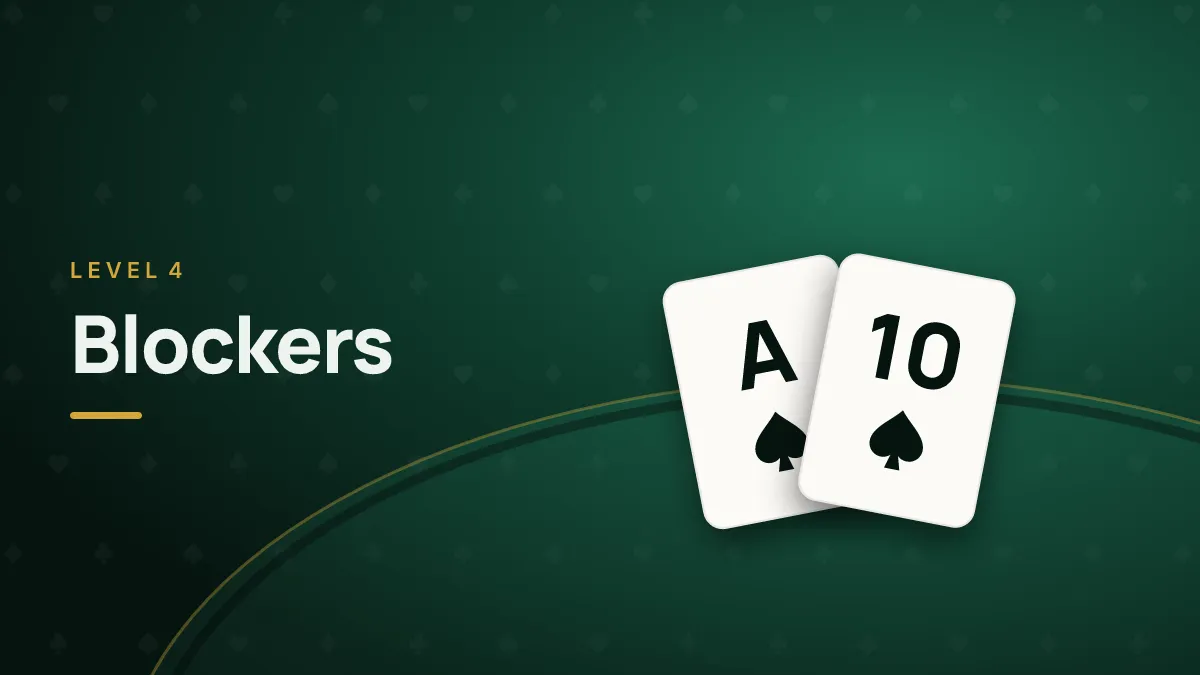
Every card in your hand is a card your opponent can’t have. That simple fact — card removal — changes how many combinations of each hand your opponent holds. When one of your cards makes their strong hands less likely, it’s called a blocker. Blockers decide many close decisions at a high level: which hands to bluff with, which to call with, and which to 3-bet. You’ve already seen the effect in Thinking in Ranges; now you’ll learn to use it deliberately.
Key takeaways
- A blocker is a card in your hand that reduces the combinations of certain hands your opponent can hold.
- Holding one card of a pair cuts that pair from 6 combos to 3; one card of an unpaired hand cuts 16 combos to 12.
- Good bluffs block your opponent's calling hands and don't block their folding hands.
- Good value bets don't block the hands you want to call.
- Blockers break ties between close decisions — they don't turn bad decisions into good ones.
The numbers
| You hold… | Effect on your opponent’s combos |
|---|---|
| One ace | AA: 6 → 3. AK: 16 → 12 (if you don’t hold a king) |
| Two aces | AA: 6 → 0. AK: 16 → 8 |
| The A♥ on a three-heart board | Nut flush (A♥ + any heart): 0 |
| One king on a K-high board | KK: 6 → 1 (two kings visible, two left) |
With a board card and a card in your hand, the numbers fall fast. On a K♦ board, holding K♣ leaves only one combination of pocket kings.
Bluffing with blockers
The best bluffs reduce the hands that call and leave the hands that fold.
Choosing a river bluff
No-Limit Hold'em · 6-max · 100bb
River
Pot 30bb
K9527- Three hearts are on the board and Hero has missed
- Option A: bluff with A♥ Q♣ — blocks every nut flush, and many strong flushes are less likely
- Option B: bluff with Q♣ J♣ — blocks nothing that calls
Other examples:
- Bluffing a straight-completing river with a card that makes the straight less likely for your opponent.
- Holding an ace when bluffing an ace-high board: it reduces the top-pair hands most likely to call.
And the flip side — don’t bluff with hands that block folds. If your opponent will fold all their missed draws, a bluff that holds those draw cards (for example, busted flush-draw cards in your hand) makes it more likely they have a made hand that calls.
Value betting without blocking
When you value bet, you want your opponent to have the hands that call. Holding cards that remove those hands lowers your value.
Example: on a board of A♣ 8♦ 5♠ 3♥ 2♣, you hold 6♠ 4♦ — the nut straight (2-3-4-5-6). Your opponent’s likely calls are aces, two pair, sets and the smaller A-4 straight. Your 4♦ removes some of those A-4 combos, which slightly lowers what you’ll win with a big bet — but you still have the nuts, so bet! Blockers matter most when choosing between similar hands or sizes, not in obvious spots.
Calling with blockers
Blockers also help you choose bluff-catchers. If two hands are equally strong, prefer to call with the one that blocks your opponent’s value hands and doesn’t block their bluffs. In the ranges lesson, K♣ Q♥ was a better bluff-catcher partly because the K♣ removed K9 (value), but the Q♥ also removed one QT bluff — a reminder that blockers cut both ways.
Preflop blockers
Blockers are why suited wheel aces (A5s–A2s) are popular 3-bet and 4-bet bluffs:
- They block AA and AK, the hands most likely to continue against your 3-bet. With an ace in your hand, AA drops from 6 combos to 3 and AK from 16 to 12.
- They play well when called: flushes, wheel straights and top pair with a backup.
Compare A5s with KJo as a 3-bet bluff: KJo blocks some KK and AK, but it’s often dominated when called and plays worse after the flop.
Unblocking
Advanced players also talk about unblocking: preferring bluffs that don’t hold cards from the opponent’s folding range. On a river where your opponent has many missed spade draws, bluffing with a hand that has no spades means their missed draws — which fold — are all still possible. Your bluff works more often.
Next up: using blockers and ranges from the big blind — Check-Raising and Big Blind Defence.
Finished this lesson?
Mark it complete to track your Level 4 progress.
Practise with a free tool
Keep going
Ready for the next level?
Up next in Level 4 — Advanced:
Check-Raising and Big Blind DefenceGet the weekly level-up
One short email a week: a new lesson, a hand to think about and a tool tip. No spam, unsubscribe any time.
By subscribing you agree to our privacy policy.
Related lessons
Turn and River Play: Double and Triple Barrels
When to keep betting on the turn and river: good and bad barrel cards, choosing your double and triple barrels, river value-to-bluff ratios and when to give up.
Multi-Street Planning and Range Advantage
Plan the whole hand before you bet the flop: sort your range into hand classes, pick barrel cards in advance, avoid capping your range and adjust on each street.
Thinking in Ranges: Stop Guessing One Hand
Learn to put opponents on a range of hands instead of one guess: count combinations, remove cards you can see, narrow ranges street by street and make better calls.