
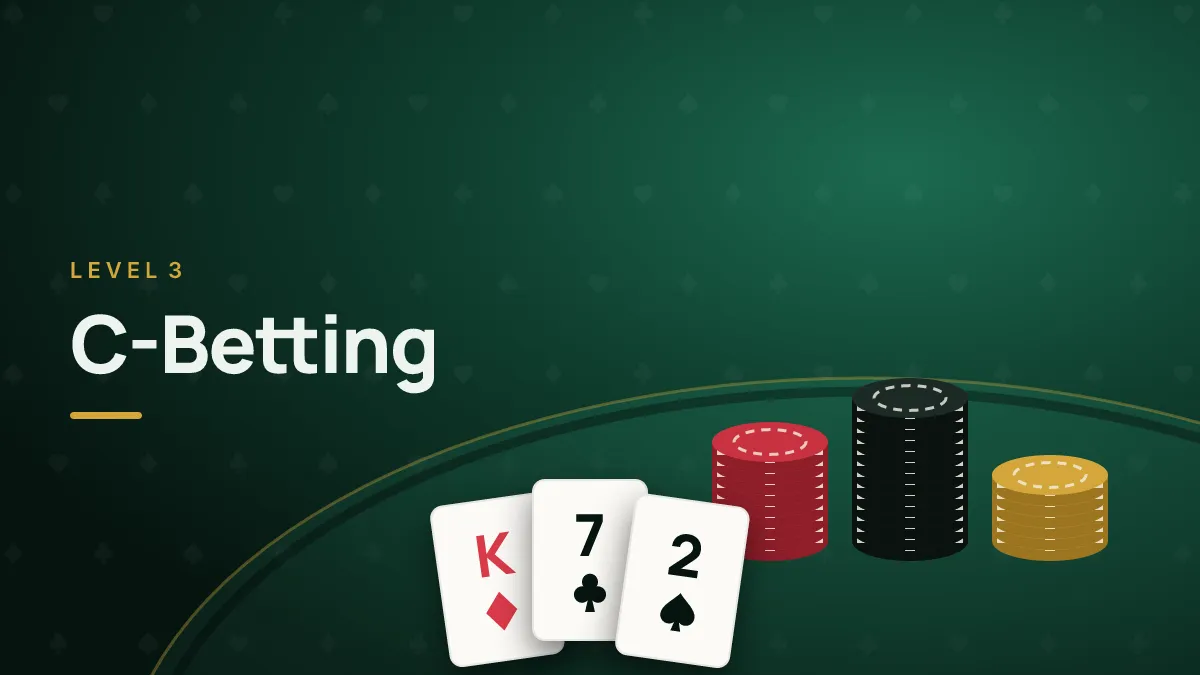
You raised before the flop and got called. The flop comes, your opponent checks, and it’s up to you. Betting again here is called a continuation bet, or c-bet, and it’s the most common bet in poker. Used well, it wins a steady stream of small pots. Used on autopilot — “I raised, so I bet” — it burns money. This lesson shows you when to c-bet, how much, and when checking is the stronger play.
Key takeaways
- A c-bet works because the preflop raiser usually has the stronger range and the caller misses most flops.
- C-bet often and small on dry, high boards that favour your range.
- C-bet less often and bigger on wet boards, and on low boards that favour the caller.
- Against two or more opponents, c-bet much less and mostly for value.
- Checking back medium hands in position keeps your range strong and the pot manageable.
Why the c-bet works
Two facts make the continuation bet powerful:
- You have the stronger range. You raised; they called. Your range contains more big pairs and strong aces, because they would often have 3-bet those.
- Most flops miss most hands. An unpaired hand flops a pair or better only about a third of the time.
So when the flop is neutral or favours you, a bet makes your opponent fold a lot of hands that couldn’t continue anyway — and gets value from the hands that can.
Step 1: Who does the board favour?
Revisit Board Texture. Ask whose range hit this flop harder:
| Flop (you raised on the button, the big blind called) | Favours |
|---|---|
| A♠ 8♦ 3♣ | You — more strong aces |
| K♦ 7♣ 2♠ | You — more kings and big pairs |
| Q♥ J♥ 5♣ | Fairly even |
| 7♠ 6♦ 5♣ | Big blind — more small pairs, connectors and two pairs |
| 9♥ 8♥ 6♣ | Big blind — more straights and combo draws |
Step 2: Choose frequency and size together
A useful rule of thumb: the more a board favours you, the more often you bet and the smaller you can bet. When the board is less friendly, bet less often, but bigger, with your strongest hands and best draws.
| Board type | How often | Size |
|---|---|---|
| Dry, high, favours you (K72r, A83r) | Most of your range | 25–33% pot |
| Paired (T T 4) | Most of your range | 25–33% pot |
| Middling and wet (J 9 8 two-tone) | Strong hands and good draws | 50–75% pot |
| Low, connected, favours caller (765) | Selectively | 50–75% pot, or check a lot |
| Monotone | Selectively | Small |
The easy c-bet
No-Limit Hold'em · 6-max · 100bb
Preflop
Pot 1.5bb
- Folds to Hero on the button, raises to 2.5bb
- SB folds, BB calls
Flop
Pot 5.5bb
K72- BB checks
- Hero bets 1.8bb (a third of the pot) — no pair, but the board favours Hero's range and the BB will fold most of its hands
- BB folds
Step 3: Consider the number of opponents
Everything above assumes one opponent. With two or more, the chance that somebody hit the flop rises fast. In multiway pots:
- C-bet much less often, mostly for value (top pair good kicker and better) and with strong draws.
- Bluff very rarely, and only with real equity.
Step 4: Position changes the plan
- In position, checking back is a strong option. You see the turn for free and can bet later with more information. It also puts some medium-strength hands in your checking range, so you’re not defenceless when you check.
- Out of position (for example, raising from the cutoff and being called by the button), your c-bets should be more selective. Your opponent can float (call with the plan to bet later) and you’ll act first on every street.
When checking is better
Check (don’t c-bet) more often when:
- The board favours the caller, such as low connected flops against the big blind.
- You have a medium hand with showdown value — second pair, a weak ace. Betting turns it into a bluff: better hands call, worse hands fold. See Pot Control.
- You’re multiway.
- Your opponent check-raises a lot. Give them fewer chances.
Checking the flop doesn’t mean giving up. A delayed c-bet — checking the flop and betting the turn when checked to — is an effective line, especially on turn cards that are good for your range.
What to do when your c-bet is called
A call means the opponent’s range is now stronger — pairs, draws and some floats. On the turn, keep betting (a double barrel) with strong hands, good draws and turn cards that favour you; check with medium hands and give up with hopeless ones. You’ll cover this in Turn and River Play.
Put this into practice in the postflop trainer: you raised on the button, the big blind checks — bet small, bet big or check?
Next up: the other side of the c-bet — Facing C-Bets.
Finished this lesson?
Mark it complete to track your Level 3 progress.
Practise with a free tool
Keep going
Ready for the next level?
Up next in Level 3 — Winning Player:
Facing C-Bets: How to Play as the Preflop CallerGet the weekly level-up
One short email a week: a new lesson, a hand to think about and a tool tip. No spam, unsubscribe any time.
By subscribing you agree to our privacy policy.
Related lessons
Facing C-Bets: How to Play as the Preflop Caller
You called preflop and your opponent c-bets the flop. How to use price, board texture and position to decide when to fold, call or raise.
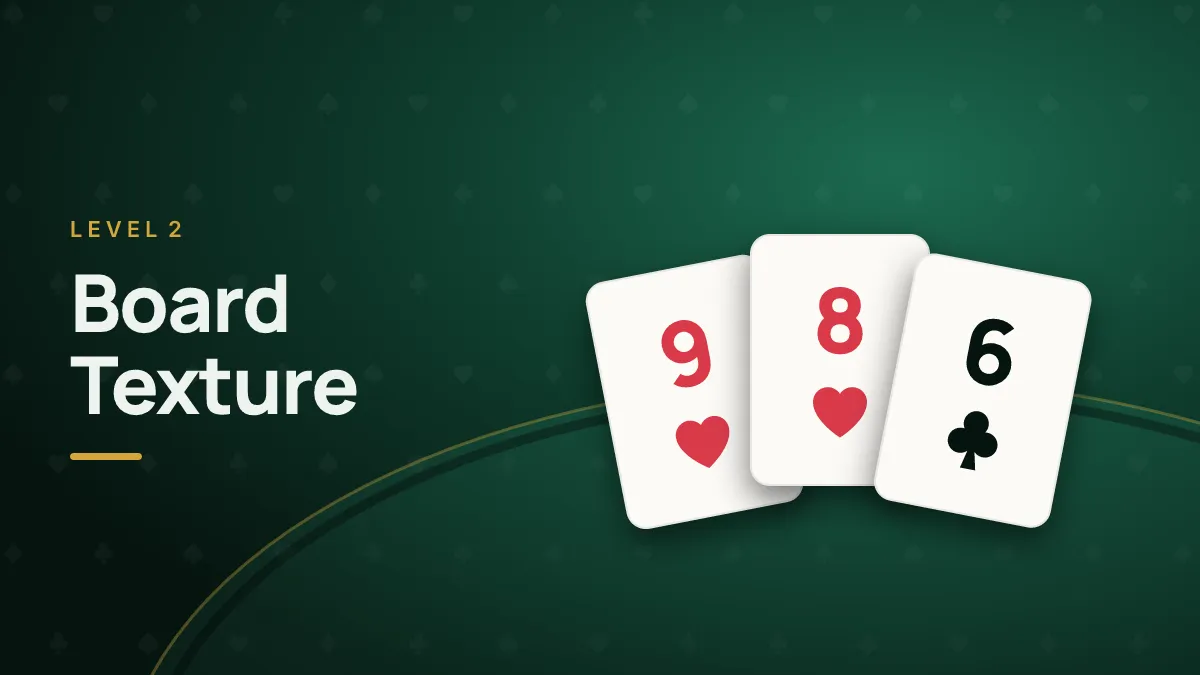
Board Texture: Reading Dry and Wet Flops
What makes a flop dry, wet, paired or monotone, which boards favour the preflop raiser or the caller, and how texture should change your betting.
Value Betting: Getting Paid With Your Strong Hands
How to win the most with your good hands: the value-bet test, choosing sizes, thin value on the river, when not to slow-play and how to value bet different opponents.