
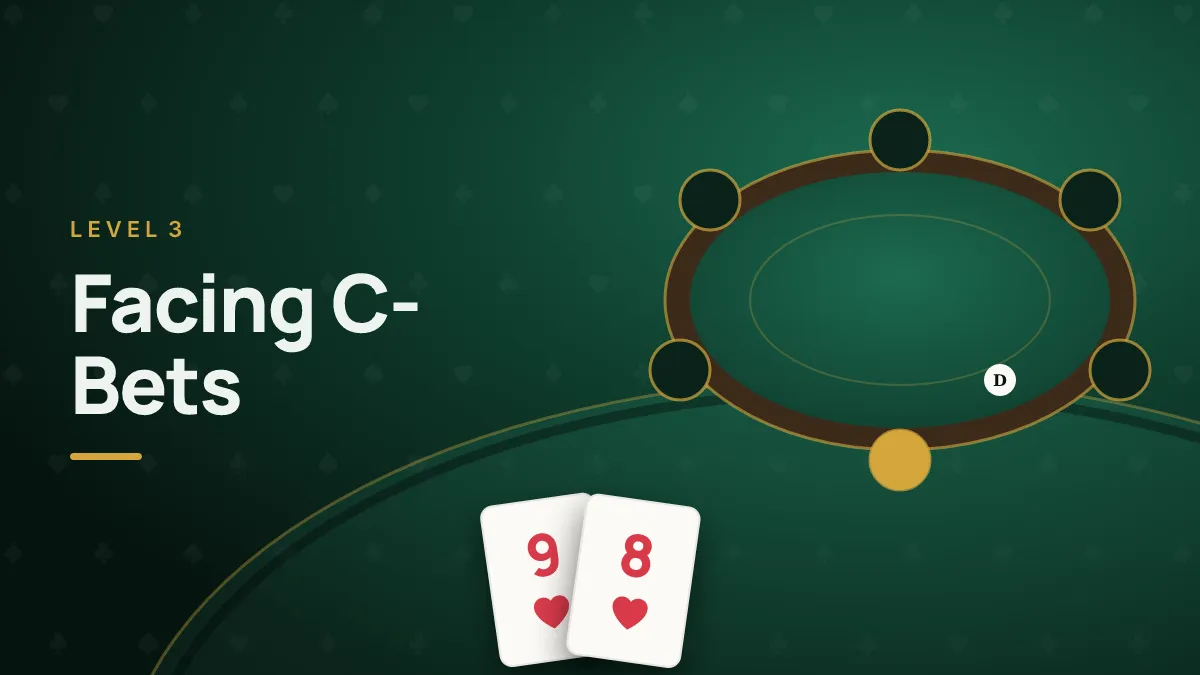
You’ve learned how to make continuation bets. Now sit on the other side of the table. You called a raise before the flop, the flop comes, and the preflop raiser bets — again. This happens in a huge share of the pots you play, and it’s where many players quietly lose money: they fold too often to small c-bets, call too often with hopeless hands, and almost never raise. This lesson gives you a simple way to decide.
Key takeaways
- Small c-bets offer a great price: against a third-pot bet you need only 20% equity to call.
- Folding too often to small c-bets lets the raiser profit with any two cards.
- Continue with pairs, draws and backdoor draws; fold hands with no pair, no draw and no backdoors.
- Raise your strongest hands and best draws, most often on boards that favour your range.
- In position you can float more; out of position, check-raise or fold more and call less.
The price of a c-bet
A c-bet tells you how much you must risk, and that tells you how often you need to win. Use the same maths as in Pot Odds and Outs and GTO Fundamentals:
| C-bet size | Equity you need to call | Minimum defence frequency |
|---|---|---|
| ⅓ pot | 20% | 75% |
| ½ pot | 25% | 67% |
| ⅔ pot | 28.6% | 60% |
| ¾ pot | 30% | 57% |
| Pot | 33% | 50% |
Two things stand out:
- Small c-bets are cheap to call. Plenty of hands that feel like nothing — overcards with a backdoor flush draw, a gutshot, bottom pair — have 20% or more.
- If you fold more than the defence frequency, the raiser profits by betting everything. Against a one-third pot bet, folding half your hands is a big leak.
Sort your hand: fold, call or raise
When the c-bet comes, put your hand into one of three groups.
| Group | Examples on K♦ 8♠ 4♣ (you called from the big blind) | Action |
|---|---|---|
| Strong | Sets, two pair (K-8, K-4, 8-4) | Raise some, call some |
| Strong draws (on wetter boards) | Flush draws, open-enders, combo draws | Raise some, call the rest |
| Showdown value | Kx with a weak kicker, 8x, pocket pairs | Call |
| Weak with equity | Gutshots, overcards with backdoor draws (Q♠J♠, T♠9♠) | Call against small bets; fold against big ones |
| Nothing | No pair, no draw, no backdoors (7♥2♦, 6♦3♥) | Fold |
Keep some strong hands in your calling range. If you raise every set, your calls are always one pair or worse — and a thinking opponent will barrel you off them.
Board texture changes the plan
Go back to Board Texture and ask whose range the flop helps.
- High, dry boards (A-8-3, K-7-2) favour the raiser. They’ll c-bet small and often. Defend with any pair, gutshots and good backdoor hands; raise rarely.
- Low, connected boards (7-6-5, 8-7-4) favour you as the caller: you have more two pairs, sets and straights. Raise more — both strong hands and draws — as covered in Check-Raising and Big Blind Defence.
- Wet middle boards (J-9-8 two-tone) hit both players. Continue with lots of draws and pairs; raise your strongest hands and best combo draws.
- Paired boards (T-T-4) rarely hit anyone. Small c-bets here are often weak — call wider, and float with overcards in position.
In position: floating
When you called in position (for example on the button against a cutoff open), you have an extra weapon: the float — calling the flop with a weak hand planning to win the pot later, when the raiser checks the turn.
A float with backdoor draws
No-Limit Hold'em · 6-max · 100bb
Preflop
Pot 1.5bb
- CO opens to 2.5bb, Hero calls on the button, blinds fold
Flop
Pot 6.5bb
Q72- CO c-bets 2bb (about a third of the pot)
- Hero calls: calling 2bb to win 10.5bb needs about 19%, and 9-8 has a backdoor flush draw, backdoor straight draws and position
Turn
Pot 10.5bb
6- CO checks
- Hero now has an open-ended straight draw (5 or T) and a flush draw — about 15 outs
- Hero bets 7bb as a strong semi-bluff
Good floats have backdoor equity and position. Bad floats are hands that can’t improve and can’t win at showdown — calling with them just delays the fold.
Out of position: check-raise or fold more
From the big blind, you act first on every street, so marginal calls are harder to play profitably. That’s why good players out of position:
- check-raise more often with strong hands and strong draws — it wins the pot now against weak c-bets and builds it when strong;
- check-call hands with solid showdown value or good draws;
- fold weak hands without backdoors more quickly than they would in position.
When the raiser checks: the probe bet
If the preflop raiser checks back the flop, their range is often capped (see Multi-Street Planning). From the big blind, you can then bet the turn — a probe bet — with pairs, draws and hands that improved. Raisers who check back flops and then fold to turn bets are very common at low stakes.
Multiway: tighten up
With another player still to act behind you, calling a c-bet is riskier: they may raise, and they may hold a strong hand. Defend tighter than the table above suggests, and prefer calling with hands that can make strong hands. See Multiway Pots.
Next up: how to get paid when you do have it — Value Betting.
Finished this lesson?
Mark it complete to track your Level 3 progress.
Practise with a free tool
Keep going
Ready for the next level?
Up next in Level 3 — Winning Player:
Value Betting: Getting Paid With Your Strong HandsGet the weekly level-up
One short email a week: a new lesson, a hand to think about and a tool tip. No spam, unsubscribe any time.
By subscribing you agree to our privacy policy.
Related lessons
Continuation Betting: When and How Much to C-Bet
When the continuation bet works, when to check instead, and how to choose a c-bet size from the board texture, your position and the number of opponents.
Playing 3-Bet Pots: Strategy at a Low SPR
3-bet pots are shallower and play faster. How ranges, SPR, c-bet sizes and commitment change after the flop — as the 3-bettor and as the caller.
Position in Poker: Why Your Seat Matters
Why acting last is such a big advantage, the name of every seat at the table, and how to adjust your hand selection and betting to your position.