
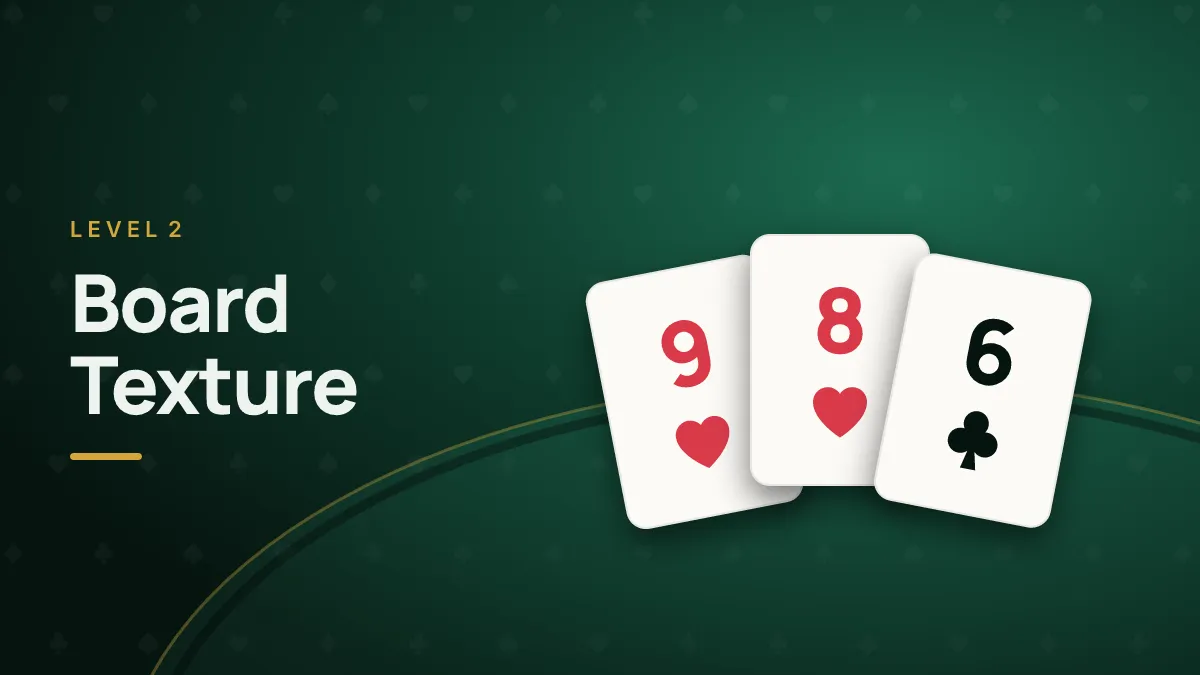
The flop changes everything. A hand that was strong before the flop can become weak, and a hand you almost folded can become a monster. Board texture is how the three flop cards relate to each other — how connected they are, how many share a suit, how high they are. Reading texture tells you how likely your hand is to still be ahead on later streets, and which player’s range the flop helped most.
Key takeaways
- Dry boards are disconnected and rainbow; hand strength rarely changes on the turn and river.
- Wet boards are connected and/or two-tone; lots of draws, and the best hand now often isn't the best hand later.
- High boards (ace or king high) usually favour the preflop raiser; low connected boards often favour the caller.
- Bet smaller and more often on dry boards; bet bigger but less often on wet boards.
- Even an overpair can be close to a coin flip against a big draw.
Dry boards
Flop
A dry board has cards far apart in rank and different suits (rainbow). There are no flush draws and very few straight draws. What it means:
- Hand strength is stable. If you’re ahead now, you’ll usually be ahead on the river.
- Few hands connect. Most of the time, neither player has much.
- The preflop raiser benefits. They have more strong kings (AK, KK, KQ) in their range than a caller does, because a caller would often have 3-bet AK or KK.
On boards like this, a small bet (around a third of the pot) is usually enough to make weak hands fold, and you can bet with a wide range.
Wet boards
Flop
A wet board is connected and/or has two cards of one suit (two-tone). Many straight and flush draws are possible, and made straights are already out there. What it means:
- Hand strength changes fast. An overpair now can be losing by the river.
- Many hands connect — especially suited connectors and small pairs that a caller loves.
- Bigger bets are needed to charge draws, and you should bet less often because your opponent’s range hit harder.
How close can things get? On 9♠ 8♦ 2♥, a pair of queens is only about 73% against J♠ T♠ (an open-ended draw with a backdoor flush draw). And on T♥ 7♣ 2♥, 9♥ 8♥ — a flush draw plus an open-ended straight draw — is actually a 56% favourite against pocket aces.
Other textures to know
| Texture | Example | What changes |
|---|---|---|
| Paired | 7♠ 7♦ 2♣ | Few hands hit; trips and full houses possible. Good board to bet small. |
| Monotone | Q♥ 8♥ 3♥ | Anyone with a heart has a draw; made flushes exist. Proceed carefully without a heart. |
| Ace-high | A♣ 8♦ 3♠ | Strongly favours the preflop raiser, who has more aces. |
| Low and connected | 6♦ 5♠ 4♣ | Favours the caller (and the big blind), who has more small pairs and connectors. |
| Broadway | K♠ Q♦ J♣ | Many strong hands for both players; straights already possible. |
How texture changes your betting
| Board | How often to bet (as preflop raiser) | Size |
|---|---|---|
| Dry, high (K72r, A83r) | Often — most of your range | Small: 25–33% pot |
| Paired (772r) | Often | Small |
| Wet, middling (986 two-tone) | Less often — strong hands and good draws | Bigger: 60–75% pot |
| Low connected vs the big blind (654r) | Selectively | Medium to big |
| Monotone | Selectively | Small to medium |
These are starting points, not rules. You’ll learn exactly how to put them into practice in Continuation Betting.
The same hand on different boards
Pocket jacks on two flops
No-Limit Hold'em · 6-max · 100bb
Dry flop
Pot 5.5bb
842- Hero has an overpair on a board where few hands can outdraw it
- Bet small for value and protection; happy to bet again on most turns
Wet flop
Pot 5.5bb
1097- Same hand, but now straights are possible and nearly every card on the turn brings a draw
- Bet bigger to charge draws, and be ready to slow down if the turn completes one
Practise reading texture
Next time you watch a hand, say the texture out loud before anyone acts: “Dry, king high — raiser’s board” or “Two-tone and connected — lots of draws.” Then test real match-ups in the odds calculator to see how close overpairs and draws really are.
Next up: why betting beats calling — Aggression and Fold Equity.
Finished this lesson?
Mark it complete to track your Level 2 progress.
Practise with a free tool
Keep going
Ready for the next level?
Up next in Level 2 — Solid Basics:
Aggression and Fold Equity: Why Betting WinsGet the weekly level-up
One short email a week: a new lesson, a hand to think about and a tool tip. No spam, unsubscribe any time.
By subscribing you agree to our privacy policy.
Related lessons
Position in Poker: Why Your Seat Matters
Why acting last is such a big advantage, the name of every seat at the table, and how to adjust your hand selection and betting to your position.
Continuation Betting: When and How Much to C-Bet
When the continuation bet works, when to check instead, and how to choose a c-bet size from the board texture, your position and the number of opponents.
Starting Hands in Texas Hold'em: Which Hands to Play
Which two-card hands are worth playing, which to fold, and why position changes everything. Includes range charts and the mistakes to avoid.