
Push-Fold Charts Explained: Nash Shoving Ranges
What push-fold charts are, how Nash equilibrium ranges are calculated, real small blind vs big blind shove and call ranges at 10 and 15bb, and when to deviate.
By PokerLevelUp Team,
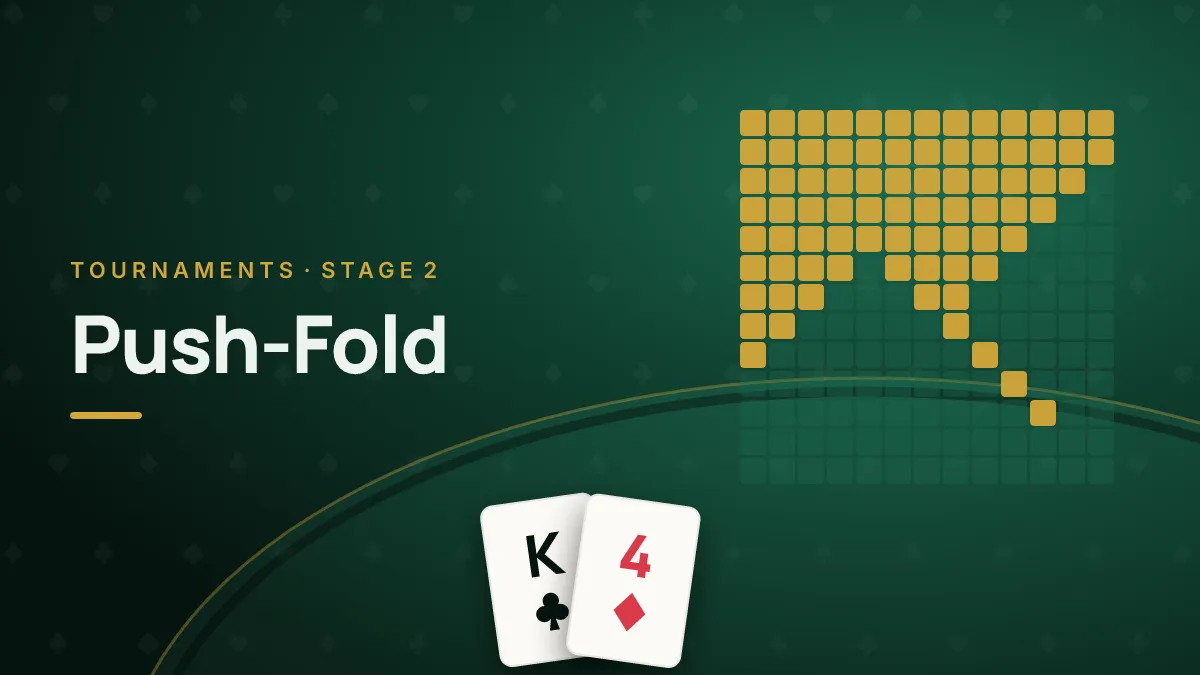
When your stack drops to around 10–15 big blinds, poker becomes a simpler game: go all-in or fold before the flop. Because the decision is so simple, it can be solved mathematically. The results — push-fold charts — show which hands to shove and which to call with at every stack size. Learning them is one of the fastest ways to improve your tournament results, because short-stack spots come up constantly and most players get them badly wrong.
Key takeaways
- Push-fold charts come from a Nash equilibrium: ranges where neither player can gain by changing strategy.
- Small blind vs big blind at 10bb: the small blind shoves about 58% of hands; the big blind calls about 38%.
- Shoving ranges are much wider than calling ranges — the gap concept in action.
- Ranges widen as stacks get shorter and as you get closer to the button.
- Charts are a baseline: adjust for antes, ICM and how your opponents actually play.
Where the charts come from
In a push-fold spot, each player has only two options. That makes it possible to find a Nash equilibrium: a shoving range for the small blind and a calling range for the big blind such that neither player can improve their result by changing their own range. (It’s the same idea as GTO, in a much smaller game.)
We calculated the ranges below with our own solver: every one of the 169 starting-hand types, equity from simulated run-outs, and repeated best responses until the ranges settled. They match the published charts closely. The setting is heads-up between the small blind and big blind, no ante, with both players holding the stated stack. The same solver powers our push-fold chart tool, where you can look up any stack from 3bb to 20bb, with or without a big blind ante.
Small blind vs big blind, 10 big blinds
Small blind shove — 10bb770 combos · 58.1% of hands
Big blind call — vs a 10bb shove498 combos · 37.6% of hands
Two things stand out:
- The shoving range is huge. Hands like K-2 offsuit and 7-4 suited are profitable shoves at 10bb, because the big blind folds most of the time and even weak hands have reasonable equity when called.
- The calling range is much tighter. The caller has no fold equity: they only win by having the best hand. This is the gap concept again.
How ranges change with stack size
| Effective stack | SB shoves | BB calls |
|---|---|---|
| 5bb | ~71% | ~62% |
| 8bb | ~62% | ~45% |
| 10bb | ~58% | ~38% |
| 12bb | ~53% | ~33% |
| 15bb | ~45% | ~29% |
| 20bb | ~40% | ~22% |
The shorter the stack, the wider both ranges get — the price of the blinds becomes a bigger share of your stack, so it’s worth more to win them.
Small blind shove — 15bb602 combos · 45.4% of hands
Antes make ranges wider
With a big blind ante, there’s more in the pot before you act, so shoving becomes more profitable and ranges widen further — sometimes dramatically at 8–12bb. At 10bb, for example, the small blind’s equilibrium shove grows from about 58% of hands to about 71% with a big blind ante, and the big blind’s call widens from about 38% to 53%. If you’re using a chart, make sure it matches the ante format of your tournament.
When to deviate from the chart
Nash ranges assume your opponent also plays perfectly. Real opponents don’t:
| Opponent tendency | Adjustment |
|---|---|
| Calls too tight (common) | Shove wider than the chart |
| Calls too loose (“I had a king!”) | Shove tighter, value-heavy |
| Shoves too tight | Call tighter when they do shove |
| Shoves any two cards | Call wider |
And near the bubble or at a final table, ICM tightens calling ranges considerably — sometimes shoving ranges too. See Bubble Play.
Common short-stack mistakes
- Waiting for a premium hand while the blinds eat your stack. At 6bb, you have far less fold equity than at 10bb.
- Min-raising and folding with 8–10bb, losing a big chunk of your stack.
- Limping with short stacks, then folding to a raise.
- Calling shoves too wide because “it’s only a few more chips”.
A standard small blind shove
Tournament · 10bb effective · folded to the SB
Preflop
Pot 1.5bb
- Folds to Hero in the small blind
- Hero shoves 10bb — K-4 offsuit is well inside the 10bb shoving range
- BB folds 63% of the time by the chart; when called, K-4 still has around 30–40% equity against much of the calling range
Drill these spots until they feel automatic in the push-fold trainer, which grades every shove and call against the same equilibrium charts.
Next up: shoving over someone else’s open — Reshoving.
Finished this lesson?
Mark it complete to track your MTT · Stage 2 progress.
Practise with a free tool
Keep going
Ready for the next level?
Up next in MTT · Stage 2 — Middle Stages & the Bubble:
Reshoving: 3-Bet All-In Ranges in TournamentsGet the weekly level-up
One short email a week: a new lesson, a hand to think about and a tool tip. No spam, unsubscribe any time.
By subscribing you agree to our privacy policy.
Related lessons
Reshoving: 3-Bet All-In Ranges in Tournaments
How to 3-bet shove over opens with 12–30bb: why reshoving works, a worked EV example, which hands to reshove, stack sizes that make it work and how to call reshoves.
Middle-Stage Tournament Strategy: 20–40 Big Blinds
How to play the middle of a tournament with 20–40bb: smaller opens, fewer speculative calls, 3-bet shoves, protecting your stack and building one before the bubble.
Bubble Play: Attacking and Surviving the Money Bubble
How the money bubble changes tournament strategy: why medium stacks tighten up, how big stacks attack, how short stacks survive, and a worked ICM example.