
Bubble Play: Attacking and Surviving the Money Bubble
How the money bubble changes tournament strategy: why medium stacks tighten up, how big stacks attack, how short stacks survive, and a worked ICM example.
By PokerLevelUp Team,
The bubble is the period just before the paid places, when one more elimination puts everyone left into the money. It’s the most distinctive moment in tournament poker: the value of surviving jumps, many players freeze up, and the chip leader can take control of the table. Knowing whether you should be attacking or surviving — and against whom — is worth a lot of money over a year of tournaments.
Key takeaways
- On the bubble, busting costs much more than doubling up gains — calls need a large risk premium.
- Medium stacks feel the most pressure; they should call all-ins from bigger stacks much tighter.
- Big stacks should open and shove wider, especially against medium stacks.
- Short stacks still need to shove before they blind out, but benefit when others bust.
- Your strategy depends on who covers whom, not just on your cards.
Why the bubble is different
You saw the key example in ICM and Final Tables: with four players left and three paid, a player with 3,000 chips facing a shove from the 4,000-chip leader needs about 73% equity to call — against 50% in a cash game. That extra 23% is the risk premium.
It exists because:
- Busting now means winning nothing.
- Folding keeps you very likely to cash — the short stack will probably bust first.
- Doubling up increases your prize equity, but by much less than it doubles your chips.
Who feels the pressure?
| Stack | Bubble situation | Strategy |
|---|---|---|
| Big stack | Can bust anyone; nobody can bust them | Attack: open and shove wide, especially at medium stacks |
| Medium stack | Could bust to the big stack; others are likely to bust first | Tighten calls against bigger stacks; attack shorter stacks |
| Short stack | Likely to bust first | Shove good spots before blinding out; can’t afford to wait too long |
The medium stack is under the most pressure, not the short stack. That’s counter-intuitive, but it’s what the maths shows: they have a lot to lose and a good chance of cashing if they wait.
Playing the big stack
With the biggest stack at the table:
- Open more hands, particularly when medium stacks are in the blinds.
- Shove wider over opens from medium stacks — they can’t call without a premium hand.
- Be careful against other big stacks and short stacks who are desperate — they’ll call wider.
- Don’t overdo it. If a medium stack does call, it’s usually with a strong hand. Your chips are still valuable: you want to reach the final table as the leader.
Playing a medium stack
- Fold more marginal hands facing all-ins from bigger stacks. Hands like A-J or 8-8 that are easy calls in chip-EV terms can be folds here.
- Keep stealing from short stacks and from tight players who won’t fight back.
- Avoid opening hands you’d have to fold to a big-stack shove, because they’ll attack you.
- Watch other tables (online, the lobby shows stacks): if short stacks elsewhere are about to bust, patience is worth more.
Playing a short stack
- Don’t blind out hoping others bust. As your stack shrinks, your fold equity disappears and even the bubble won’t save you.
- Shove first in rather than calling other players’ shoves.
- Target medium stacks, who have to fold wide against you.
- Use position: shoving from the button or small blind gives the fewest players a chance to call.
The chip leader attacks
Tournament · bubble · 4 left, 3 paid
Preflop
Pot 2.5bb
- Hero has 60bb on the button
- SB has 25bb, BB has 30bb — two medium stacks afraid of busting; a 6bb stack is at another table
- Hero opens to 2bb
- Both blinds fold
Hand-for-hand play
Near the bubble, many tournaments go hand-for-hand: each table plays one hand at a time, so nobody can stall to wait for eliminations. Expect slower play and more folds — and more opportunities for the stacks who are willing to attack.
Next up: all of this in a single decision, with real ICM numbers — Hand Review: Folding Ace-King on the Bubble.
Finished this lesson?
Mark it complete to track your MTT · Stage 2 progress.
Practise with a free tool
Keep going
Ready for the next level?
Up next in MTT · Stage 2 — Middle Stages & the Bubble:
Hand Review: Folding Ace-King on the BubbleGet the weekly level-up
One short email a week: a new lesson, a hand to think about and a tool tip. No spam, unsubscribe any time.
By subscribing you agree to our privacy policy.
Related lessons
Satellite Strategy: When Survival Is Everything
How satellite tournaments work, why every seat is worth the same, the extreme ICM near the bubble with a worked example, and when folding aces can be correct.
Middle-Stage Tournament Strategy: 20–40 Big Blinds
How to play the middle of a tournament with 20–40bb: smaller opens, fewer speculative calls, 3-bet shoves, protecting your stack and building one before the bubble.
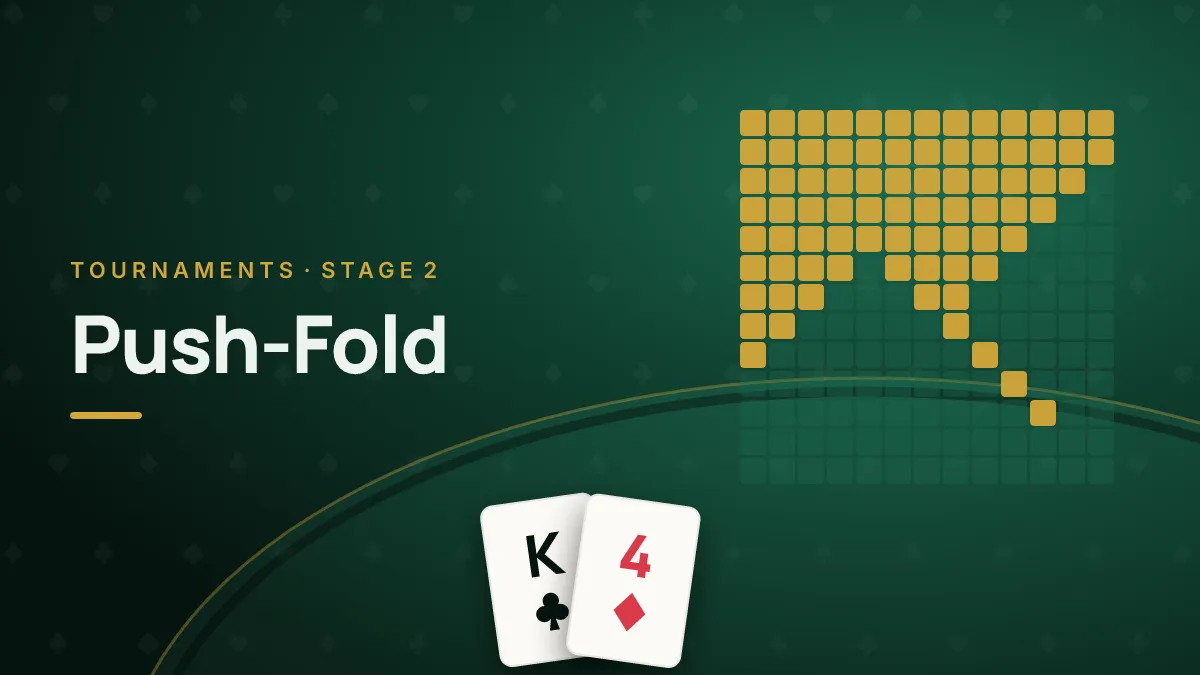
Push-Fold Charts Explained: Nash Shoving Ranges
What push-fold charts are, how Nash equilibrium ranges are calculated, real small blind vs big blind shove and call ranges at 10 and 15bb, and when to deviate.