
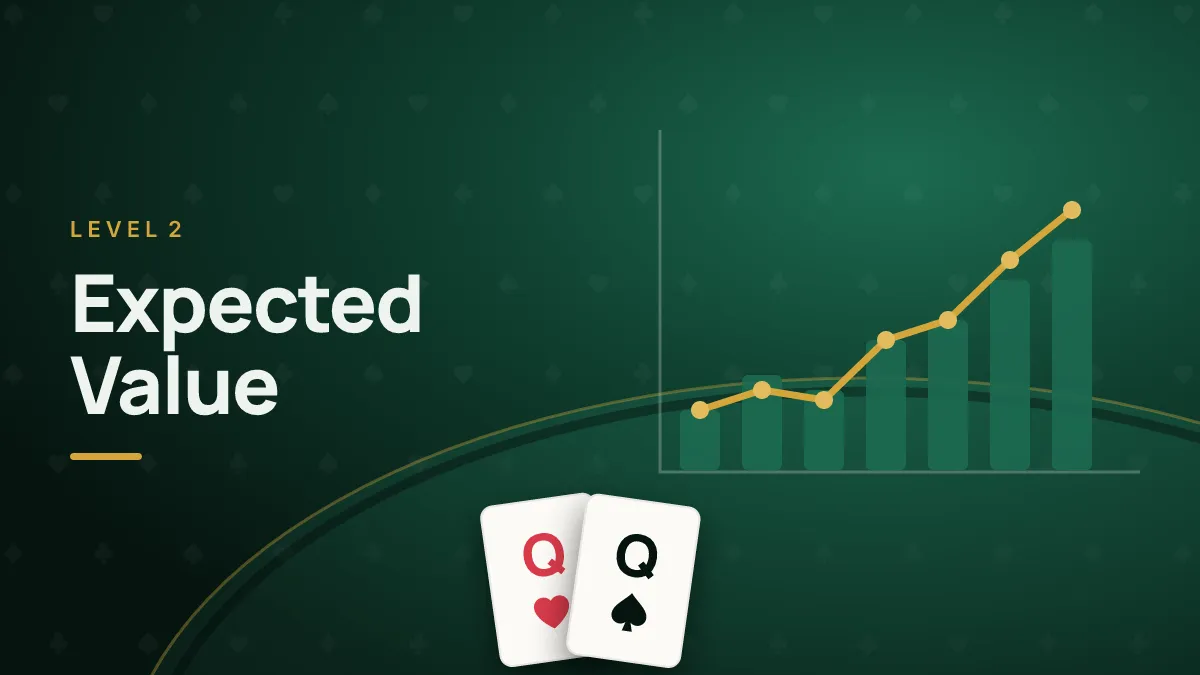
Every lesson so far has quietly relied on one idea: some decisions make money over time and some lose money over time, whatever happens in a single hand. That idea is called expected value, or EV. It’s the single most important concept in poker strategy. Once you think in EV, bad beats stop feeling like proof that you played badly, and lucky wins stop fooling you into repeating mistakes.
Key takeaways
- EV is the average result of a decision if you could repeat it many times.
- EV of a call = (your equity × final pot) − the amount you call.
- Folding is the zero point: every other option is compared with it.
- Money already in the pot belongs to the pot, not to you — ignore what you've invested.
- Judge decisions by their EV, not by the result of one hand.
What is expected value?
Expected value is the average amount a decision wins or loses if you made it again and again in the same situation.
A simple example: a friend offers you a bet on a coin flip. Heads, you win 12; tails, you lose 10.
EV = (0.5 × +12) + (0.5 × −10) = 6 − 5 = +1
You’ll lose half the flips, but on average you make +1 per flip. Take this bet as often as you can. That’s exactly how winning poker works: make lots of small +EV decisions, and the results follow over time.
EV of a call
When you’re deciding whether to call a bet, the formula is:
EV(call) = (equity × final pot) − amount to call
where the final pot includes everything: the pot before the bet, your opponent’s bet and your call.
Example. On the river the pot is 100 and your opponent bets 50. You think you win 30% of the time.
EV(call) = 0.30 × 200 − 50 = 60 − 50 = +10
Calling makes money. With 20% equity it would be 0.20 × 200 − 50 = −10, and folding would be better. The break-even point is exactly the required equity from Pot Odds and Outs: 50 ÷ 200 = 25%.
EV of an all-in
Before the flop, you have Q♥ Q♠ and your opponent shows A♦ K♣. You each have 100bb and everything goes in. (We’ll ignore the blinds.)
QQ AKQueens win about 57% against ace-king. The final pot is 200bb, and you put in 100bb:
EV = 0.57 × 200 − 100 = +14bb
You’ll lose this all-in 43% of the time — often painfully — but every time you take it, you gain about 14bb on average. That’s why a great player can lose a big pot and still be happy with the decision.
Folding is zero
When you fold, you neither win nor lose any more money from that point. That makes folding the natural baseline: every call or raise is either better than zero (+EV) or worse (−EV).
This leads to one of the most important lessons in poker:
Money in the pot isn’t yours
Suppose you raised preflop, bet the flop and bet the turn. Now your opponent makes a big raise on the river and you’re almost sure you’re beaten. It’s tempting to call because you’ve “already put so much in”.
But those chips belong to the pot. The only question is: from here, does calling win more on average than folding? If your equity is below the price you’re being offered, folding is correct — no matter how much you’ve invested. Economists call the mistake the sunk cost fallacy. Poker players call it “pot-committed thinking”, and it costs beginners a fortune.
(The size of the pot does matter — it changes the price you’re getting. What doesn’t matter is who put the money there.)
Results vs decisions
Because poker has luck in the short term, a good decision can lose and a bad one can win. Players who judge themselves on results fall into two traps:
- After a bad beat, they stop making a good play that “never works”.
- After a lucky win, they repeat a bad play because “it worked last time”.
Instead, ask: given what I knew, was the decision +EV? That’s the only thing you control. The results come from making good decisions over thousands of hands — which is also why variance is a whole lesson later in this course.
You’ve finished Level 2
You can now choose hands, use position, calculate pot odds, open and 3-bet sensibly, read board texture and think in EV. Take the Level 2 quiz to earn your badge, practise in the trainers, and then start Level 3 by learning to think about your opponent’s whole range: Thinking in Ranges.
Finished this lesson?
Mark it complete to track your Level 2 progress.
Practise with a free tool
Keep going
Ready for the next level?
That’s the last lesson in Level 2. Take the short quiz to earn your Level 2 badge and move on to Winning Player.
Get the weekly level-up
One short email a week: a new lesson, a hand to think about and a tool tip. No spam, unsubscribe any time.
By subscribing you agree to our privacy policy.
Related lessons
Pot Odds and Outs: The Maths Behind Every Call
Learn to count outs, calculate pot odds and use the rule of 2 and 4 to decide in seconds whether a call is profitable. Worked examples included.
Aggression and Fold Equity: Why Betting Wins
Why betting and raising beats checking and calling: the two ways to win, how to calculate fold equity, and a worked semi-bluff example with real numbers.
Starting Hands in Texas Hold'em: Which Hands to Play
Which two-card hands are worth playing, which to fold, and why position changes everything. Includes range charts and the mistakes to avoid.