
Hand Review: Ace-King in a 3-Bet Pot on a Low Board
A street-by-street review of ace-king in a 3-bet pot: why checking the flop was right, how to bet the turn and how thin to value bet the river.
By PokerLevelUp Team,
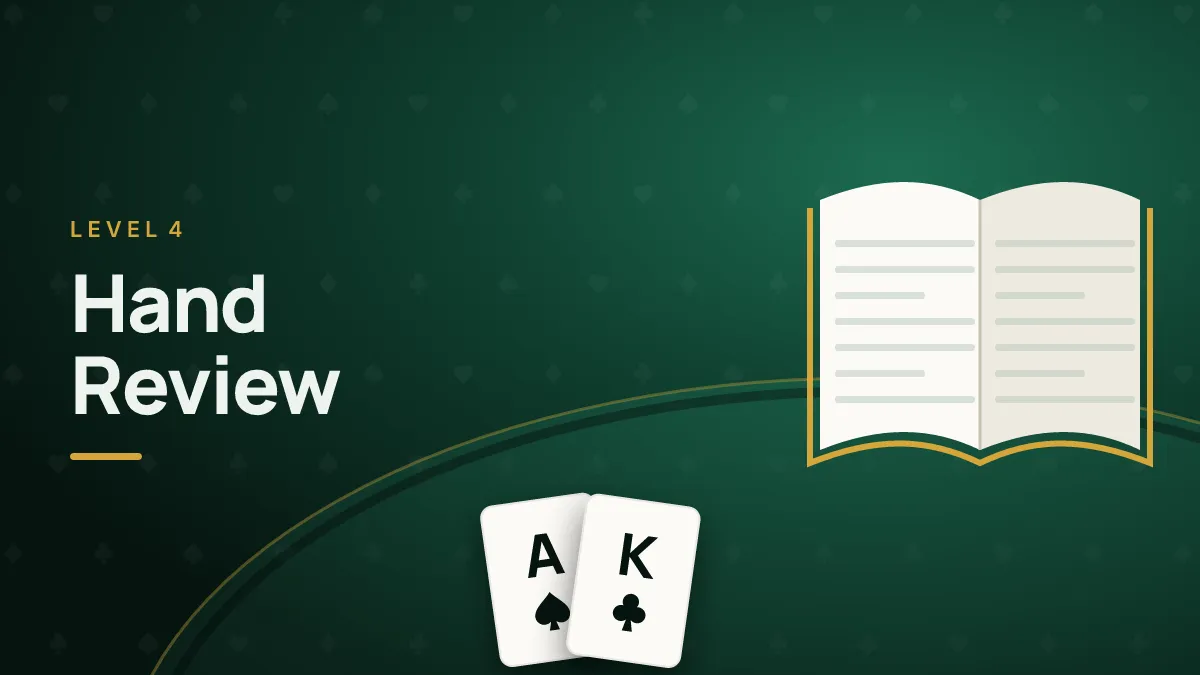
This review puts Level 4 to work: range and nut advantage, SPR, bet sizing and multi-street planning — all in one hand. Hero 3-bets ace-king, gets called, and sees a flop that suits the caller much better than the 3-bettor. What happens next is a good example of why strong players don’t c-bet on autopilot, even in 3-bet pots.
Key takeaways
- Even in a 3-bet pot, check when the flop favours the caller's range and your hand has little equity.
- Checking the flop keeps the pot manageable at an SPR of about 5 and gives you a free look at the turn.
- When the turn gives you top pair top kicker, bet for value and protection against the draws.
- On a blank river, a thin value bet works against a capped range that checked twice.
The hand
Ace-king in a 3-bet pot
No-Limit Hold'em · 6-max · 100bb
Preflop
Pot 1.5bb
- CO opens to 2.5bb, Hero 3-bets to 8bb on the button
- Blinds fold, CO calls
Flop
Pot 17.5bb · SPR ~5.3
986- CO checks, Hero checks behind
Turn
Pot 17.5bb
K- CO checks, Hero bets 9bb
- CO calls
River
Pot 35.5bb
2- CO checks, Hero bets 17bb
- CO calls
Preflop: a standard 3-bet
A-K is one of the hands Hero always 3-bets for value — see 3-Betting and Facing Raises. In position against a cutoff open, 3× the open (8bb) is standard.
Verdict: ✔ Standard.
Flop: 9♥ 8♥ 6♣ — a check that looks strange
Ranges. The cutoff called a 3-bet, so their range is full of hands like TT–66, suited connectors (T9s, 98s, 87s, 76s), suited broadways (KQs, QJs, JTs) and AQ. On this flop that range has sets (99, 88, 66), two pairs (98s), straights (T7s, 75s if they call with them) and a huge number of draws. Hero’s range has more overpairs, but also lots of A-K, A-Q and A-J that missed completely.
Advantage. The caller has the nut advantage and is close in overall equity. This is exactly the kind of board from Playing 3-Bet Pots where the 3-bettor should check a lot.
Hero’s hand. A♠K♣ has two overcards, no pair and no backdoor flush draw (no hearts). If Hero bets, almost every pair and draw continues, and strong hands raise — at an SPR of 5, a raise would force Hero to fold with a lot of equity left on the table.
Action. Hero checks behind and takes a free card.
Alternative. A small c-bet would fold out a few weak hands such as K-Q with no draw, but it bloats the pot with a hand that’s usually behind when called.
Verdict: ✔ Good. Checking protects the rest of Hero’s checking range too — Hero will also check some overpairs here, so the check isn’t always weak.
Turn: K♦ — top pair, top kicker
What changed? The king gives Hero top pair, top kicker. It’s also a good card for the 3-bettor’s range, which has more A-K and K-K. The flush draw and straight draws are still live.
Plan. With 17.5bb in the pot and 92bb behind, Hero can’t get all-in comfortably with one pair on this wet board — but top pair top kicker is strong enough for two streets of value against a range that checked the flop.
Action. Hero bets 9bb (about half pot):
- worse kings (K-Q, K-J, K-T), pairs with draws and naked draws all call;
- the draws pay a real price to see the river;
- the size keeps the pot under control if the cutoff check-raises (which would mostly mean sets, two pair and straights).
Verdict: ✔ Good. Checking again would give a free river to many flush and straight draws.
River: 2♠ — a thin value bet
What changed? Nothing. The flush and straight draws missed.
The value-bet test (see Value Betting):
| Hands that call a half-pot bet | Versus Hero |
|---|---|
| K-Q, K-J, K-T | Worse — call |
| 9x and 8x pairs that called the turn | Worse — some call |
| Missed draws | Worse — fold |
| Sets, straights, two pair | Better — but most of these would have raised the turn or bet the river themselves |
The cutoff has checked twice and just called the turn: their range is capped. Many strong hands would have check-raised the turn. The worse hands that call outnumber the better ones.
Action. Hero bets 17bb (about half pot) — big enough to get value from worse kings, small enough that they still call.
Verdict: ✔ Good. If the cutoff had check-raised the river, Hero would have been facing mostly sets and straights — a fold against most players.
What made this hand work
- The flop check. It avoided a bloated pot on the caller’s best board and set up two streets of value when the turn helped Hero.
- Size for the hands that call. Half pot on both the turn and river kept worse kings in.
- A plan for the raise. At every step, Hero knew what a raise would mean and what to do about it.
Rule for next time: “In 3-bet pots, check low connected flops with unpaired hands. When the turn gives me top pair top kicker, bet two streets for value — around half pot.”
Next up: why tournament chips aren’t worth the same as money — ICM and Final Tables.
Finished this lesson?
Mark it complete to track your Level 4 progress.
Practise with a free tool
Keep going
Ready for the next level?
Up next in Level 4 — Advanced:
ICM and Final Tables: Tournament Equity ExplainedGet the weekly level-up
One short email a week: a new lesson, a hand to think about and a tool tip. No spam, unsubscribe any time.
By subscribing you agree to our privacy policy.
Related lessons
Hand Review: Top Pair in a Button vs Big Blind Pot
A full street-by-street review of ace-jack on the button against the big blind: c-bet sizing, a turn value bet and a tricky river decision.
Playing 3-Bet Pots: Strategy at a Low SPR
3-bet pots are shallower and play faster. How ranges, SPR, c-bet sizes and commitment change after the flop — as the 3-bettor and as the caller.
Stack-to-Pot Ratio (SPR) and Commitment
What stack-to-pot ratio is, how to calculate it on the flop, and how SPR tells you which hands are strong enough to get all-in in single-raised, 3-bet and 4-bet pots.