
Hand Review: Top Pair in a Button vs Big Blind Pot
A full street-by-street review of ace-jack on the button against the big blind: c-bet sizing, a turn value bet and a tricky river decision.
By PokerLevelUp Team,
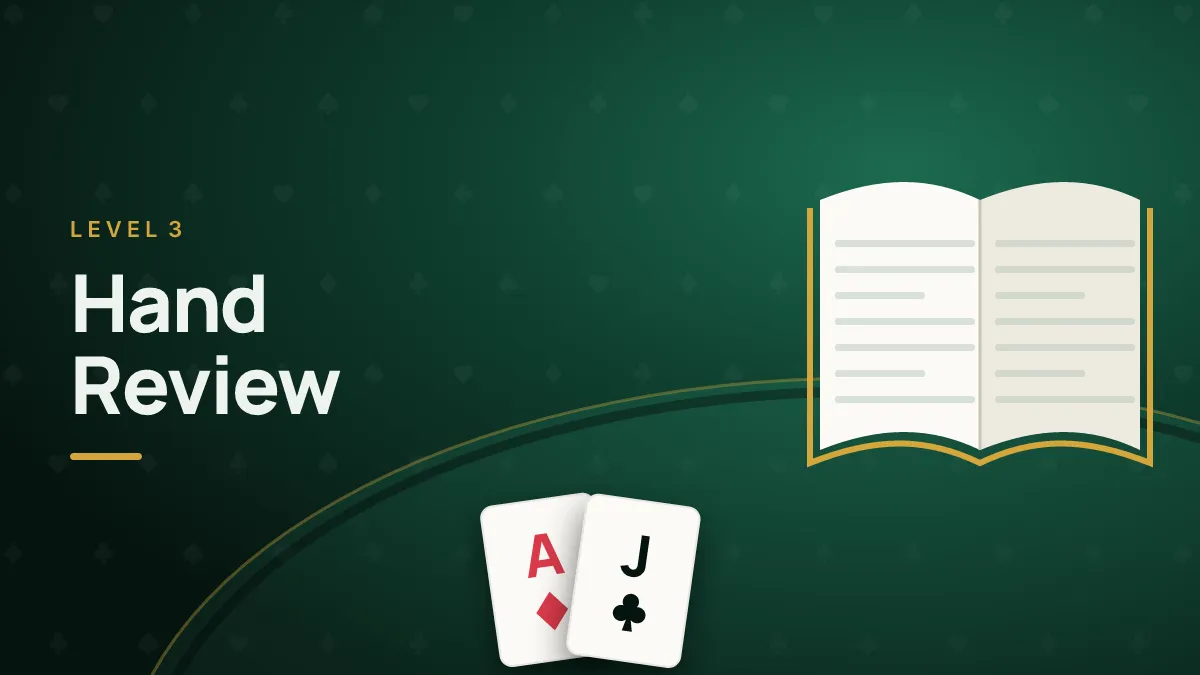
The best way to see Level 3 working together is to follow one hand from start to finish. This is the most common spot in 6-max poker — the button opens, the big blind calls — played with a hand you’ll hold again and again: top pair, good kicker. At each street we’ll ask the same questions you’d use in a session review: what are the ranges, what’s the plan, and what are the alternatives?
Key takeaways
- Plan the hand on the flop: top pair good kicker usually wants two streets of value, not three.
- Size your bets for the hands that call: small on dry flops, bigger on turns that add draws.
- Re-run the value-bet test on every river card — a card that improves your opponent's calling range can turn a bet into a mistake.
- Checking back a good hand isn't weak: it's how you win the pot against the hands you beat without paying off the ones you don't.
The hand
Ace-jack on the button
No-Limit Hold'em · 6-max · 100bb
Preflop
Pot 1.5bb
- Folds to Hero on the button, raises to 2.5bb
- SB folds, BB calls
Flop
Pot 5.5bb
J73- BB checks, Hero bets 1.8bb
- BB calls
Turn
Pot 9.1bb
8- BB checks, Hero bets 6bb
- BB calls
River
Pot 21.1bb
K- BB checks
- Hero checks behind
Now let’s review it properly — decision by decision.
Preflop: a standard open
A-J offsuit is a clear open from the button — it’s comfortably inside the button opening range of about 35% of hands. The size, 2.5bb, is the same one Hero uses with every button open.
Verdict: ✔ Standard.
Flop: J♥ 7♠ 3♦ — a small c-bet
Ranges. The board is dry and fairly high. Hero’s range has more strong jacks (AJ, KJ, QJ) and overpairs (QQ–AA), which the big blind would usually have 3-bet before the flop. The big blind has more 7x, 3x and weak draws. Range advantage: Hero.
Plan. Top pair, top-ish kicker is a strong hand on this board, but not strong enough to play for 100bb. The plan from Pot Control and Multi-Street Planning: two streets of value is realistic; three if the board stays safe and the opponent keeps calling.
Action. A third-pot c-bet (1.8bb) lets weaker jacks, 7x, pocket pairs and gutshots continue — exactly the hands Hero wants calls from.
Alternative. A bigger bet (⅔ pot) folds out most of those hands, turning the bet into a bet that only better hands call. Checking back gives up value from many worse hands.
Verdict: ✔ Good.
Turn: 8♥ — a value bet that also protects
What changed? The 8♥ adds a flush draw (two hearts), completes T-9 (a straight), and gives straight draws to hands like T-9, 9-6, T-6 and 6-5. It also makes two pair for J-8 and 8-7.
Ranges. The big blind’s range after calling the flop: jacks with weaker kickers (JT, J9, J6s–J2s), 7x, pocket pairs, gutshots that now have more outs, and a few hands that got there.
Action. Hero bets 6bb into 9.1bb (about two-thirds pot). That’s bigger than the flop bet on purpose:
- worse jacks and 7x still call;
- the new draws — hearts and straight draws — must pay a real price to see the river;
- a bigger turn bet builds the pot for a possible river bet.
Verdict: ✔ Good. Checking back would give free cards to many draws that now have 8–12 outs.
River: K♠ — the decision that matters
This is the kind of spot Value Betting was written for. Run the test: if Hero bets, will worse hands call more often than better hands?
| Hands in the big blind’s range | Versus Hero | Would they call a river bet? |
|---|---|---|
| JT, J9, J6s–J2s | Worse | Some would — but many would be unhappy after an overcard |
| 7x, 8x, pocket pairs | Worse | Mostly fold |
| Missed draws (hearts, 65, 96) | Worse | Fold |
| K-J, K-8s, K-7s (two pair) | Better | Call or raise |
| T-9 (straight), J-8, 8-7 (two pair) | Better | Call or raise |
| Sets (77, 33, 88) | Better | Raise |
The K♠ is a bad card for Hero’s value: it improves some of the big blind’s calling hands to two pair, and it makes weaker jacks nervous. The worse hands that call are no longer clearly more numerous than the better hands that call.
Action. Hero checks behind.
Alternative. A small bet (about a quarter to a third of the pot) could get thin value from the weaker jacks — reasonable against a player who calls too much. A big bet mostly gets called by better hands.
Verdict: ✔ A good check. Against this big blind, checking wins the pot against the hands Hero beats without paying off the ones Hero doesn’t.
The rule Hero wrote down
A good review ends with one line you can use next time:
“Top pair good kicker in a single-raised pot: plan two streets of value. On the river, re-run the value-bet test — especially when an overcard improves the caller’s two-pair hands.”
Next up: the money side of the game — Bankroll Management.
Finished this lesson?
Mark it complete to track your Level 3 progress.
Practise with a free tool
Keep going
Ready for the next level?
Up next in Level 3 — Winning Player:
Bankroll Management: Protect Your Poker MoneyGet the weekly level-up
One short email a week: a new lesson, a hand to think about and a tool tip. No spam, unsubscribe any time.
By subscribing you agree to our privacy policy.
Related lessons
Hand Review: Ace-King in a 3-Bet Pot on a Low Board
A street-by-street review of ace-king in a 3-bet pot: why checking the flop was right, how to bet the turn and how thin to value bet the river.
Continuation Betting: When and How Much to C-Bet
When the continuation bet works, when to check instead, and how to choose a c-bet size from the board texture, your position and the number of opponents.
Facing C-Bets: How to Play as the Preflop Caller
You called preflop and your opponent c-bets the flop. How to use price, board texture and position to decide when to fold, call or raise.