
You know the rules, the rankings, the vocabulary and how to behave. The last step in Level 1 is a plan — a small set of habits that will make you a winning player against most casual opponents before you learn any advanced strategy. The plan is built on one idea that has held up for decades: play fewer hands, and play them aggressively. Poker players call this style tight-aggressive (TAG).
Key takeaways
- Play fewer hands than your opponents — especially from early seats.
- Raise or fold before the flop. Don't limp.
- Bet your strong hands; don't slow-play on dangerous boards.
- Don't bluff players who never fold.
- Play stakes you can afford to lose, and stop when you're tired or upset.
Why tight and aggressive?
Tight means you only enter pots with hands that are likely to be ahead or to make strong hands. Aggressive means that when you do play, you’re usually betting and raising rather than checking and calling.
The combination works because:
- Good starting hands make better hands after the flop, so you win bigger pots and lose smaller ones.
- Betting gives you two ways to win: your opponent folds, or you have the best hand at showdown. Calling only gives you one.
- Most casual players do the opposite — they play too many hands and call too much — which is exactly what a tight-aggressive player profits from.
Step 1: Choose your hands before the flop
When everyone has folded to you, open-raise with a hand from this simple guide, and fold the rest. It’s deliberately tight; you’ll widen it in Level 2.
| Your seat (6-max) | Raise with |
|---|---|
| Early (UTG, hijack) | Pairs 66+, AT+ suited, AQ+ offsuit, KQ suited |
| Late (cutoff, button) | All pairs, any suited ace, suited broadways, KJ+ offsuit, QJ offsuit, suited connectors 65s+ |
| Small blind | Same as the cutoff |
Early-seat starting range (beginner)98 combos · 7.4% of hands
If someone has already raised, play only your strongest hands — big pairs (TT+) and AK/AQ — until you’ve studied 3-betting. And if players have limped in front of you, raise your good hands anyway: a raise of 3–4 big blinds plus one per limper.
Step 2: Size your bets simply
Before you learn the finer points, use these defaults:
- Open raise: 2.5 big blinds online, 3 big blinds live (plus one for each limper).
- Flop bet: about half the pot.
- Turn and river bets: half to three-quarters of the pot with strong hands.
Keeping sizes consistent also means you don’t give away the strength of your hand with your bet size.
Step 3: After the flop, count your strength
A simple framework for your first sessions:
| You have… | Plan |
|---|---|
| Two pair or better, or top pair with a good kicker | Bet for value on most streets |
| Top pair with a weak kicker, or a medium pair | Bet once or check; avoid building a huge pot |
| A strong draw (flush draw, open-ended) | Bet or call if the price is right — see pot odds |
| Nothing | Check and fold to a bet, unless you raised preflop and the flop missed your opponent too |
The five biggest beginner leaks
- Playing too many hands. Most losing players enter the pot with 40–50% of their hands. Start below 25%.
- Calling too much. “I had to see if they were bluffing” is expensive. If a passive player suddenly raises big, believe them.
- Slow-playing. Checking your big hands lets opponents catch up for free and keeps the pot small. Bet them.
- Bluffing the wrong players. Some players never fold. Against them, stop bluffing and bet your good hands bigger.
- Playing tired, bored or upset. Your decisions get worse when your head isn’t right. Stop the session.
Before, during and after a session
Before
- Decide how much you’re prepared to lose today and stick to it.
- Choose stakes where one buy-in is a small part of your poker money — see Bankroll Management.
- Have a time limit.
During
- Watch hands you’re not in: who plays a lot, who only bets strong hands?
- Mark interesting hands to review later.
- Take a short break every hour.
After
- Record the result in the bankroll tracker.
- Review two or three hands you weren’t sure about. Post one in the community for feedback.
- Play the daily Hand of the Day and a round of the preflop trainer to keep the basics sharp.
Keep perspective
Short-term results in poker are noisy. You can play well and lose, or play badly and win. Judge yourself on the quality of your decisions, not on today’s result — and remember that poker should stay fun. If it stops being fun, read our responsible gambling page.
You’ve finished Level 1
Take the Level 1 quiz to earn your first badge. Then start Level 2 with the hands worth playing: Starting Hands.
Finished this lesson?
Mark it complete to track your Level 1 progress.
Practise with a free tool
Keep going
Ready for the next level?
That’s the last lesson in Level 1. Take the short quiz to earn your Level 1 badge and move on to Solid Basics.
Get the weekly level-up
One short email a week: a new lesson, a hand to think about and a tool tip. No spam, unsubscribe any time.
By subscribing you agree to our privacy policy.
Related lessons
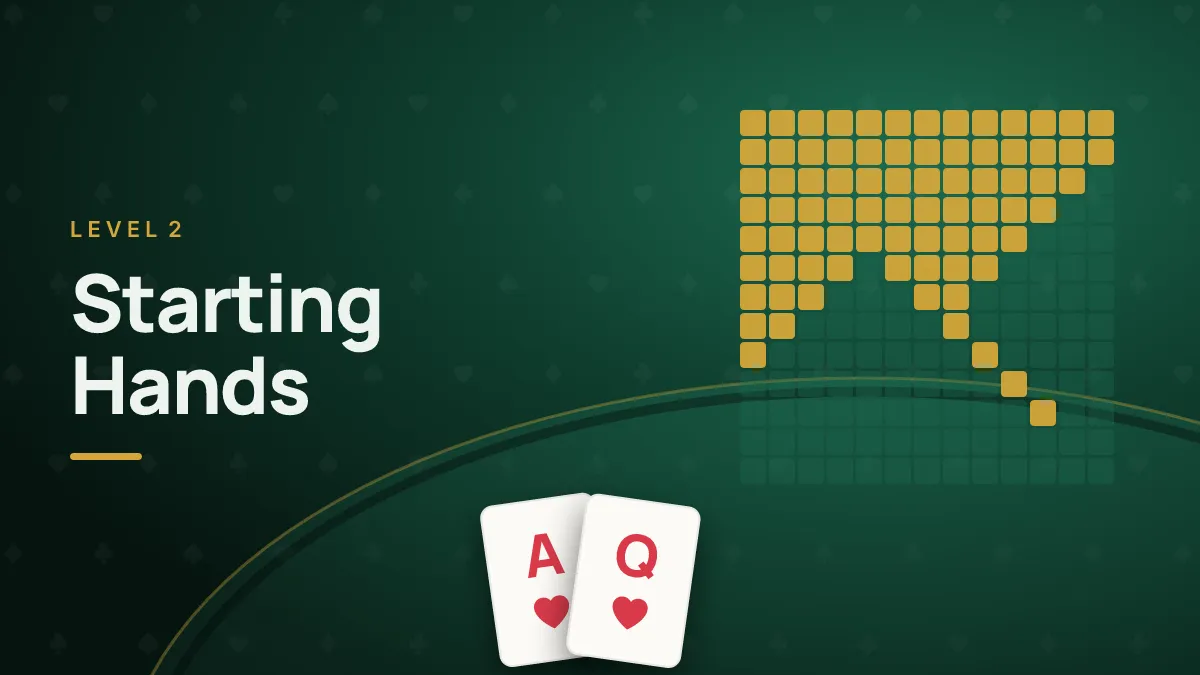
Starting Hands in Texas Hold'em: Which Hands to Play
Which two-card hands are worth playing, which to fold, and why position changes everything. Includes range charts and the mistakes to avoid.
Position in Poker: Why Your Seat Matters
Why acting last is such a big advantage, the name of every seat at the table, and how to adjust your hand selection and betting to your position.
Pot Odds and Outs: The Maths Behind Every Call
Learn to count outs, calculate pot odds and use the rule of 2 and 4 to decide in seconds whether a call is profitable. Worked examples included.