
PLO5 Bluffing and Blockers
When bluffing works in Five-Card Omaha: why pure bluffs succeed less often, how five-card blockers help, the best bluffing spots, and what river raises usually mean.
By PokerLevelUp Team,
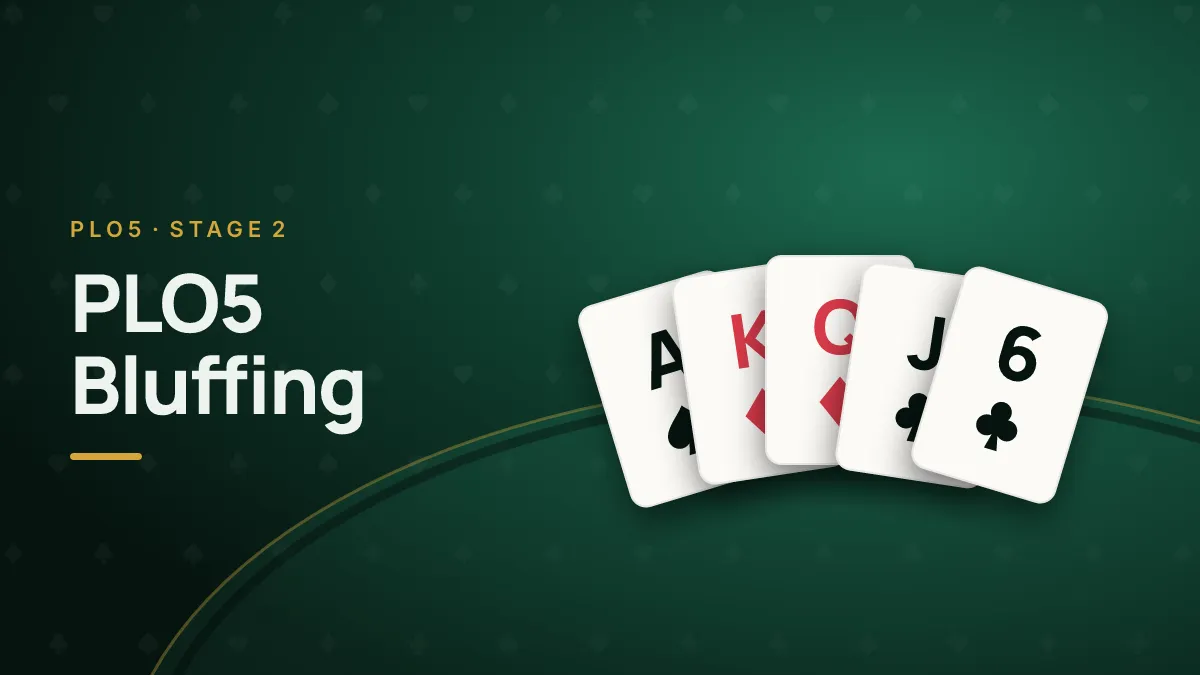
Bluffing in PLO5 is harder than in any other form of poker. Your opponents hold ten two-card combinations each, so they connect with the board more often and have more reasons to call. But blockers are more powerful too: with five cards in your hand, you remove more of your opponent’s possible strong hands than in PLO4 or Hold’em. Good PLO5 bluffs are rare, targeted — and built on blockers.
Key takeaways
- Pure bluffs work less often in PLO5 because opponents connect with more boards.
- With five cards, your blockers remove more of your opponent's strong hands.
- The best bluffs combine a nut blocker, a believable line and an opponent who can fold.
- Semi-bluffs with big draws are far better than pure bluffs.
- At most stakes, a river raise in PLO5 is heavily weighted to the nuts.
Why pure bluffs work less often
In Hold’em, most flops miss most hands. In PLO5, a typical hand has pairs, draws or backdoor draws on almost every flop. Your opponent folds less often, and when multiple players are in the pot, somebody almost always has something. So:
- Bluff heads-up, rarely multiway.
- Prefer semi-bluffs with nut draws to pure bluffs.
- Bluff less against players who call a lot — common in PLO5 games.
Blockers in five-card hands
Blockers work as in Blockers in PLO, but with five cards you hold more of them:
- The ace of the flush suit makes the nut flush impossible for your opponent.
- Key straight cards — for example, holding two jacks and a ten on a board where J-T is the nut straight — cut your opponent’s nut straight combinations sharply.
- Board-pairing cards on paired boards reduce full-house combinations.
The more of these you hold, the more credible and profitable a bluff becomes.
The best bluffing spots
- You block the nuts and your opponent’s range is full of strong-but-not-nut hands that can fold.
- Your line tells the story of the nuts: you bet the streets a nut hand would bet.
- You’re heads-up against a thinking opponent.
- The price is right: a pot-sized bluff needs folds 50% of the time; a half-pot bluff needs 33%.
A PLO5 blocker bluff
PLO5 · 6-max · 100bb · heads-up after the flop
Flop
Pot 7.5bb
1093- BB checks, Hero bets 4bb with a 13-out straight draw (no flush draw — only one spade)
- BB calls
Turn
Pot 15.5bb
2- BB checks, Hero bets 10bb, BB calls
River
Pot 35.5bb
5- BB checks
- Hero missed everything — but the flush just completed and Hero holds the A♠, so BB can't have the nut flush
- Hero bets 25bb, representing the nut flush
Reading river raises
In most PLO5 games, players raise the river with the nuts or something very close to it. Bluff-raises on the river are rare. Unless you have a specific read, treat a big river raise as very strong and fold hands below the second nuts.
Semi-bluffs over pure bluffs
The hand above started as a semi-bluff: on the flop it had 13 straight outs. That’s the pattern to follow in PLO5 — bet draws that can win, and turn them into river bluffs only when the story and blockers line up. Pure bluffs with no equity and no blockers are the most expensive plays in the game.
Next up: handling the swings of five-card Omaha — PLO5 Variance.
Finished this lesson?
Mark it complete to track your PLO5 · Stage 2 progress.
Practise with a free tool
Keep going
Ready for the next level?
Up next in PLO5 · Stage 2 — PLO5 Strategy:
PLO5 Variance, Bankroll and Game SelectionGet the weekly level-up
One short email a week: a new lesson, a hand to think about and a tool tip. No spam, unsubscribe any time.
By subscribing you agree to our privacy policy.
Related lessons
PLO5 Flop Play: Playing for the Nuts
How to play the flop in Five-Card Omaha: naming the nuts, betting nut hands with redraws, handling sets and two pair, c-betting less, and folding second-best.
PLO5 Draws: Wraps, Redraws and Freerolls
Drawing in Five-Card Omaha: 20-out wraps, nut vs non-nut draws, discounting outs when opponents hold more cards, and how redraws and freerolls win the biggest pots.
PLO5 Rules: What Changes With Five Cards
How Five-Card Omaha works, what's the same as PLO4, and what changes: ten two-card combinations, stronger showdown hands and a bigger premium on the nuts.