
Blockers in PLO: Bluffing With the Nut Blocker
Why blockers matter even more in Omaha: bluffing with the nut blocker, blocking straights and full houses, choosing bluff-catchers, and when blockers aren't enough.
By PokerLevelUp Team,
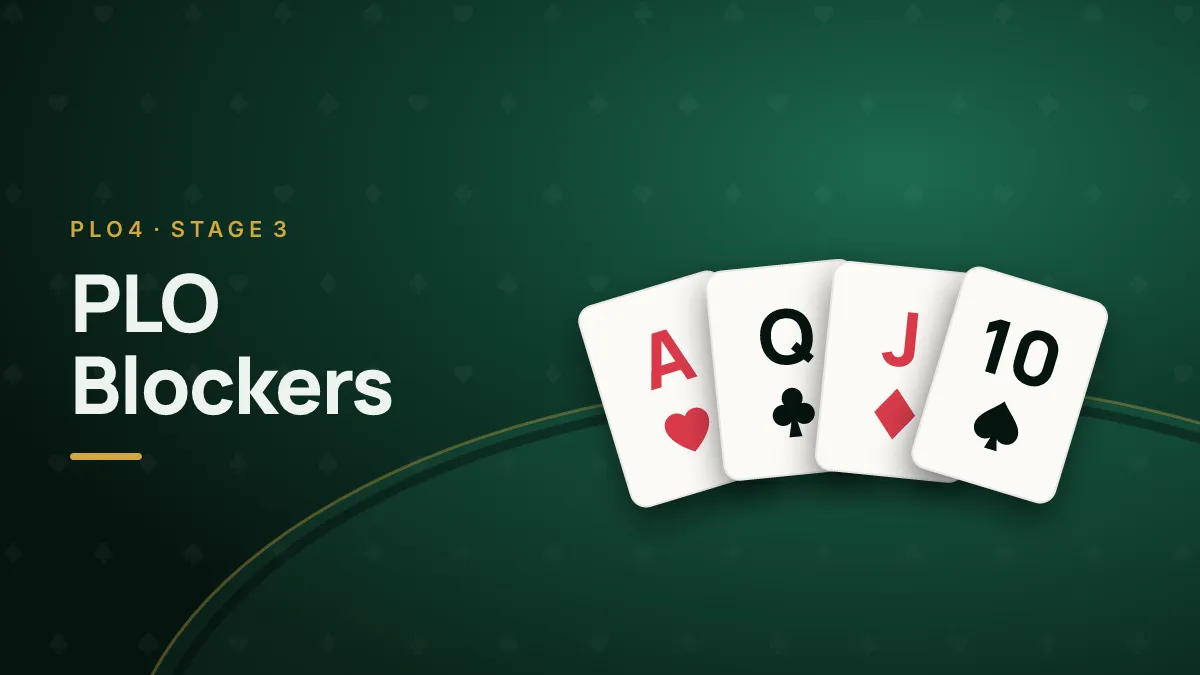
You met blockers in Hold’em in Blockers and Card Removal. In Omaha, they’re even more powerful. Because the nuts matters so much and hands are so strong, a single card that proves your opponent can’t hold the nuts can turn a hopeless hand into a profitable bluff. The most famous example — betting the river with the ace of the flush suit and nothing else — has a name: the nut blocker bluff.
Key takeaways
- A blocker is a card in your hand that makes certain opponent hands impossible or less likely.
- The nut blocker (e.g. the A♥ on a three-heart board) proves your opponent can't have the nut flush.
- Bluffs work best when you block the nuts and your opponent holds strong-but-not-nut hands.
- Blockers also help choose bluff-catchers — and warn you when you're unlikely to be good.
- Blockers are a tie-breaker, not a reason to bluff calling stations.
Why blockers matter more in PLO
In Omaha, big river bets are usually made with the nuts or close to it. So the question “can my opponent have the nuts?” decides many pots. With four cards in your hand, you remove more possible combinations than in Hold’em — and holding the single card that makes the nuts possible can remove it completely.
The nut blocker bluff
Flop
Turn
River
The river puts a third heart on the board. You hold A♥ Q♣ J♦ T♠ — no flush, no pair. But you hold the A♥, so nobody can have the ace-high flush.
- Your opponent’s strong hands here are mostly non-nut flushes — the Q♥ or J♥ flush and lower (the K♥ is on the board, so every flush without the A♥ is second-best or worse) — and sets.
- A big bet puts those non-nut flushes in a tough spot: you can represent the nut flush, and they know it’s possible.
- Your bluff is credible as long as your earlier betting fits a player who could hold A♥ with another heart — for example, a flop bet on a two-heart board.
This works because the hands that would call a big bet without worry — the nuts — are exactly the ones you’ve removed.
Blocking straights
On boards where a straight is the nuts, holding the key cards reduces your opponent’s straight combinations:
Flop
Turn
River
The nut straight here uses J-T (7-8-9-T-J). If you hold J-J or T-T — or both a jack and a ten — your opponent is much less likely to have it. That makes a bluff more credible and a call more reasonable. (This board is also paired, so full houses are possible — always check what the true nuts is.)
Blocking full houses
On paired boards, holding cards that make full houses less likely can matter. On K♣ K♦ 8♠ 4♥ 4♣, holding one of the two remaining kings makes quad kings impossible for your opponent and halves the kings they can hold for kings full.
Choosing bluff-catchers
Blockers help decide calls too:
- Call more with hands that block the opponent’s value hands and don’t block their bluffs.
- Fold more when your hand blocks their bluffs. For example, if the natural bluffs on a river are missed flush draws, holding two cards of that suit means fewer of those bluffs exist.
When blockers aren’t enough
Blockers make a play better; they don’t make a bad play good. A nut blocker bluff still needs:
- an opponent capable of folding,
- a believable story,
- a price that makes the bluff profitable (the break-even fold rate from Bluffing With Purpose).
A nut blocker bluff
PLO · 6-max · 100bb
Flop
Pot 7bb
K95- BB checks, Hero bets 4bb — no flush draw (only one heart), but any Q, J or T makes a straight: 9 outs
- BB calls
Turn
Pot 15bb
2- BB checks, Hero checks
River
Pot 15bb
7- BB checks
- The flush came in — and Hero holds the A♥, so BB can't have the nut flush
- Hero bets 12bb
Next up: planning how much to commit — SPR and Commitment in PLO.
Finished this lesson?
Mark it complete to track your PLO4 · Stage 3 progress.
Practise with a free tool
Keep going
Ready for the next level?
Up next in PLO4 · Stage 3 — Advanced PLO:
SPR and Commitment in PLOGet the weekly level-up
One short email a week: a new lesson, a hand to think about and a tool tip. No spam, unsubscribe any time.
By subscribing you agree to our privacy policy.
Related lessons
SPR and Commitment in PLO
Stack-to-pot ratio in Pot-Limit Omaha: SPR in single-raised, 3-bet and 4-bet pots, the 1-3-9 rule for pot-sized bets, and which hands are strong enough to commit.
PLO Turn and River Play
How to play the turn and river in Pot-Limit Omaha: how the nuts change, when to keep betting, river value bets, bluff-catching and folding second-best.
PLO Preflop Strategy: Position, Raising and 3-Bets
How to play PLO before the flop: why position matters even more than in Hold'em, opening ranges by seat, raise sizes, when to 3-bet, and how to defend the blinds.