
SPR and Commitment in PLO
Stack-to-pot ratio in Pot-Limit Omaha: SPR in single-raised, 3-bet and 4-bet pots, the 1-3-9 rule for pot-sized bets, and which hands are strong enough to commit.
By PokerLevelUp Team,
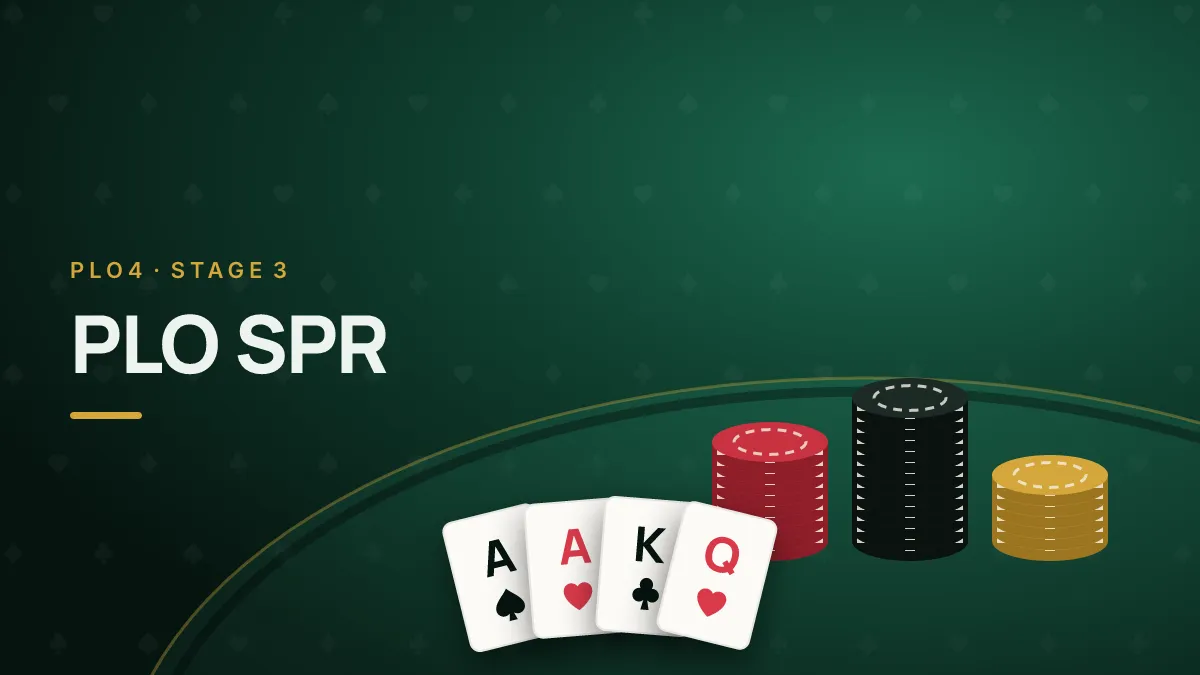
In Hold’em, stack-to-pot ratio tells you how strong your hand needs to be to get all-in. In Omaha, it’s even more important, because pot-limit betting controls how quickly the money can go in, and hand strength swings so much between streets. Knowing the SPR before you act on the flop lets you plan your commitment — and avoid finding out on the river that your top two pair wasn’t worth 100 big blinds.
Key takeaways
- SPR = effective stack ÷ pot on the flop.
- Each called pot-sized bet triples the pot: bets of 1, 3 and 9 pots get an SPR of 13 all-in by the river.
- Single-raised PLO pots at 100bb have SPRs around 13–15; 3-bet pots around 3–4; 4-bet pots under 1.
- Low SPR: overpairs with draws and top two pair can commit. High SPR: play for the nuts and redraws.
- Decide your commitment on the flop, not on the river.
SPR in common PLO pots
With 100bb stacks and pot-sized raises (blinds 0.5/1):
| Pot type | Preflop action | Flop pot | Stack behind | SPR |
|---|---|---|---|---|
| Single-raised | BTN opens 3bb, BB calls | 6.5bb | 97bb | ~15 |
| Single-raised, pot open | CO opens 3.5bb, BTN calls, blinds fold | 8.5bb | 96.5bb | ~11 |
| 3-bet | HJ opens 3.5, BTN 3-bets pot to 12, HJ calls | 25.5bb | 88bb | ~3.5 |
| 4-bet | …HJ 4-bets pot to 41, BTN calls | 83.5bb | 59bb | ~0.7 |
The 1–3–9 rule
When a pot-sized bet is called, the pot triples. So starting from a pot of 1 unit:
- Flop pot bet: 1 unit → pot becomes 3
- Turn pot bet: 3 units → pot becomes 9
- River pot bet: 9 units → pot becomes 27
The bets total 1 + 3 + 9 = 13 units. So:
| SPR | Pot-sized bets needed to get all-in |
|---|---|
| About 1 | One (the flop) |
| About 4 | Two (flop and turn) |
| About 13 | Three (flop, turn and river) |
That’s why single-raised pots, with an SPR around 13–15, play over three streets, and 3-bet pots usually go all-in by the turn.
Which hands can commit?
| SPR | Happy to get it in with |
|---|---|
| Under 2 | Overpairs with a draw, top two pair, sets, big draws |
| 2–5 | Sets, top two pair on safe boards, nut draws with extra equity, strong combo draws |
| 6–10 | Sets with redraws, nut straights with redraws, big combo draws |
| 10+ | The nuts with a redraw — and very few other hands |
The key difference from Hold’em: in Omaha, one pair almost never commits at high SPR, and even two pair or a small set can be in trouble.
Same hand, different SPR
PLO · 6-max · 100bb
3-bet pot
Pot 25.5bb · SPR ~3.5
J73- Aces with the nut flush draw
- Two pot-sized bets get it in — Hero is happy to commit against most ranges
Single-raised
Pot 6.5bb · SPR ~15
J73- Same hand
- Bet for value and to build the pot with the draw, but if Hero faces a raise and re-raise, the opponent often has a set or better — commitment depends on the turn
Using SPR preflop
SPR also guides your preflop decisions:
- Aces and big pairs want a low SPR — 3-bet them. See Playing Aces in PLO.
- Rundowns and suited hands that make big draws and disguised nuts want a high SPR — they prefer calling in position in single-raised pots.
- Calling a 3-bet out of position with a speculative hand gives you a low SPR and no position — a bad combination.
Next up: the later streets — PLO Turn and River Play.
Finished this lesson?
Mark it complete to track your PLO4 · Stage 3 progress.
Practise with a free tool
Get the weekly level-up
One short email a week: a new lesson, a hand to think about and a tool tip. No spam, unsubscribe any time.
By subscribing you agree to our privacy policy.
Related lessons
Blockers in PLO: Bluffing With the Nut Blocker
Why blockers matter even more in Omaha: bluffing with the nut blocker, blocking straights and full houses, choosing bluff-catchers, and when blockers aren't enough.
PLO Turn and River Play
How to play the turn and river in Pot-Limit Omaha: how the nuts change, when to keep betting, river value bets, bluff-catching and folding second-best.
PLO Preflop Strategy: Position, Raising and 3-Bets
How to play PLO before the flop: why position matters even more than in Hold'em, opening ranges by seat, raise sizes, when to 3-bet, and how to defend the blinds.