
PLO Preflop Strategy: Position, Raising and 3-Bets
How to play PLO before the flop: why position matters even more than in Hold'em, opening ranges by seat, raise sizes, when to 3-bet, and how to defend the blinds.
By PokerLevelUp Team,
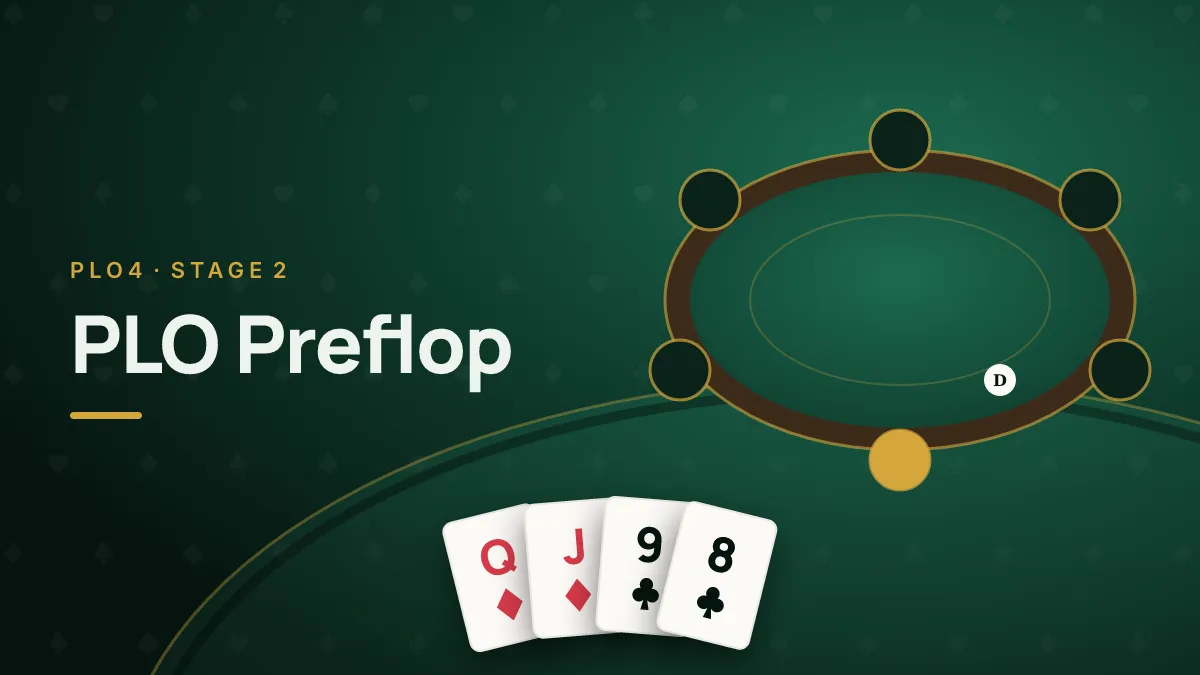
Because Omaha hands run so close together before the flop, preflop mistakes cost less in PLO than in Hold’em — but position costs more. Post-flop decisions in Omaha are bigger and harder, and acting last makes them easier on every street. A solid PLO preflop strategy is built on one idea: play more hands in position and fewer out of position, and prefer hands that make the nuts.
Key takeaways
- Position is even more valuable in PLO than in Hold'em — widen late, tighten early.
- Open-raise rather than limp; common sizes are 3bb to a pot-sized 3.5bb.
- 3-bet hands with strong nut potential, especially in position — and aces to build the pot.
- Avoid calling raises out of position with medium hands; the small blind is the toughest seat.
- The big blind gets a good price and closes the action, so it defends quite wide.
Why position matters more
In Omaha, post-flop spots are complex: draws are big, hands change on every street, and pots grow fast with pot-sized bets. Acting last lets you:
- see whether your opponent has shown strength before you commit chips;
- control the size of the pot with medium hands and draws;
- realise far more of your equity.
Out of position, even good hands are hard to play profitably. That’s why the gap between tight early-position ranges and wide button ranges is larger in PLO than in Hold’em.
Opening ranges by seat (6-max, 100bb)
A common, solid approach when it’s folded to you:
| Seat | Share of hands to open (approx.) | Focus |
|---|---|---|
| UTG | 15–20% | Strong aces, high rundowns, good double-suited hands |
| Hijack | 20–25% | Add more suited broadways and good middle rundowns |
| Cutoff | 25–35% | Add more single-suited connected hands |
| Button | 40–50% | Most hands where all four cards work together |
| Small blind | 25–40% | Raise-or-fold is simplest; you’ll be out of position |
Use the checklist from PLO Starting Hands: all four cards working together, suited (ideally to an ace), connected and high enough to make the nuts.
Open sizes
- Pot-size (3.5bb) is the traditional open and still standard in many games.
- 3bb or smaller is common in modern online games, especially from the button.
- Live, add one big blind per limper, as in Hold’em.
Whichever you choose, keep it the same for all hands from a given seat.
Limping
Open-limping gives up the initiative and invites multiway pots in which your hand’s nut potential is tested by everyone. As in Hold’em, raise or fold when you’re first in. (Limping behind other limpers on the button with speculative hands is more reasonable, but raising to isolate is usually better with good hands.)
3-betting
3-bets in PLO are usually pot-sized (see Pot-Limit Betting). Good reasons to 3-bet:
- Aces — to build the pot and lower the SPR, so your one-pair hand plays better. More in Playing Aces in PLO.
- High, double-suited hands with great nut potential (A-K-Q-J ds, K-Q-J-T ds), especially in position.
- Isolation — getting heads-up in position against a weaker opener.
In position, it’s also fine to call with strong hands that play well post-flop, such as double-suited rundowns. Out of position, 3-bet or fold much more often than you call.
Defending the blinds
- Small blind: the worst seat in PLO. Calling leaves you out of position against the raiser and invites the big blind in. Prefer 3-bet or fold, and fold a lot.
- Big blind: you already have a big blind in, and you close the action. Against a button raise, you can defend a wide range of hands that work together — but play carefully post-flop, since you’ll act first.
A standard button open
PLO · 6-max · 100bb
Preflop
Pot 1.5bb
- Folds to Hero on the button with a double-suited, connected hand
- Hero opens to 3bb
- SB folds, BB calls
Multiway pots
PLO pots often go multiway. The more players, the more likely someone has the nuts, so:
- Nut potential becomes even more important.
- Hands like small pairs and low rundowns lose value.
- Aces lose value too — a multiway pot is where aces most often lose.
Next up: the huge draws that make Omaha unique — Drawing in PLO.
Finished this lesson?
Mark it complete to track your PLO4 · Stage 2 progress.
Practise with a free tool
Keep going
Ready for the next level?
Up next in PLO4 · Stage 2 — PLO Strategy:
Drawing in PLO: Wraps, Nut Draws and RedrawsGet the weekly level-up
One short email a week: a new lesson, a hand to think about and a tool tip. No spam, unsubscribe any time.
By subscribing you agree to our privacy policy.
Related lessons
Playing Aces in PLO
How to play pocket aces in Pot-Limit Omaha: good and bad aces, why 3-betting aces works, what happens multiway, and how to handle aces after the flop.
PLO Starting Hands: Suited, Connected and Double-Suited
What makes a strong PLO starting hand: nut potential, suits, connectedness and pairs. The best hand types, the ones to avoid, and equity numbers for each.
Drawing in PLO: Wraps, Nut Draws and Redraws
How to count and value draws in Pot-Limit Omaha: wraps with up to 20 outs, nut and non-nut flush draws, combo draws, redraws and freerolls — with calculated equities.