
Playing Aces in PLO
How to play pocket aces in Pot-Limit Omaha: good and bad aces, why 3-betting aces works, what happens multiway, and how to handle aces after the flop.
By PokerLevelUp Team,
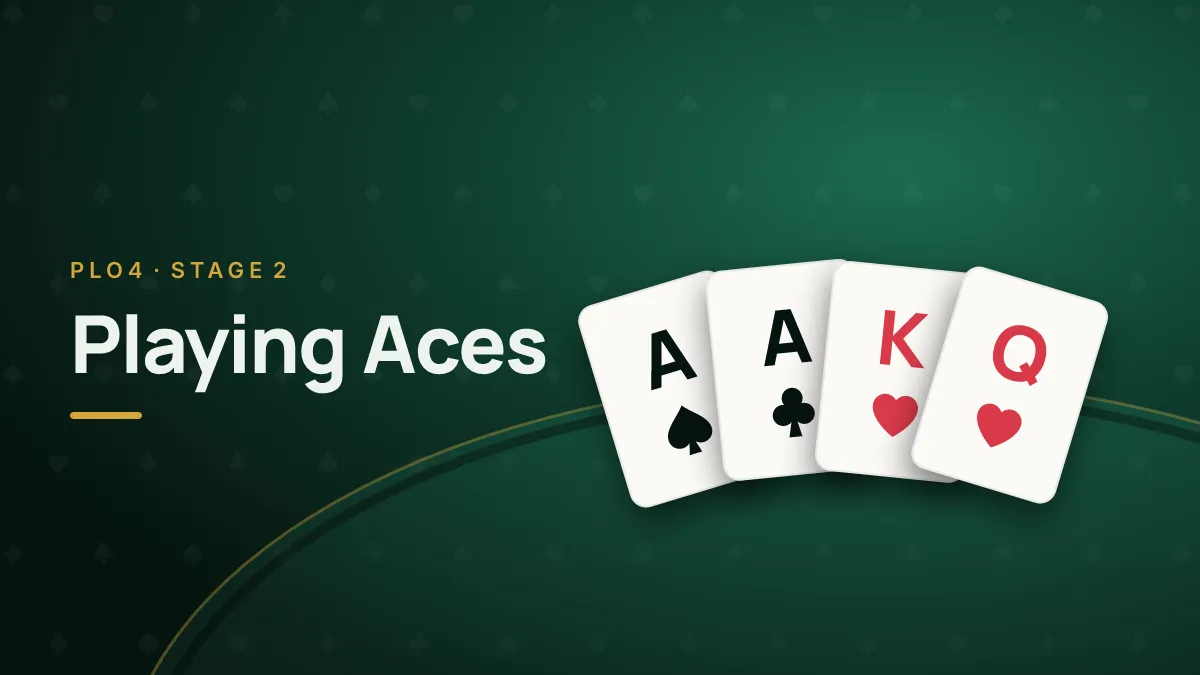
Pocket aces are the best starting pair in Omaha — but they’re not the monster they are in Hold’em. You’ll hold them about once every 40 hands, and how you play them decides whether they’re your most profitable hand or your most expensive one. The key is understanding that aces are a one-pair hand that wants a small pot relative to the stacks, or a big pot only when they’ve improved.
Key takeaways
- You're dealt A-A in PLO about 2.5% of the time — roughly once every 40 hands.
- Not all aces are equal: A♠A♥K♠K♥ is about 71% against a random hand; A♠A♥7♦2♣ only about 61%.
- 3-betting aces builds the pot and lowers the SPR, so a single pair is easier to play.
- Aces do much worse multiway; try to play them heads-up.
- After the flop, unimproved aces are a medium hand on most boards — don't stack off without help.
Good aces and bad aces
The other two cards decide how good your aces are:
| Hand | Why | Equity vs random |
|---|---|---|
| A♠A♥K♠K♥ | Double-suited, connected, second pair | ~71% |
| A♠A♥J♦T♦ | Suited ace, connected side cards | Strong |
| A♠A♥7♦2♣ | No suits to the ace, no connection | ~61% |
Against a strong double-suited rundown like J♦T♦9♥8♥, rainbow aces with junk are only about 50%. Aces with suited, connected side cards make many more flushes, straights and two pairs — which is what wins big pots in Omaha.
Why 3-bet aces?
Raising and re-raising with aces does two things:
- Builds the pot while you’re ahead. Aces are usually the favourite preflop against any single hand.
- Lowers the stack-to-pot ratio (SPR). In a 3-bet pot at 100bb, the SPR on the flop is often around 3–4. That makes it much easier to get the money in with an overpair plus a draw, or to commit when you flop a set of aces. In a single-raised pot with an SPR of 10+, unimproved aces are hard to play for stacks.
See SPR and Commitment in PLO for more.
The drawback: 3-betting aces tells observant opponents a lot. Many strong players also 3-bet some non-ace hands with high, double-suited cards, so their 3-bets aren’t just aces.
Aces multiway
Aces lose value fast as more players join:
- Heads-up, even weak aces are a favourite.
- Four-way, A♠A♥K♦Q♣ has only about 33% equity against three random hands — ahead of each individual opponent, but losing most of the time.
That’s another reason to raise aces: it helps you get heads-up.
Aces after the flop
On most flops, unimproved aces are a medium-strength hand:
- On dry, high boards (K♠ 7♦ 2♣), aces are often the best hand. Bet for value and protection.
- On wet, middling boards (9♥ 8♥ 6♣), aces are in serious trouble against two pairs, sets, straights and big draws. Check-call or check-fold unless you have a nut draw to go with them.
- Against big action — a raise and a re-raise — aces are often beaten. A-A against a set is only about 15%.
Letting aces go
PLO · 6-max · 100bb
Preflop
Pot 1.5bb
- Hero opens to 3bb from the cutoff, BB calls
Flop
Pot 6.5bb
1072- BB checks, Hero bets 4bb, BB check-raises pot to 18.5bb
- Hero has one pair and no draw; a check-raise here often means a set or top two pair
- Hero folds
Facing a 3-bet or 4-bet with aces
- Heads-up, in position: aces are happy to call or 4-bet and play for stacks.
- 4-betting aces usually gets close to all-in. Against a range of high double-suited hands, good aces are a clear favourite; bad aces less so.
- Out of position, deep-stacked: calling a 3-bet with weak aces can lead to difficult post-flop spots. 4-betting to get stacks in preflop is often simpler.
You’ve finished PLO Stage 2
Take the Stage 2 quiz to earn your badge. Stage 3 covers the advanced side of Omaha: Blockers in PLO.
Finished this lesson?
Mark it complete to track your PLO4 · Stage 2 progress.
Practise with a free tool
Keep going
Ready for the next level?
That’s the last lesson in PLO4 · Stage 2. Take the short quiz to earn your PLO4 · Stage 2 badge and move on to Advanced PLO.
Get the weekly level-up
One short email a week: a new lesson, a hand to think about and a tool tip. No spam, unsubscribe any time.
By subscribing you agree to our privacy policy.
Related lessons
PLO Preflop Strategy: Position, Raising and 3-Bets
How to play PLO before the flop: why position matters even more than in Hold'em, opening ranges by seat, raise sizes, when to 3-bet, and how to defend the blinds.
PLO Starting Hands: Suited, Connected and Double-Suited
What makes a strong PLO starting hand: nut potential, suits, connectedness and pairs. The best hand types, the ones to avoid, and equity numbers for each.
Drawing in PLO: Wraps, Nut Draws and Redraws
How to count and value draws in Pot-Limit Omaha: wraps with up to 20 outs, nut and non-nut flush draws, combo draws, redraws and freerolls — with calculated equities.