
Drawing in PLO: Wraps, Nut Draws and Redraws
How to count and value draws in Pot-Limit Omaha: wraps with up to 20 outs, nut and non-nut flush draws, combo draws, redraws and freerolls — with calculated equities.
By PokerLevelUp Team,
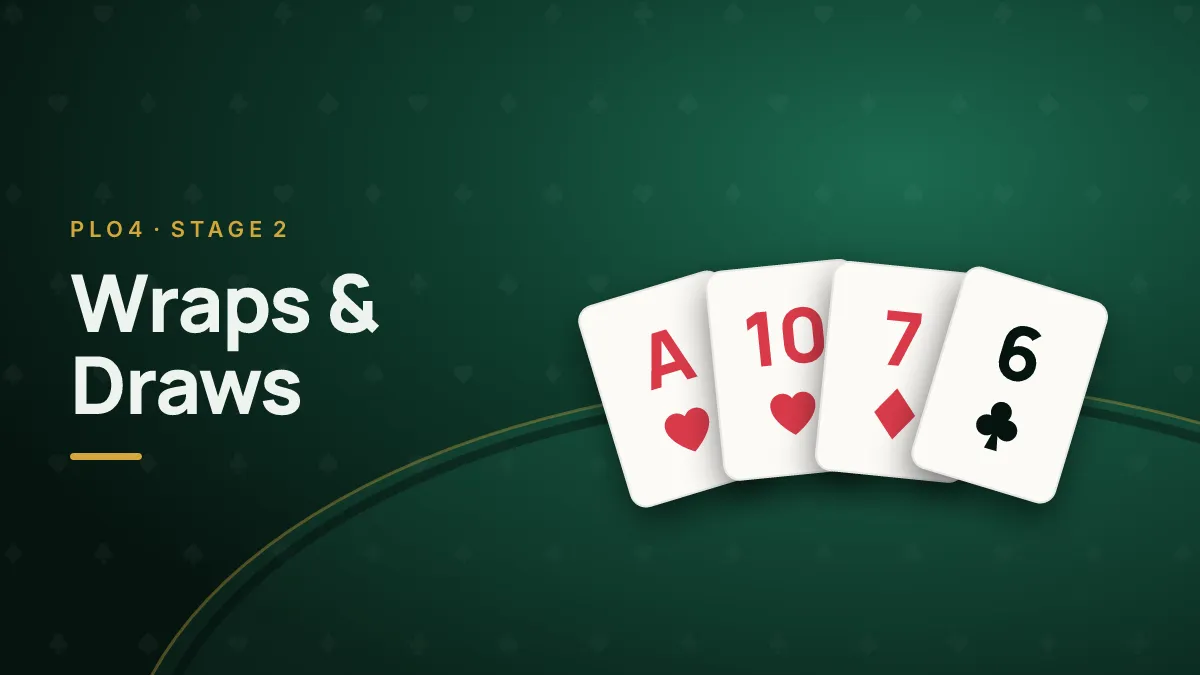
Draws in Omaha are bigger than anything you’ve seen in Hold’em. With four hole cards, a straight draw can have 20 outs, and a flush draw plus a straight draw can be a favourite over a set. But draws in Omaha also carry a hidden danger: with so many players holding so many cards, the flush or straight you make isn’t always the best one. The skill is telling the difference between nut draws, which win big pots, and second-best draws, which lose them.
Key takeaways
- A wrap is a straight draw that uses three or four of your cards; the biggest has 20 outs.
- Big wraps and combo draws can be favourites over top set on the flop.
- Draw to the nuts: non-nut flush draws are often drawing to a losing hand.
- Discount outs that pair the board when your opponent may have a set.
- Redraws and freerolls — draws to an even better hand — add a lot of value.
Wraps
In Hold’em, an open-ended straight draw has 8 outs. In Omaha, your extra cards can surround the board, creating a wrap. Our counts on a 9♥ 8♣ 2♦ flop:
| Your hand | Draw | Straight outs |
|---|---|---|
| J-T-4-3 | Open-ended (like Hold’em) | 8 |
| J-T-7-x | Wrap with three cards | 17 |
| T-7-6-x | Wrap below and above | 17 |
| J-T-7-6 | The full wrap | 20 |
With J-T-7-6, any Q, J, T, 7, 6 or 5 makes a straight: 20 cards. That’s more than a flush draw and an open-ender combined in Hold’em.
How strong are big draws?
From our Omaha evaluator, on a 9♥ 8♣ 2♦ flop:
- J♣T♦7♠6♥ (20-out wrap) vs 9♠9♦A♣K♥ (top set): the wrap is about 54%.
And on a two-heart 9♥ 8♥ 2♣ flop:
- A♥T♥7♦6♣ (nut flush draw + wrap, about 21 winning outs) vs 9♠9♦K♣Q♠ (top set): about 54% for the draw.
- A♥J♥5♣4♦ (a nut flush draw on its own) vs the same set: about 31%.
The lesson: a single flush draw is a drawing hand; a combo draw is often a favourite. Play big draws aggressively — raising a set with 20+ outs is often correct — and be much more careful with small draws.
Nut draws vs non-nut draws
With many players holding four cards each, it’s common for two players to draw to the same flush. The higher flush wins, and the pot is often large.
On 9♥ 8♠ 2♥, K♥Q♥ (king-high flush draw) against A♥J♥ (nut flush draw): the king-high flush draw has only about 23% equity — it wins mainly when it makes a straight or the board pairs its cards.
| Draw | How to treat it |
|---|---|
| Nut flush draw (ace-high) | A strong draw; play it aggressively, especially with extra outs |
| Second-nut flush draw (king-high) | Playable, but beware of big action |
| Low flush draw | Often drawing to a losing hand — mostly fold to big bets |
| Nut straight draw | Draws to the top of the straight |
| “Ignorant end” straight draw | Draws to the low end; a higher straight often beats it |
Discounting outs
Not every out is clean:
- If your opponent likely has a set, cards that pair the board give them a full house. Remove those from your count.
- If you’re drawing to a flush and a card also completes a higher straight or flush for your opponent, it’s not a real out.
- On a paired board, your straight and flush outs may be worth very little.
Redraws and freerolls
A redraw is a draw to a better hand after you’ve already made one. Example: you flop a straight and have a nut flush draw. If your opponent makes the same straight, you’re freerolling: you can’t lose, and you win outright if a flush card arrives.
Hands with redraws are the ones that win the biggest pots in Omaha, because they can bet and raise without fear of being outdrawn.
Playing a monster draw aggressively
PLO · 6-max · 100bb
Preflop
Pot 1.5bb
- BTN opens to 3bb, Hero calls in the big blind
Flop
Pot 6.5bb
982- Hero checks, BTN bets 4bb
- Hero check-raises pot: nut flush draw + wrap (about 21 outs) — a favourite even against top set
Practise counting wraps and combo draws in the PLO outs trainer, and check any match-up in the Omaha equity calculator.
Next up: putting draws and made hands together on the flop — PLO Flop Strategy.
Finished this lesson?
Mark it complete to track your PLO4 · Stage 2 progress.
Practise with a free tool
Keep going
Ready for the next level?
Up next in PLO4 · Stage 2 — PLO Strategy:
PLO Flop Strategy: C-Bets and Board TextureGet the weekly level-up
One short email a week: a new lesson, a hand to think about and a tool tip. No spam, unsubscribe any time.
By subscribing you agree to our privacy policy.
Related lessons
PLO Preflop Strategy: Position, Raising and 3-Bets
How to play PLO before the flop: why position matters even more than in Hold'em, opening ranges by seat, raise sizes, when to 3-bet, and how to defend the blinds.
PLO Flop Strategy: C-Bets and Board Texture
How to play the flop in Pot-Limit Omaha: which boards favour the preflop raiser, c-betting heads-up and multiway, bet sizes, and how to play made hands and draws.
Playing Aces in PLO
How to play pocket aces in Pot-Limit Omaha: good and bad aces, why 3-betting aces works, what happens multiway, and how to handle aces after the flop.