
PLO Starting Hands: Suited, Connected and Double-Suited
What makes a strong PLO starting hand: nut potential, suits, connectedness and pairs. The best hand types, the ones to avoid, and equity numbers for each.
By PokerLevelUp Team,
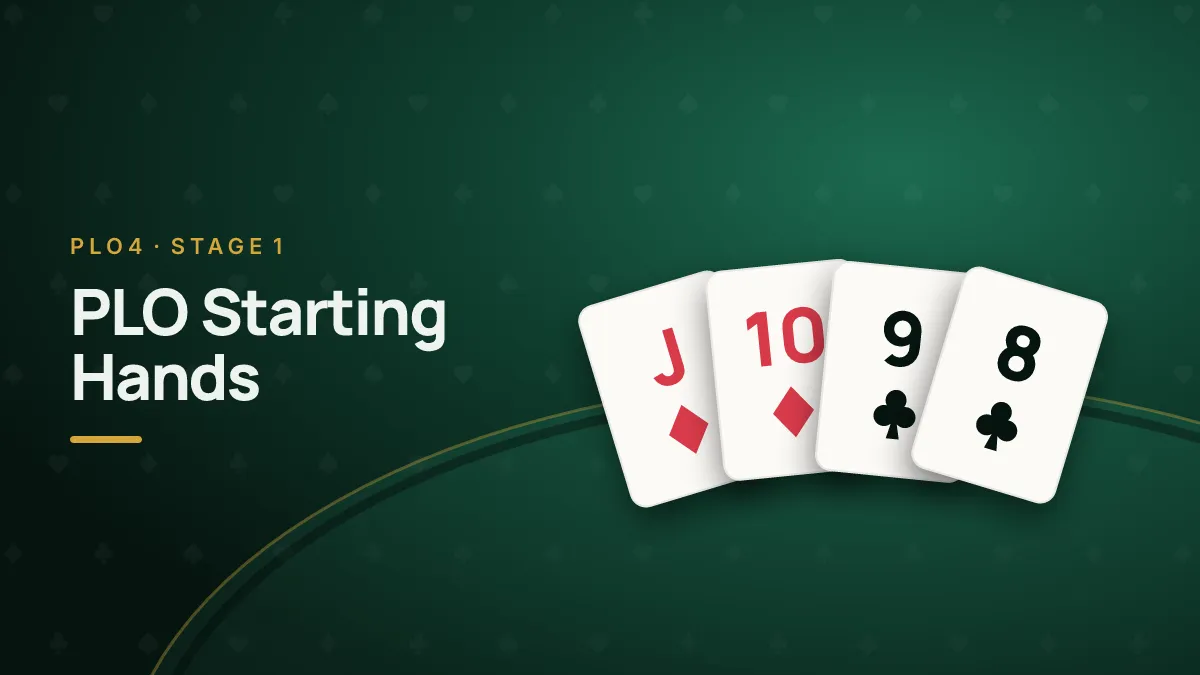
With 270,725 possible four-card hands, you can’t memorise a PLO chart the way you might in Hold’em. Instead, strong players judge hands by a few qualities: can this hand make the nuts, and in how many ways? A good Omaha hand is one where all four cards work together — connected for straights, suited for flushes, high for top pairs and sets. This lesson teaches you to recognise those hands at a glance.
Key takeaways
- All four cards should work together; a card that doesn't connect is called a 'dangler'.
- Suits: double-suited is best, single-suited is good, rainbow is weakest — and suited to an ace is best of all.
- Connectedness: rundowns like J-T-9-8 make many straights; big gaps reduce them.
- High cards matter: low rundowns make the bottom end of straights.
- Avoid trips, low unsuited junk and hands that can only make second-best.
The four qualities
1. Nut potential
The central question in Omaha: when this hand makes a straight or flush, will it be the best one? Hands with an ace suited to another card, high rundowns and high pairs make nut hands. Low cards make the low end of straights (“the ignorant end”) and small flushes that lose to bigger ones.
2. Suitedness
| Type | Example | Notes |
|---|---|---|
| Double-suited (ds) | A♠K♠J♦T♦ | Two flush draws possible. About 13.5% of all hands |
| Single-suited (ss) | A♠K♠J♦T♣ | One flush draw — best if the ace is suited |
| Rainbow | A♠K♥J♦T♣ | No flush potential at all |
A card suited to an ace is especially valuable: it makes the nut flush.
3. Connectedness
A rundown is four consecutive cards (J-T-9-8). Rundowns make straights and straight draws on many boards, including huge wraps. Gaps (J-T-8-7, one gap) reduce the number of straights; big gaps (K-9-5-2) make the hand far weaker.
4. Pairs
A pair in your hand gives you set potential. Big pairs (A-A, K-K) are valuable, especially with suited and connected side cards. Three of a kind in your hand (7-7-7-x) is one of the worst holdings: you can only make a set with one of the other sevens, and your hand has only two useful cards.
Our equity numbers
Heads-up all-in equity against a random hand (from our Omaha evaluator):
| Hand | Type | Equity |
|---|---|---|
| A♠A♥K♠K♥ | Aces and kings, double-suited | ~71% |
| A♠Q♠J♦T♦ | Ace-high broadways, double-suited | ~61% |
| K♠Q♠J♦T♦ | Broadway rundown, double-suited | ~59% |
| K♠K♦7♥2♣ | Kings with no support | ~57% |
| J♦T♦9♣8♣ | Middle rundown, double-suited | ~56% |
| 9♠8♠7♦6♦ | Lower rundown, double-suited | ~51% |
| A♥7♥6♣2♦ | Ace suited with junk | ~47% |
| 6♠5♠4♦3♦ | Low rundown, double-suited | ~44% |
| 5♣4♦3♥2♠ | Low rundown, rainbow | ~33% |
| 7♠7♦7♥2♣ | Trips | ~31% |
Notice how the rundowns fall away as they get lower: 6-5-4-3 makes straights that often lose to higher straights, and without suits it’s one of the weakest hands you can hold.
The best hand types
- Aces with support: A-A-K-Q, A-A-J-T, A-A-9-8 — ideally double-suited.
- High rundowns, double-suited: K-Q-J-T, Q-J-T-9, J-T-9-8.
- Ace-suited with broadways: A♠K♠Q♦J♦, A♠Q♠J♦T♦.
- Big pairs with connected, suited sides: K-K-Q-J ds, Q-Q-J-T ds.
- Double pairs: K-K-Q-Q, J-J-T-T — lots of set potential.
Hands that cost beginners money
- Danglers: three good cards plus one that doesn’t fit (K-Q-J-3). You’re really playing a three-card hand.
- Low rundowns without suits (5-4-3-2 rainbow): they make the low end of straights.
- Small flush draws: 8♠6♠ in a hand without the A♠ often makes a flush that loses.
- Trips in your hand.
- Dominated rundowns: K-Q-J-T against A-K-J-T type hands, or J-T-9-8 when a player holds Q-J-T-9. In our test, A♠K♠J♦T♦ was about 62% against K♥Q♥J♣T♣.
You’ve finished PLO Stage 1
Take the Stage 1 quiz to earn your badge. Stage 2 turns this into strategy: PLO Preflop Strategy.
Finished this lesson?
Mark it complete to track your PLO4 · Stage 1 progress.
Practise with a free tool
Keep going
Ready for the next level?
That’s the last lesson in PLO4 · Stage 1. Take the short quiz to earn your PLO4 · Stage 1 badge and move on to PLO Strategy.
Get the weekly level-up
One short email a week: a new lesson, a hand to think about and a tool tip. No spam, unsubscribe any time.
By subscribing you agree to our privacy policy.
Related lessons
Pot-Limit Omaha Rules: Four Cards, Use Exactly Two
How to play Pot-Limit Omaha: dealing, betting rounds, the must-use-exactly-two rule, and the hand-reading traps that catch every Hold'em player moving to PLO.
Pot-Limit Betting: How to Calculate the Pot
How pot-limit betting works: the maximum bet and raise, the quick 3× formula for a pot-sized raise, and worked preflop and post-flop examples.
PLO Hand Values: Why Equities Run So Close
Why Omaha equities are so close: calculated match-ups for aces, rundowns and double-suited hands, why one pair rarely wins and why drawing to the nuts matters.