
PLO Hand Values: Why Equities Run So Close
Why Omaha equities are so close: calculated match-ups for aces, rundowns and double-suited hands, why one pair rarely wins and why drawing to the nuts matters.
By PokerLevelUp Team,
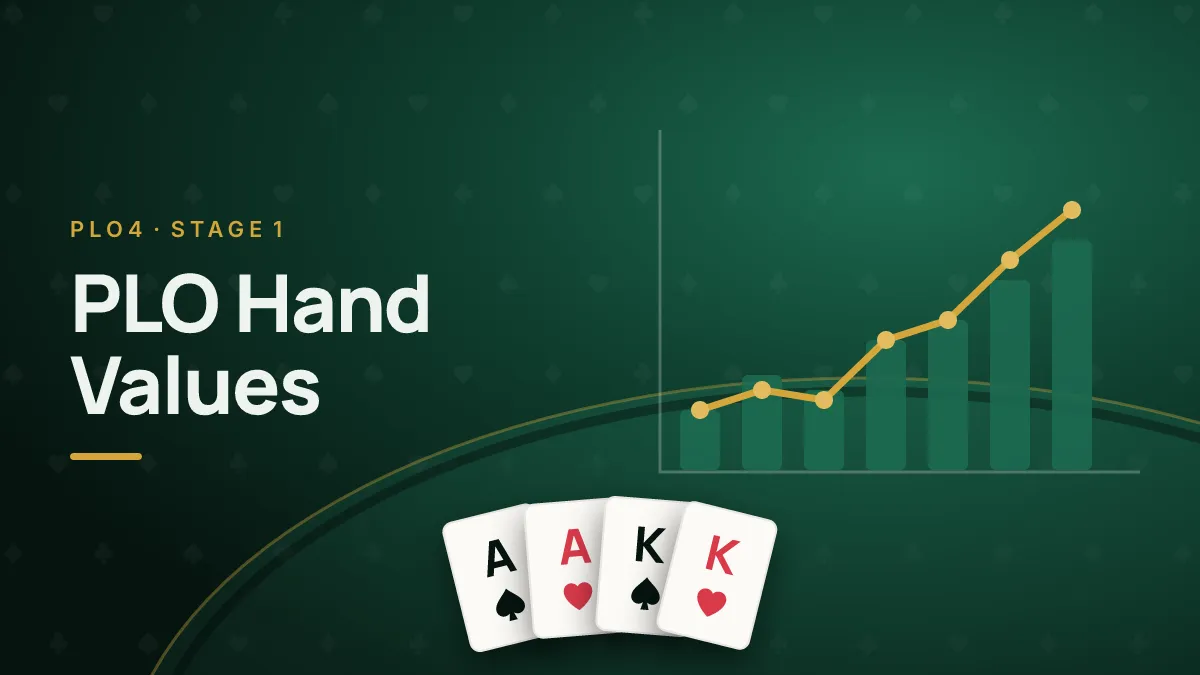
In Hold’em, pocket aces are an 85% favourite against a random hand. In Omaha, the best starting hand — double-suited aces and kings — is only about a 70% favourite. Hand values in PLO are compressed: starting hands run close together, made hands are stronger, and draws can be favourites over made hands. This lesson uses equity numbers we’ve calculated for every example so you can recalibrate your instincts.
Key takeaways
- Preflop equities run close: A♠A♥K♠K♥ is about 71% against a random hand; a weak rainbow A-A hand about 61%.
- Good rundowns like J-T-9-8 double-suited are roughly even with rainbow aces.
- On the flop, a 20-out wrap is a slight favourite over top set.
- One pair — even aces — rarely wins a big pot in PLO.
- Draw to the nuts: second-best flushes and straights lose big pots.
Preflop: close races everywhere
All figures below are heads-up all-in equities before the flop, from our own simulations.
| Hand | Against | Equity |
|---|---|---|
| A♠A♥K♠K♥ (AAKK double-suited) | A random hand | ~71% |
| A♠A♥7♦2♣ (aces with no support) | A random hand | ~61% |
| J♦T♦9♣8♣ (double-suited rundown) | A random hand | ~56% |
| A♠A♥K♠K♥ | J♦T♦9♣8♣ | ~61% / 39% |
| A♠A♥7♣2♦ | J♦T♦9♥8♥ | ~50% / 50% |
For comparison, in Hold’em A-A is about 85% against a random hand. In Omaha, even the best hand isn’t far ahead, and “junk aces” are a coin flip against a strong rundown.
Why this happens
With four cards, each player has six two-card combinations. That gives every hand many ways to make pairs, straights and flushes. The best hand before the flop has much less of an edge because the “worse” hand has so many chances to improve.
It also means multiway pots are common — and in a four-way pot, even A♠A♥ K♦Q♣ has only about 33% equity against three random hands.
After the flop: draws can be favourites
This is the biggest shock for Hold’em players.
99AK J1076Flop
Top set of nines against J-T-7-6, which has a 20-out wrap (any Q, J, T, 7, 6 or 5 makes a straight). The wrap is about a 54% favourite. The set needs the board to pair to win.
And a monster draw can be a favourite even with the set’s full-house outs counted:
99KQ A1076Flop
A♥T♥7♦6♣ has a nut flush draw plus a wrap — about 21 winning outs on the turn — and is about 54% against top set.
One pair doesn’t win big pots
In Hold’em, an overpair is often good. In Omaha:
- A♠A♣ with no other help against top two pair on 9-8-2: about 29%.
- A-A against a set: about 15%.
- Top two pair against a set: about 15%.
So one pair — even aces — is a hand that wins small pots and loses big ones.
The nuts matter
When several players are drawing, the best possible hand often shows up. A flush that isn’t the nut flush can be expensive: with K♥Q♥ against A♥J♥ on a board with two hearts, the king-high flush draw has only about 23% equity — it’s drawing to a flush that often loses.
This leads to the central principle of Omaha strategy:
Play hands that make the nuts, and be careful with hands that make second-best.
Next up: which hands to play — PLO Starting Hands.
Finished this lesson?
Mark it complete to track your PLO4 · Stage 1 progress.
Practise with a free tool
Keep going
Ready for the next level?
Up next in PLO4 · Stage 1 — PLO Foundations:
PLO Starting Hands: Suited, Connected and Double-SuitedGet the weekly level-up
One short email a week: a new lesson, a hand to think about and a tool tip. No spam, unsubscribe any time.
By subscribing you agree to our privacy policy.
Related lessons
Pot-Limit Omaha Rules: Four Cards, Use Exactly Two
How to play Pot-Limit Omaha: dealing, betting rounds, the must-use-exactly-two rule, and the hand-reading traps that catch every Hold'em player moving to PLO.
Pot-Limit Betting: How to Calculate the Pot
How pot-limit betting works: the maximum bet and raise, the quick 3× formula for a pot-sized raise, and worked preflop and post-flop examples.
PLO Starting Hands: Suited, Connected and Double-Suited
What makes a strong PLO starting hand: nut potential, suits, connectedness and pairs. The best hand types, the ones to avoid, and equity numbers for each.