
PLO5 Rules: What Changes With Five Cards
How Five-Card Omaha works, what's the same as PLO4, and what changes: ten two-card combinations, stronger showdown hands and a bigger premium on the nuts.
By PokerLevelUp Team,
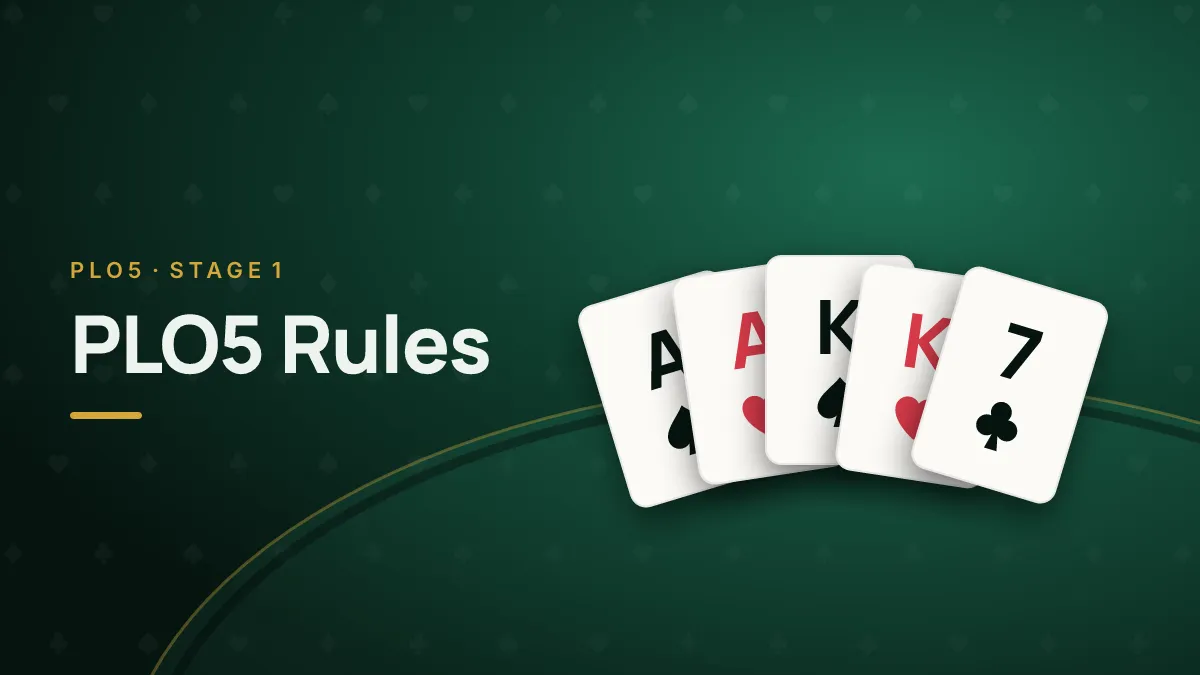
Five-Card Pot-Limit Omaha (PLO5, or “5-card PLO”) has grown quickly online and in live card rooms. The rules are almost identical to four-card Omaha — you just get one more hole card. But that one card has a big effect: every hand has far more ways to connect with the board, showdowns are won by stronger hands, and the difference between the nuts and second-best becomes the most important thing in the game.
Key takeaways
- PLO5 is PLO with five hole cards. You still use exactly two hole cards and three board cards.
- Five cards give ten two-card combinations (PLO4 has six; Hold'em has one).
- Showdowns are won by stronger hands: in six-way pots that reach the river, the winner has a straight or better about 89% of the time.
- Starting-hand equities run even closer than in PLO4.
- Drawing to — and holding — the nuts matters more than in any other common poker game.
What stays the same
- Blinds, positions and betting rounds are the same as Hold’em and PLO4.
- Pot-limit betting — see Pot-Limit Betting.
- The exactly-two rule: your hand is always two hole cards plus three board cards. The traps from PLO Rules all still apply — one heart in your hand never makes a flush, and you can’t play a straight that needs three of your cards.
Because a full table needs more cards, PLO5 is usually played 6-max or smaller.
What changes
More combinations
| Game | Hole cards | Two-card combinations per hand |
|---|---|---|
| Hold’em | 2 | 1 (and you may use 0, 1 or 2) |
| PLO4 | 4 | 6 |
| PLO5 | 5 | 10 |
Ten combinations means a PLO5 hand connects with almost every board in some way.
Stronger winning hands
We simulated all-in showdowns where every player sees all five board cards:
| Game | Winning hand is a straight or better (6 players) | Winning hand is a full house or better (6 players) |
|---|---|---|
| Hold’em | ~39% | ~12% |
| PLO4 | ~78% | ~31% |
| PLO5 | ~89% | ~40% |
Real pots don’t all go to showdown six-way, but the direction is clear: hands that are strong in Hold’em — one pair, two pair, even sets — are often not good enough in PLO5.
Closer equities
The best PLO5 hands have smaller edges than in PLO4. From our Omaha evaluator:
- A♠A♥K♠K♥ + 7♣ is about 64% against a random PLO5 hand (compared with about 71% for A♠A♥K♠K♥ in PLO4).
- A strong rundown like J♦T♦9♣8♣7♥ is about 55% against weak aces (A♠A♥7♣4♦2♥) — rundowns gain relative to unsupported aces.
Aces come more often
You’ll hold at least two aces in about 4.2% of PLO5 hands — roughly one in 24, compared with one in 40 in PLO4.
Common mistakes when switching from PLO4
- Overvaluing two pair and sets. They win far less often at showdown.
- Playing non-nut draws. Someone often holds the higher flush or straight.
- Using three hole cards when reading straights — the rule is still exactly two.
- Bluffing too much, especially multiway. With ten combinations each, opponents connect more often.
Next up: which five-card hands to play — PLO5 Starting Hands.
Finished this lesson?
Mark it complete to track your PLO5 · Stage 1 progress.
Practise with a free tool
Keep going
Ready for the next level?
Up next in PLO5 · Stage 1 — PLO5 Foundations:
PLO5 Starting Hands: Building Five-Card HandsGet the weekly level-up
One short email a week: a new lesson, a hand to think about and a tool tip. No spam, unsubscribe any time.
By subscribing you agree to our privacy policy.
Related lessons
PLO5 Starting Hands: Building Five-Card Hands
How to judge Five-Card Omaha starting hands: nut potential, suits, connectedness and the fifth card — with equity numbers for the best and worst hand types.
PLO5 Equity: Why the Nuts Matter Even More
How equity behaves in Five-Card Omaha: closer preflop races, sets vs draws after the flop, the cost of non-nut draws and why second-best hands lose the biggest pots.
PLO5 Preflop Strategy: Opening, 3-Betting and Position
A practical preflop plan for Five-Card Omaha: opening by position, raise sizes, which hands to 3-bet, playing the blinds and adjusting for multiway pots.