
PLO5 Equity: Why the Nuts Matter Even More
How equity behaves in Five-Card Omaha: closer preflop races, sets vs draws after the flop, the cost of non-nut draws and why second-best hands lose the biggest pots.
By PokerLevelUp Team,
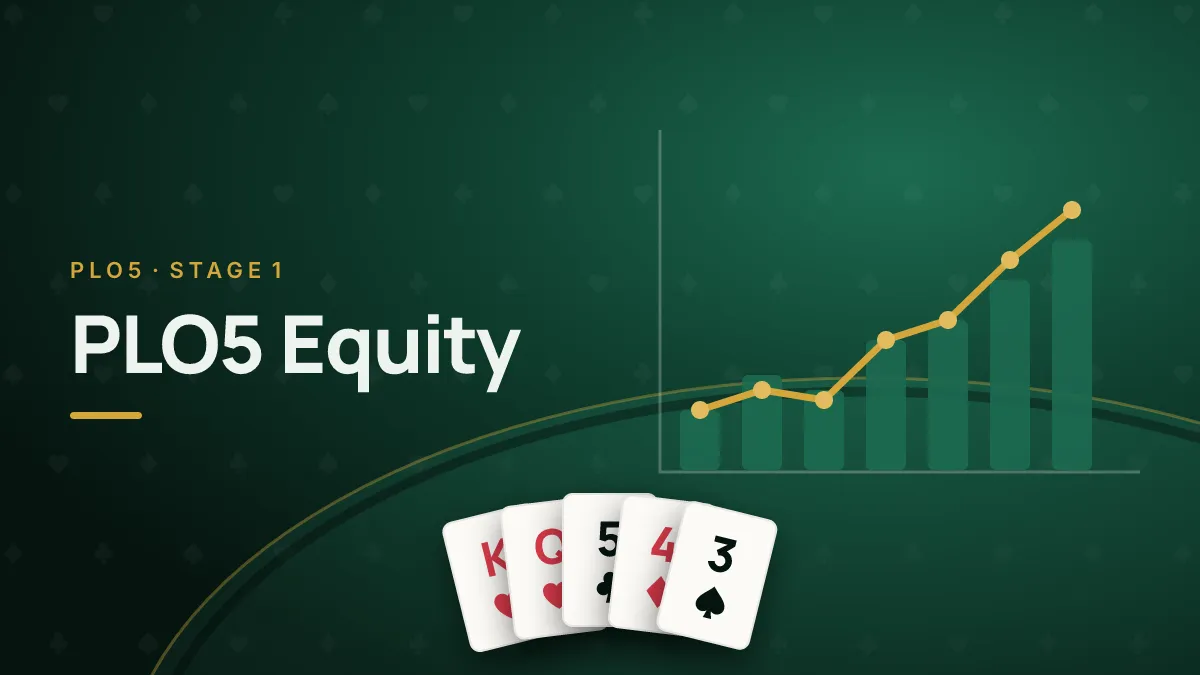
In PLO5, your opponents hold ten two-card combinations each. That changes the equity picture in two ways. Before the flop, hands run even closer together than in PLO4. After the flop, whoever holds the nuts — or the best draw to it — has a huge advantage, and hands that are “nearly the nuts” become expensive. This lesson uses calculated examples to build your PLO5 instincts.
Key takeaways
- Preflop edges are small: even the best hands are only around 64–65% against a random hand.
- After the flop, the extra card helps both sides: sets gain outs, draws gain outs.
- In our example, top set was about a 54% favourite against a nut flush draw with a wrap.
- Non-nut flush draws are in terrible shape against nut draws: about 23% in our example.
- Plan to win big pots only with the nuts or strong draws to the nuts.
Preflop: small edges
From our simulations against a random PLO5 hand, the best hands are around 64–65%, strong rundowns around 55–58% and weak hands around 30–40%. Compare that with Hold’em, where A-A is about 85% against a random hand.
Small preflop edges mean:
- Position and post-flop skill decide more of your results.
- Getting all-in preflop is rarely a big edge, except with premium aces against weak ranges.
- Multiway pots are common and change hand values a lot.
After the flop: both sides have more outs
The fifth card helps every hand — including made hands. On a 9♥ 8♥ 2♣ flop:
| Hero | Villain | Equity |
|---|---|---|
| 9♠9♦K♣Q♠J♦ (top set) | A♥T♥7♦6♣5♠ (nut flush draw + wrap) | ~54% / 46% |
| 9♠9♦K♣Q♠3♦ (top set) | 8♠2♠A♥T♥4♣ (bottom two pair + nut flush draw) | ~66% / 34% |
Compare the first line with PLO4 (lesson Drawing in PLO), where a similar draw was a 54% favourite over top set. Here the set holder’s extra cards (like the J♦, which blocks and adds straight outs) swing it back. The lesson: in PLO5, don’t assume a big draw is ahead — count what your opponent’s extra cards can do too.
Non-nut draws
On 9♥ 8♠ 2♥, a king-high flush draw (K♥Q♥ in a five-card hand) against a nut flush draw (A♥J♥): the king-high draw has only about 23%. It wins mainly when it makes a straight or pairs up and the board cooperates.
In PLO5, the chance that someone holds the ace of your suit is higher than in PLO4 — they have more cards. So:
- Nut flush draws: play them aggressively, especially with extra outs.
- King-high flush draws: proceed with caution in big pots.
- Low flush draws: usually not worth a big bet.
Why second-best is so expensive
When two strong hands collide, one of them is usually drawing thin. Because PLO5 players make strong hands so often, these collisions happen all the time: set over set, higher straight over lower straight, nut flush over second-nut flush. The player who habitually plays hands that can only make second-best hands will lose the biggest pots of the night.
Every example above can be re-run in the Omaha equity calculator, which supports five-card hands. Try swapping one card in the set or the draw and watch how much the equity moves.
Next up: putting this into a preflop plan — PLO5 Preflop Strategy.
Finished this lesson?
Mark it complete to track your PLO5 · Stage 1 progress.
Practise with a free tool
Keep going
Ready for the next level?
Up next in PLO5 · Stage 1 — PLO5 Foundations:
PLO5 Preflop Strategy: Opening, 3-Betting and PositionGet the weekly level-up
One short email a week: a new lesson, a hand to think about and a tool tip. No spam, unsubscribe any time.
By subscribing you agree to our privacy policy.
Related lessons
PLO5 Rules: What Changes With Five Cards
How Five-Card Omaha works, what's the same as PLO4, and what changes: ten two-card combinations, stronger showdown hands and a bigger premium on the nuts.
PLO5 Starting Hands: Building Five-Card Hands
How to judge Five-Card Omaha starting hands: nut potential, suits, connectedness and the fifth card — with equity numbers for the best and worst hand types.
PLO5 Preflop Strategy: Opening, 3-Betting and Position
A practical preflop plan for Five-Card Omaha: opening by position, raise sizes, which hands to 3-bet, playing the blinds and adjusting for multiway pots.