
PLO5 Starting Hands: Building Five-Card Hands
How to judge Five-Card Omaha starting hands: nut potential, suits, connectedness and the fifth card — with equity numbers for the best and worst hand types.
By PokerLevelUp Team,
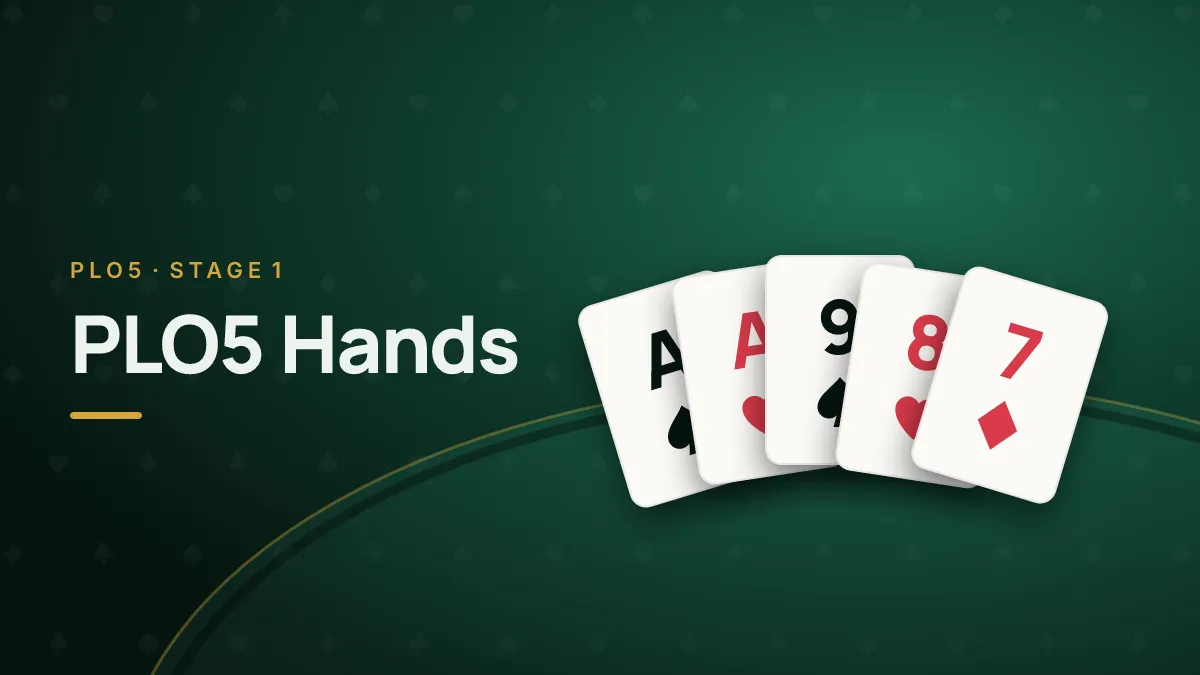
In PLO5 almost every hand looks playable: five cards give you pairs, suits and connectors nearly every time. That’s exactly the trap. Because everyone’s hand is stronger, the hands worth playing are the ones that make the nuts — the top straight, the ace-high flush, the top full house — in many different ways. This lesson shows you how to recognise them, with equity numbers from our Omaha evaluator.
Key takeaways
- Judge PLO5 hands by nut potential: suited aces, high connected cards and big pairs with support.
- Connectedness matters even more than in PLO4: aces with connected, suited side cards are the strongest hands.
- A 'fifth card' that doesn't connect is less harmful than a PLO4 dangler — but it's still dead weight.
- Low rundowns, trips and non-nut flush cards lose a lot of value.
- Equities are close, so position and post-flop skill decide more than starting hands.
The same four qualities — with higher standards
The qualities from PLO Starting Hands still apply: nut potential, suitedness, connectedness and pairs. The difference is the standard. In PLO5, nearly every hand has some suit and some connection, so ask whether yours makes the top of those holdings.
- Suits: an ace-suited card is gold; a low suited card without the ace is often a liability.
- Connectedness: the more of your five cards that work together, the more nut straights and wraps you’ll make.
- High cards: high rundowns make the top of straights; low ones make the “ignorant end”.
- Pairs: big pairs with connected, suited side cards are the premium hands.
Equity against a random hand
Heads-up, all-in preflop against a random PLO5 hand:
| Hand | Description | Equity |
|---|---|---|
| A♠A♥9♠8♥7♦ | Aces + connected, double-suited side cards | ~65% |
| A♠A♥K♠K♥7♣ | Aces and kings, double-suited, spare card | ~64% |
| A♠K♠Q♦J♦T♣ | Five-card broadway, double-suited with the ace | ~60% |
| K♠Q♠J♦T♦9♣ | High rundown, double-suited | ~58% |
| A♠A♥7♣4♦2♥ | Aces with weak, disconnected cards | ~57% |
| K♠K♦Q♥Q♣J♠ | Double pairs plus a connector | ~57% |
| J♦T♦9♣8♣7♥ | Middle rundown, double-suited | ~55% |
| 9♠8♠7♦6♦5♣ | Lower rundown, double-suited | ~50% |
| 6♣5♦4♥3♠2♣ | Low rundown, nearly rainbow | ~39% |
| 7♠7♦7♥2♣3♦ | Trips | ~30% |
Two lessons stand out:
- Aces need support. A♠A♥9♠8♥7♦, with connected and suited side cards, is stronger than A♠A♥K♠K♥ plus a spare card — and far stronger than aces with junk.
- Low hands fall off a cliff. A five-card low rundown is one of the weakest hands you can hold.
The best hand types
- Aces with connected, suited side cards: A-A-9-8-7 ds, A-A-J-T-9 ds.
- High, double-suited rundowns: K-Q-J-T-9, Q-J-T-9-8 — ideally with an ace-suited card.
- Aces with a second pair and suits: A-A-K-K-x ds.
- Broadway hands with a suited ace: A-K-Q-J-T ds.
- Big double pairs with connectors: K-K-Q-Q-J, Q-Q-J-J-T.
Hands to be careful with
- Weak aces: A-A with three disconnected, off-suit cards. Playable, but not the monster they look like.
- Low rundowns: 6-5-4-3-2, 7-6-5-4-3 — they make low straights that lose to higher ones.
- Non-nut flush potential: two low cards of a suit without the ace.
- Trips and quads in your hand.
- Hands with two or more dead cards.
Next up: how equity behaves after the flop — PLO5 Equity.
Finished this lesson?
Mark it complete to track your PLO5 · Stage 1 progress.
Practise with a free tool
Keep going
Ready for the next level?
Up next in PLO5 · Stage 1 — PLO5 Foundations:
PLO5 Equity: Why the Nuts Matter Even MoreGet the weekly level-up
One short email a week: a new lesson, a hand to think about and a tool tip. No spam, unsubscribe any time.
By subscribing you agree to our privacy policy.
Related lessons
PLO5 Rules: What Changes With Five Cards
How Five-Card Omaha works, what's the same as PLO4, and what changes: ten two-card combinations, stronger showdown hands and a bigger premium on the nuts.
PLO5 Equity: Why the Nuts Matter Even More
How equity behaves in Five-Card Omaha: closer preflop races, sets vs draws after the flop, the cost of non-nut draws and why second-best hands lose the biggest pots.
PLO5 Preflop Strategy: Opening, 3-Betting and Position
A practical preflop plan for Five-Card Omaha: opening by position, raise sizes, which hands to 3-bet, playing the blinds and adjusting for multiway pots.