
PLO5 Draws: Wraps, Redraws and Freerolls
Drawing in Five-Card Omaha: 20-out wraps, nut vs non-nut draws, discounting outs when opponents hold more cards, and how redraws and freerolls win the biggest pots.
By PokerLevelUp Team,
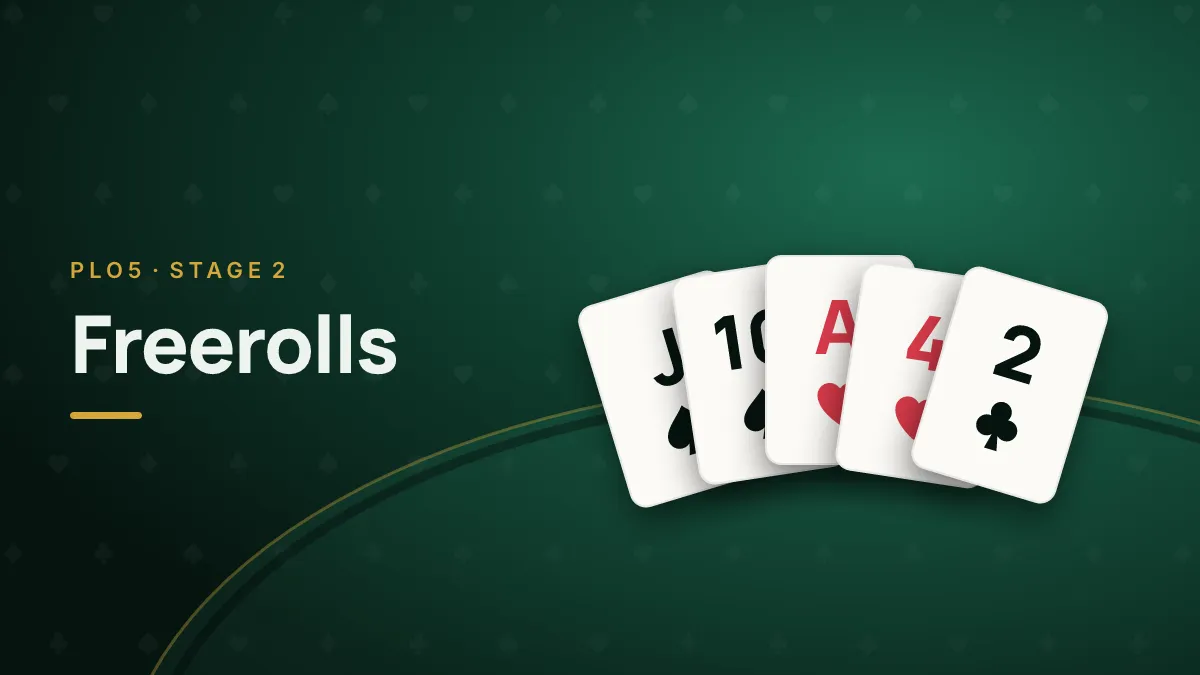
Draws in PLO5 look enormous: with five cards, wraps and combo draws appear on almost every flop. But your opponents hold five cards too, which means more of your “outs” are already in their hands — and more of the hands you make are beaten by something better. Drawing well in PLO5 means drawing to the nuts, discounting outs honestly, and valuing redraws that keep you safe when you get there.
Key takeaways
- Five-card wraps reach 20 outs, just like the biggest PLO4 wraps — but opponents hold more of your outs.
- Discount outs that pair the board against likely sets, and outs that give an opponent a better hand.
- Nut flush draws are strong; non-nut flush draws are often drawing to a losing hand.
- A redraw (a draw to a better hand after making one) turns coin flips into freerolls.
- Play big nut draws aggressively; play small or non-nut draws cheaply or not at all.
Wraps in PLO5
With five cards, you can surround the board with even more cards. On 9♥ 8♣ 2♦, a hand like J-T-7-6-4 has a 20-out wrap (any Q, J, T, 7, 6 or 5) — the same maximum as in PLO4. The fifth card doesn’t add straight outs here, but in other hands it often adds flush draws, pair outs or blockers.
Discounting outs
Your opponents’ extra cards matter in three ways:
- Blocked outs. With five cards each, some of the cards you need are already in other players’ hands. Count raw outs, then expect to lose a few.
- Board-pairing outs. If your opponent likely has a set, cards that pair the board give them a full house. Remove them.
- Outs that make someone else better. A card that completes your straight may complete a higher straight or a flush for your opponent.
Nut draws vs non-nut draws
From our PLO5 simulations, on 9♥ 8♠ 2♥:
- A king-high flush draw against the nut flush draw: about 23%.
On 9♥ 8♥ 2♣:
- Top set (9♠9♦K♣Q♠3♦) against bottom two pair + nut flush draw (8♠2♠A♥T♥4♣): about 66% / 34% for the set.
- Top set (9♠9♦K♣Q♠J♦) against a nut flush draw + wrap (A♥T♥7♦6♣5♠): about 54% / 46% for the set.
Even the biggest draws are rarely big favourites over a strong made hand in PLO5 — because the made hand usually has extra outs of its own.
| Draw | How to play it in PLO5 |
|---|---|
| Nut flush draw + big wrap | Aggressively — raise and get it in with good SPR |
| Nut flush draw alone | Call or bet; be careful when the board pairs against a likely set |
| Nut straight wrap | Solid; check whether flush cards complete other hands |
| King-high flush draw | Cautiously; small pots |
| Low flush draw / bottom-end straight draw | Usually fold to big bets |
Redraws and freerolls
A redraw is a draw to an even better hand after you’ve already made one:
- The nut straight plus a nut flush draw.
- A set plus a flush draw (you can improve to a full house or a flush).
When you and an opponent hold the same made hand, a redraw makes it a freeroll: you can split at worst and win the whole pot when the redraw hits. In PLO5, where players frequently hold the same straight, freerolls are one of the biggest sources of profit.
A freeroll
PLO5 · heads-up on the flop · 100bb
Flop
Pot 10bb
987- BB bets pot with J♦T♦6♠5♣3♦ — the nut straight (J-T with 9-8-7)
- Hero has the same straight plus the nut flush draw (A♥4♥)
- Hero raises: the worst case is a split pot
Next up: bluffing when everyone has a hand — PLO5 Bluffing and Blockers.
Finished this lesson?
Mark it complete to track your PLO5 · Stage 2 progress.
Practise with a free tool
Keep going
Ready for the next level?
Up next in PLO5 · Stage 2 — PLO5 Strategy:
PLO5 Bluffing and BlockersGet the weekly level-up
One short email a week: a new lesson, a hand to think about and a tool tip. No spam, unsubscribe any time.
By subscribing you agree to our privacy policy.
Related lessons
PLO5 Equity: Why the Nuts Matter Even More
How equity behaves in Five-Card Omaha: closer preflop races, sets vs draws after the flop, the cost of non-nut draws and why second-best hands lose the biggest pots.
PLO5 Flop Play: Playing for the Nuts
How to play the flop in Five-Card Omaha: naming the nuts, betting nut hands with redraws, handling sets and two pair, c-betting less, and folding second-best.
PLO5 Bluffing and Blockers
When bluffing works in Five-Card Omaha: why pure bluffs succeed less often, how five-card blockers help, the best bluffing spots, and what river raises usually mean.