
PLO5 Variance, Bankroll and Game Selection
Why Five-Card Omaha is the swingiest common poker game, how big a PLO5 bankroll should be, how to choose games and how to keep your head through the downswings.
By PokerLevelUp Team,
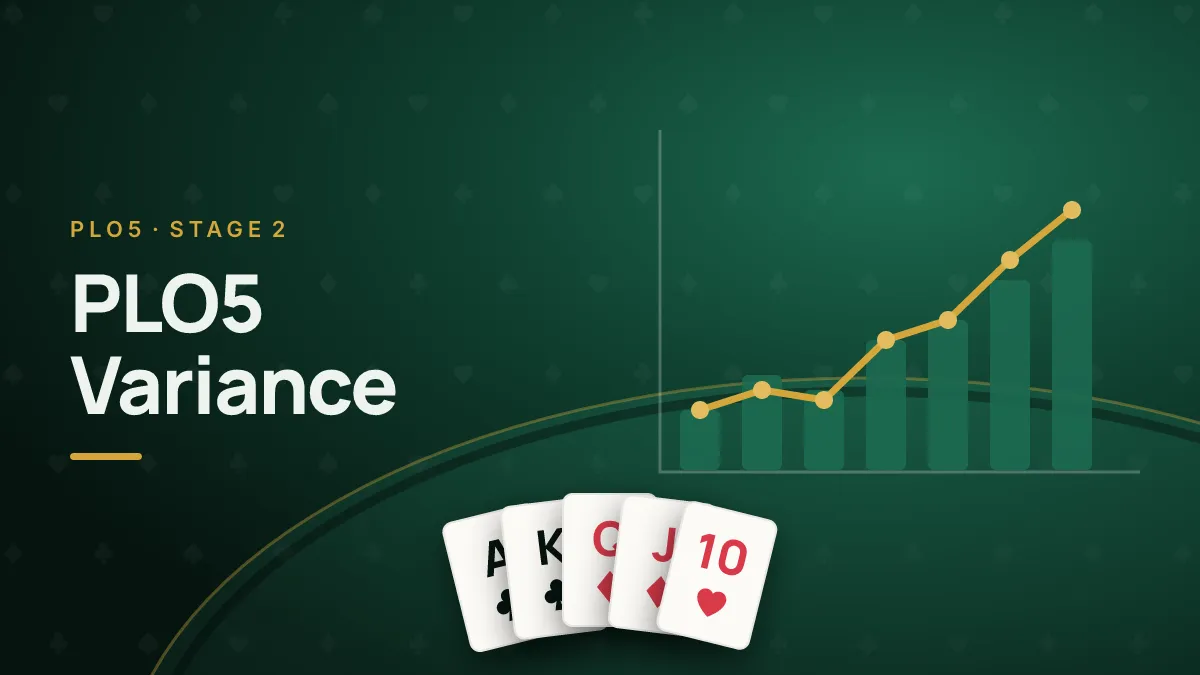
If PLO4 swings more than Hold’em, PLO5 swings more again. Equities run closer, strong hands collide more often, and big pots are decided by a single card more than in any other popular poker game. That doesn’t mean PLO5 is a bad game to play — many PLO5 games are among the softest in poker. It does mean you need a bigger bankroll, a calm approach to losing streaks and good judgement about where to play.
Key takeaways
- PLO5 is usually swingier than PLO4: closer equities and more frequent coolers.
- Keep more buy-ins than for PLO4 — 100 or more for cash games is a sensible starting point.
- Many PLO5 games are soft because the format is newer; game selection matters a lot.
- Rake can be a big share of pots at low stakes — compare games carefully.
- Judge your PLO5 results over very large samples and on decision quality.
Why PLO5 swings so much
Everything that made PLO4 swingy is stronger in PLO5:
- Closer equities — the best hands are only around 64–65% against a random hand, and many all-ins are near coin flips.
- Coolers — set over set, straight over straight and nut flush over second-nut flush happen constantly, because everyone holds strong hands.
- Big multiway pots — more players see flops with playable hands.
You saw in PLO Variance and Bankroll that a solid PLO4 winner can easily be behind after 10,000 hands. In PLO5, expect those stretches to be longer and deeper.
Bankroll guidelines
| Format | Buy-ins (100bb) to keep |
|---|---|
| PLO5 cash, cautious | 100+ |
| PLO5 cash, proven winner | 60–80 |
| PLO5 tournaments | 150–200+ |
If you’re moving from Hold’em or PLO4, consider dropping a stake while you learn. You’ll lose less while your decisions catch up with the new game, and your bankroll will be sized properly for the swings. Track every session in the bankroll tracker.
Game selection
PLO5 is newer than Hold’em and PLO4, so many games still contain lots of recreational players who:
- play too many hands, especially weak aces and low rundowns;
- pay off with second-best hands;
- bluff too little on the river.
That’s a big opportunity. Apply the principles from Game Selection:
- Look for tables with many players seeing flops and big average pots.
- Sit to the left of the loosest, most aggressive players.
- Leave tables where the recreational players have gone.
Rake
At low stakes, pots in PLO5 are often large relative to the blinds, so rake caps can be hit frequently — but small pots are raked heavily too. Compare rake structures and rakeback between sites and clubs; it can decide whether a small edge is a winning one.
Keeping your head
- Expect coolers. Losing a big pot with a strong hand is part of PLO5, not a sign you played badly.
- Review decisions, especially big pots: did you get in with the nuts, a freeroll or a strong draw — or with second-best?
- Use stop-losses and breaks from Tilt Control. PLO5’s swings make tilt more likely.
- Keep perspective. Results over a few thousand hands of PLO5 say almost nothing about your skill.
You’ve finished the PLO5 course
Take the Stage 2 quiz to earn your PLO5 badge. You’ve now completed every PokerLevelUp course — Hold’em Core, Tournaments, PLO4 and PLO5. Keep your skills sharp with the daily Hand of the Day, share hands in the community, and revisit any lesson from the courses page.
Finished this lesson?
Mark it complete to track your PLO5 · Stage 2 progress.
Practise with a free tool
Keep going
Ready for the next level?
That’s the last lesson in PLO5 · Stage 2. Take the short quiz to earn your PLO5 · Stage 2 badge.
Get the weekly level-up
One short email a week: a new lesson, a hand to think about and a tool tip. No spam, unsubscribe any time.
By subscribing you agree to our privacy policy.
Related lessons
PLO5 Flop Play: Playing for the Nuts
How to play the flop in Five-Card Omaha: naming the nuts, betting nut hands with redraws, handling sets and two pair, c-betting less, and folding second-best.
PLO5 Draws: Wraps, Redraws and Freerolls
Drawing in Five-Card Omaha: 20-out wraps, nut vs non-nut draws, discounting outs when opponents hold more cards, and how redraws and freerolls win the biggest pots.
PLO5 Bluffing and Blockers
When bluffing works in Five-Card Omaha: why pure bluffs succeed less often, how five-card blockers help, the best bluffing spots, and what river raises usually mean.