
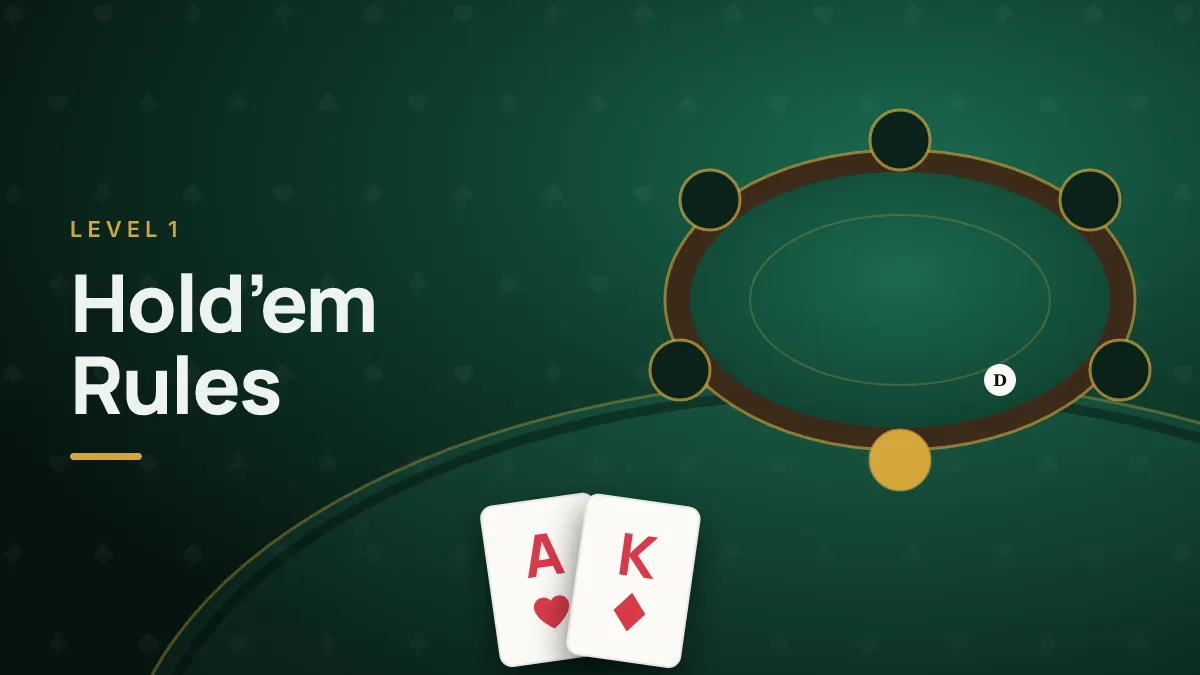
Texas Hold’em is the most popular poker game in the world, and the good news is that its rules fit on a single page. In this lesson you’ll learn exactly how a hand unfolds — from the moment the blinds go in to the moment someone scoops the pot — so you can sit down at any table, live or online, and follow every action with confidence.
Key takeaways
- Each player gets two private cards; five shared community cards are dealt in the middle.
- There are four betting rounds: preflop, flop, turn and river.
- Your hand is the best five cards from the seven available to you — two hole cards plus five community cards.
- You win by having the best hand at showdown, or by betting so that everyone else folds.
The goal of the game
You win chips in two ways:
- Have the best five-card hand at the showdown, when the remaining players reveal their cards.
- Make everyone else fold before the showdown, so the pot is yours without showing anything.
That second route is what makes poker a game of skill rather than pure luck. You don’t need the best cards to win a pot — you need to make better decisions than your opponents over time.
The table, the button and the blinds
A Hold’em table seats between two and ten players. One player has the dealer button, a small disc that marks who acts last in most betting rounds. After every hand, the button moves one seat clockwise so everyone takes turns in each position.
Before any cards are dealt, the two players to the left of the button post forced bets called blinds:
- The small blind sits directly to the left of the button and posts half the minimum bet (or close to it).
- The big blind sits two seats to the left of the button and posts the full minimum bet.
Blinds make sure there is always something in the pot to play for. In a game described as “1/2”, the small blind is 1 and the big blind is 2. In tournaments, blinds increase at set intervals, and many tournaments add an ante — a small forced bet from every player (or a single “big blind ante” posted by the big blind).
A 6-max table before the cards are dealt
The five actions you can take
Whenever it is your turn, you can do one of the following:
| Action | What it means | When you can do it |
|---|---|---|
| Fold | Give up your hand and any chips you’ve put in the pot | Any time it’s your turn |
| Check | Pass the action without betting | Only if nobody has bet on this round |
| Bet | Put chips in when nobody else has | Only if nobody has bet on this round |
| Call | Match the current bet | When someone has bet |
| Raise | Increase the current bet | When someone has bet |
Going all-in means betting every chip you have in front of you. In No-Limit Hold’em you can do this at any time.
In No-Limit games, the smallest raise you can make is the size of the previous bet or raise. If someone bets 10, the minimum raise is to 20. If they bet 10 and another player raises to 30 (a raise of 20), the next minimum raise is to 50.
How a hand plays out
1. Preflop
Every player is dealt two cards face down — your hole cards. Only you can see them.
The first player to act is the one directly to the left of the big blind, a seat called under the gun. Action moves clockwise, and each player can fold, call the big blind or raise. The big blind acts last before the flop; if nobody has raised, they can simply check.
AK Your two hole cards are yours alone. Here you hold ace–king, one of the strongest starting hands.
2. The flop
Once preflop betting is finished, the dealer burns one card (discards it face down) and deals three community cards face up. This is the flop, and every player can use these cards.
Flop
A new round of betting starts with the first active player to the left of the button. With the ace–king above, you’ve now made a pair of kings with the best possible kicker — a strong hand on this board.
3. The turn
Another card is burned and a fourth community card is dealt: the turn. Another betting round follows, again starting with the first active player to the left of the button.
4. The river
A final burn, then the fifth and last community card: the river. The last round of betting follows.
Flop
Turn
River
5. The showdown
If two or more players are still in after the river betting, it’s time for the showdown. The last player to bet or raise on the river shows first. If everyone checked the river, the first active player to the left of the button shows first. Players who can’t win may muck (throw away their cards without showing), although in many card rooms anyone who put money in on the river can ask to see a called hand.
The best five-card hand wins the pot.
Making your best five-card hand
At showdown you have seven cards available: your two hole cards and the five community cards. Your hand is the best combination of any five of those seven. You can use:
- both of your hole cards and three from the board,
- one hole card and four from the board, or
- none of your hole cards — this is called playing the board.
If the best possible hand is on the board itself and nobody can beat it, everyone still in the hand splits the pot.
Not sure which hand beats which? The next lesson, Poker Hand Rankings, walks through every hand from high card to royal flush.
Ties, kickers and split pots
When two players make the same type of hand, the higher-ranked cards win. If the main part of the hand is identical, the kicker — the highest unpaired card — decides it.
The kicker decides it
No-Limit Hold'em · showdown
Board
A9642- Player A shows A♠ K♣
- Player B shows A♦ Q♦
Result
- Both players have a pair of aces
- Player A's king kicker beats Player B's queen kicker
If the best five cards are exactly the same for two players — for example, both play the board — the pot is split equally. Suits never break ties in Hold’em.
Side pots when a player is all-in
A player can’t win more from each opponent than they put in. If someone goes all-in for less than the current bet, a side pot is created for the remaining players:
- The main pot contains the all-in player’s stake matched by each caller. Everyone still in the hand can win it.
- The side pot contains any extra betting between the players who still have chips. Only those players can win it.
At showdown, the side pot is awarded first, then the main pot. It sounds complicated, but the dealer (or the software) handles it for you.
Table etiquette worth knowing
- Act in turn. Acting before it’s your turn gives away information and can be binding in live games.
- Protect your cards. Place a chip on your hole cards so they aren’t mucked by accident.
- Declare your raise. In live games, say “raise” before moving chips forward, or put the full amount in at once. Adding chips in several trips is a “string bet” and usually isn’t allowed.
- Keep your cards on the table and in view — and never show your hand to a player still in the pot.
Putting it all together
Here’s one complete hand from deal to showdown, so you can see how everything fits.
A complete hand of Hold'em
No-Limit Hold'em · 6 players · blinds 1/2
Preflop
Pot 3
- UTG folds, HJ folds, CO folds
- Hero raises to 6 on the button
- SB folds, BB calls 4 more
Flop
Pot 13
K83- BB checks
- Hero bets 6
- BB calls
Turn
Pot 25
2- BB checks
- Hero bets 16
- BB calls
River
Pot 57
J- BB checks
- Hero bets 30
- BB folds
Notice that the hand ended without a showdown: a well-timed bet made the other player fold. You’ll learn when and how much to bet in later levels. For now, the rules are what matter — and you’ve just covered all of them.
What’s next
You know how a hand flows. The next step is to make sure you can always tell which hand wins. Head to Poker Hand Rankings, then try the odds calculator to see how often your favourite hands win.
Finished this lesson?
Mark it complete to track your Level 1 progress.
Practise with a free tool
Keep going
Ready for the next level?
Up next in Level 1 — Foundations:
Poker Hand Rankings: From High Card to Royal FlushGet the weekly level-up
One short email a week: a new lesson, a hand to think about and a tool tip. No spam, unsubscribe any time.
By subscribing you agree to our privacy policy.
Related lessons
Poker Hand Rankings: From High Card to Royal Flush
Every poker hand ranked from strongest to weakest, with examples, odds and the tie-break rules that settle close showdowns.
Betting Rules: Minimum Raises, All-Ins and the Big Blind Option
How much you can bet and raise in No-Limit Hold'em, what happens when someone is all-in, and the betting rules that settle most disputes at the table.
Basic Poker Terms Every Player Should Know
The poker vocabulary you'll hear at every table, grouped by topic: seats, actions, hand types, draws, money and strategy — each explained in plain English.