
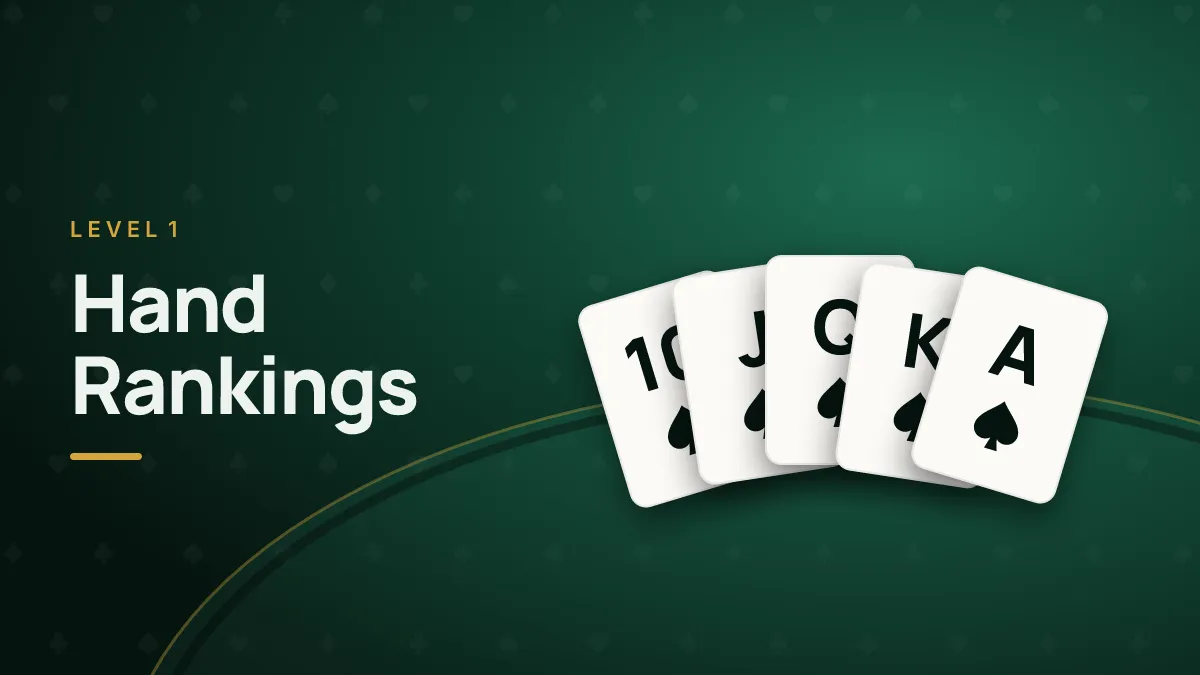
Every decision in poker starts with one question: how strong is my hand? Before you can answer that, you need to know the hand rankings cold. This lesson covers all ten hands, from the strongest to the weakest, shows you how ties are broken, and clears up the mix-ups that catch out new players.
Key takeaways
- There are ten hand categories. A hand in a higher category always beats a hand in a lower one.
- Within the same category, higher cards win — and kickers break ties.
- A flush beats a straight, and a full house beats a flush.
- Suits are never used to break a tie in Texas Hold'em.
The hand rankings at a glance
Your hand is always the best five cards you can make. Here they are from strongest to weakest, with the chance of finishing with each one in Hold’em when you see all seven cards (two hole cards plus five on the board).
| Rank | Hand | Example | Chance by the river* |
|---|---|---|---|
| 1 | Royal flush | A♠ K♠ Q♠ J♠ T♠ | 0.003% |
| 2 | Straight flush | 9♥ 8♥ 7♥ 6♥ 5♥ | 0.03% |
| 3 | Four of a kind | Q♣ Q♦ Q♥ Q♠ 7♦ | 0.17% |
| 4 | Full house | J♠ J♥ J♦ 4♣ 4♠ | 2.6% |
| 5 | Flush | A♦ J♦ 8♦ 6♦ 2♦ | 3.0% |
| 6 | Straight | T♣ 9♦ 8♠ 7♥ 6♣ | 4.6% |
| 7 | Three of a kind | 8♠ 8♥ 8♦ K♣ 3♥ | 4.8% |
| 8 | Two pair | A♣ A♦ 5♥ 5♠ K♣ | 23.5% |
| 9 | One pair | K♥ K♠ 9♦ 7♣ 2♠ | 43.8% |
| 10 | High card | A♠ Q♦ 9♣ 6♥ 3♦ | 17.4% |
Now let’s look at each one properly.
1. Royal flush
AKQJ10Ace, king, queen, jack and ten, all of the same suit. It’s simply the highest possible straight flush, and it can’t be beaten. Many players go years without seeing one — don’t plan your strategy around it.
2. Straight flush
98765Five cards in sequence, all the same suit. If two players have a straight flush, the one with the higher top card wins. The lowest straight flush is 5-4-3-2-A of one suit — the ace can play low in a straight.
3. Four of a kind (quads)
QQQQ7All four cards of the same rank, plus one side card (the kicker). Higher quads beat lower quads. If the four of a kind is on the board, the best kicker wins.
4. Full house (a boat)
JJJ44Three of a kind plus a pair. It’s described by the three-of-a-kind first: the hand above is “jacks full of fours”. When two full houses meet, the higher three-of-a-kind wins; if that’s shared, the higher pair decides it.
5. Flush
AJ862Any five cards of the same suit, not in sequence. Flushes are compared card by card from the top: an ace-high flush beats a king-high flush. If the top cards match, compare the second card, then the third, and so on.
6. Straight
109876Five cards in sequence in mixed suits. The highest card names the straight — the hand above is a “ten-high straight”. The ace can be high (A-K-Q-J-T, “Broadway”) or low (5-4-3-2-A, “the wheel”), but a straight can’t wrap around: Q-K-A-2-3 is not a straight.
7. Three of a kind
888K3Three cards of the same rank plus two unrelated cards. When you make it with a pocket pair and one matching card on the board, it’s called a set. When you make it with one hole card and a pair on the board, it’s called trips. Sets are usually stronger in practice because they’re harder for opponents to see coming.
8. Two pair
AA55KTwo different pairs plus a kicker. Compare the higher pair first, then the lower pair, then the kicker. “Aces and fives” beats “kings and queens” because the top pair is higher.
9. One pair
KK972Two cards of the same rank plus three unrelated cards. If two players have the same pair, the highest kicker wins, then the next, and so on.
10. High card
AQ963When nobody makes a pair or better, the hand with the highest card wins — with the next highest cards used to break ties. It’s the weakest hand, but “ace-high” wins more pots than you might think, especially heads-up.
How ties are broken
Close showdowns are always decided the same way:
- Compare the hand category. Any full house beats any flush, whatever the cards.
- Compare the cards that make the hand. Kings full beats queens full; a pair of nines beats a pair of eights.
- Compare the kickers, one at a time from the highest down, until one player’s card is higher.
- If all five cards match, split the pot. Suits don’t matter.
Remember: only five cards count. A sixth or seventh card can never act as a tie-breaker.
Flop
Turn
River
On this board, every player has at least two pair — kings and nines — before looking at their own cards. The fifth card, the kicker, decides the pot, and it’s always your single best remaining card from all seven. If neither player can improve on the board’s own K-K-9-9-4, both play the board and split the pot.
Common questions
Does a straight beat three of a kind?
Yes. A straight ranks higher than three of a kind.
What’s the best possible hand when the board has no pair and no flush possible?
The nut hand is then the highest straight available; if no straight is possible either, it’s the best set — three of a kind using a pocket pair that matches the highest board card.
Can I use just one of my hole cards?
Yes. Your hand is the best five of your seven cards — you can use two, one or none of your hole cards.
Are some suits better than others?
Not in Texas Hold’em. Some other games and some promotions use suit order, but in standard Hold’em, all suits are equal.
Practise until it’s automatic
Reading the board should become as quick as reading a clock. Try this: deal five cards face up, then deal two cards each to two imaginary players and decide who wins before you count. Or open the odds calculator, enter any two hands and a board, and check whether you picked the winner.
When the rankings feel automatic, move on to the betting rules that decide how much you can bet and raise: Betting Rules.
Finished this lesson?
Mark it complete to track your Level 1 progress.
Practise with a free tool
Keep going
Ready for the next level?
Up next in Level 1 — Foundations:
Betting Rules: Minimum Raises, All-Ins and the Big Blind OptionGet the weekly level-up
One short email a week: a new lesson, a hand to think about and a tool tip. No spam, unsubscribe any time.
By subscribing you agree to our privacy policy.
Related lessons
Texas Hold'em Rules: How to Play, Step by Step
Learn the rules of Texas Hold'em from the blinds to the showdown. A clear, step-by-step guide to every betting round, action and tie-breaker.
Reading the Board: How to Find the Nuts
A four-step method to find the best possible hand on any board: check for pairs, flushes and straights, then rank the hands that beat you. With practice boards.
Betting Rules: Minimum Raises, All-Ins and the Big Blind Option
How much you can bet and raise in No-Limit Hold'em, what happens when someone is all-in, and the betting rules that settle most disputes at the table.