
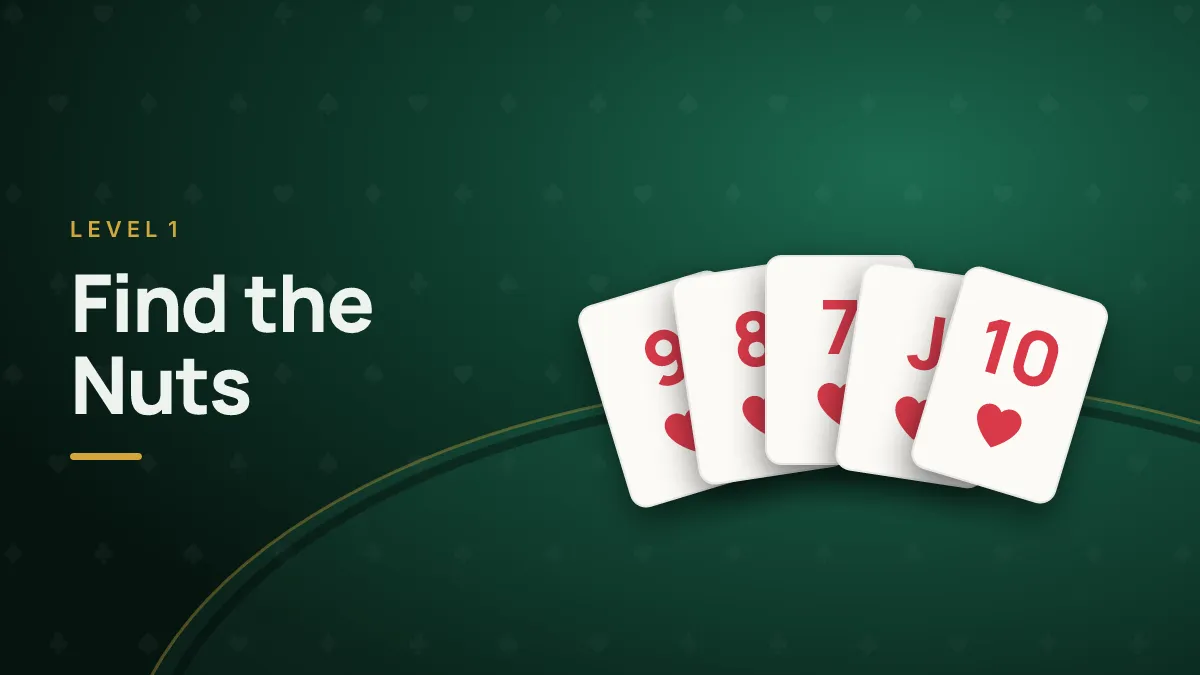
Knowing the hand rankings tells you that a flush beats a straight. Reading the board tells you whether a flush is even possible — and whether your hand is the best one out there. The best possible hand on a given board is called the nuts. Finding it quickly is one of the most important skills in the game: it stops you from paying off hands you can’t beat and gives you the confidence to bet when you can’t lose.
Key takeaways
- The nuts is the best possible hand given the community cards.
- A paired board makes full houses and four of a kind possible.
- Three cards of one suit make a flush possible; four make it possible with one card.
- Three cards within a five-rank window make a straight possible.
- If none of those apply, the nuts is the top set.
The four-step check
Every time a new card hits the board, run through these questions in order. They follow the hand rankings from the top down.
- Is the board paired? If yes, full houses and four of a kind are possible.
- Are there three or more cards of one suit? If yes, a flush is possible. Check for a straight flush too.
- Are there three cards within any five-rank window? If yes, a straight is possible.
- None of the above? Then the nuts is three of a kind — the top set, using a pocket pair of the board’s highest card.
Practice board 1: nothing possible
Flop
Turn
River
- Paired? No.
- Three of a suit? Only two spades. No flush.
- Three cards within five ranks? 9-7 need a third card between 5 and J — there isn’t one. 2-4 need a third between A and 6 — the 7 is too far. No straight.
So the nuts is a set of kings (K♣ K♦, for example). If you hold K-9, you have top two pair — a strong hand, but not the nuts.
Practice board 2: a straight is possible
Flop
Turn
River
- Paired? No. Flush? Only two hearts. No.
- Straight? J, T and 8 fit inside 8–Q (and 7–J). Yes.
Which straight is highest? Q-9 makes 8-9-T-J-Q, a queen-high straight. 9-7 makes a jack-high straight (7-8-9-T-J), which loses to Q-9. The nuts is Q-9.
Practice board 3: a paired board
Flop
Turn
River
The board is paired, so four of a kind is possible: the nuts is 7-7 (the last two sevens). There are also three spades, but a spade flush loses to every full house.
The ranking of the full houses is worth working through:
| Your cards | Your hand | Beats |
|---|---|---|
| 7♥ 7♣ | Four sevens | Everything |
| A♥ A♦ | Aces full of sevens | Every other full house |
| K♥ K♦ | Kings full of sevens | A-7, K-7 and flushes |
| A♦ 7♥ | Sevens full of aces | K-7 and every flush |
Notice that A-A beats A-7: with A-A you have three aces and a pair of sevens (aces full), while A-7 gives three sevens and a pair of aces (sevens full). The three-of-a-kind part decides who wins.
Practice board 4: flushes and straight flushes
Flop
Turn
River
Three hearts that are also connected. Straight flushes are possible:
- J♥ T♥ makes 7-8-9-T-J of hearts — the nuts.
- T♥ 6♥ makes 6-7-8-9-T of hearts — the second nuts.
- 6♥ 5♥ makes 5-6-7-8-9 of hearts.
- A♥ x♥ (the ace of hearts with any other heart that doesn’t make a straight flush) is the best plain flush.
Straight flushes are rare, so in practice the ace-high flush often wins here — but only if you’ve checked.
Four to a flush on the board
When four cards of one suit are on the board, one card of that suit in your hand makes a flush. That means lots of hands have a flush, and the value of the highest card of that suit becomes huge.
Flop
Turn
River
Here any heart makes a flush, and the A♥ makes the nuts. The unpaired board rules out full houses, and no straight flush fits these hearts. A player holding K♣ K♦ has a set — a hand that looks strong but loses to every heart.
When the board plays
Sometimes the five community cards are the best hand available to you. If the board is 5♣ 6♦ 7♥ 8♠ 9♣ and you hold A♠ 2♦, your best five cards are the board’s straight — you “play the board”. Anyone holding a T (making 6 through T) beats you, and if nobody can improve on the board, the pot is split.
Practise it
Deal a random board five times a day and name the nuts within ten seconds. Then check yourself in the odds calculator. The daily Hand of the Day puzzles often test exactly this skill.
Next up: how to behave at the table, live and online — Table Etiquette.
Finished this lesson?
Mark it complete to track your Level 1 progress.
Practise with a free tool
Keep going
Ready for the next level?
Up next in Level 1 — Foundations:
Table Etiquette for Live and Online PokerGet the weekly level-up
One short email a week: a new lesson, a hand to think about and a tool tip. No spam, unsubscribe any time.
By subscribing you agree to our privacy policy.
Related lessons
Poker Hand Rankings: From High Card to Royal Flush
Every poker hand ranked from strongest to weakest, with examples, odds and the tie-break rules that settle close showdowns.
Texas Hold'em Rules: How to Play, Step by Step
Learn the rules of Texas Hold'em from the blinds to the showdown. A clear, step-by-step guide to every betting round, action and tie-breaker.
Betting Rules: Minimum Raises, All-Ins and the Big Blind Option
How much you can bet and raise in No-Limit Hold'em, what happens when someone is all-in, and the betting rules that settle most disputes at the table.