
Bounty and PKO Tournaments: How Bounties Change Ranges
How bounty and progressive knockout (PKO) tournaments work, how to include a bounty in your pot odds, why covering stacks matters and how ranges widen as bounties grow.
By PokerLevelUp Team,
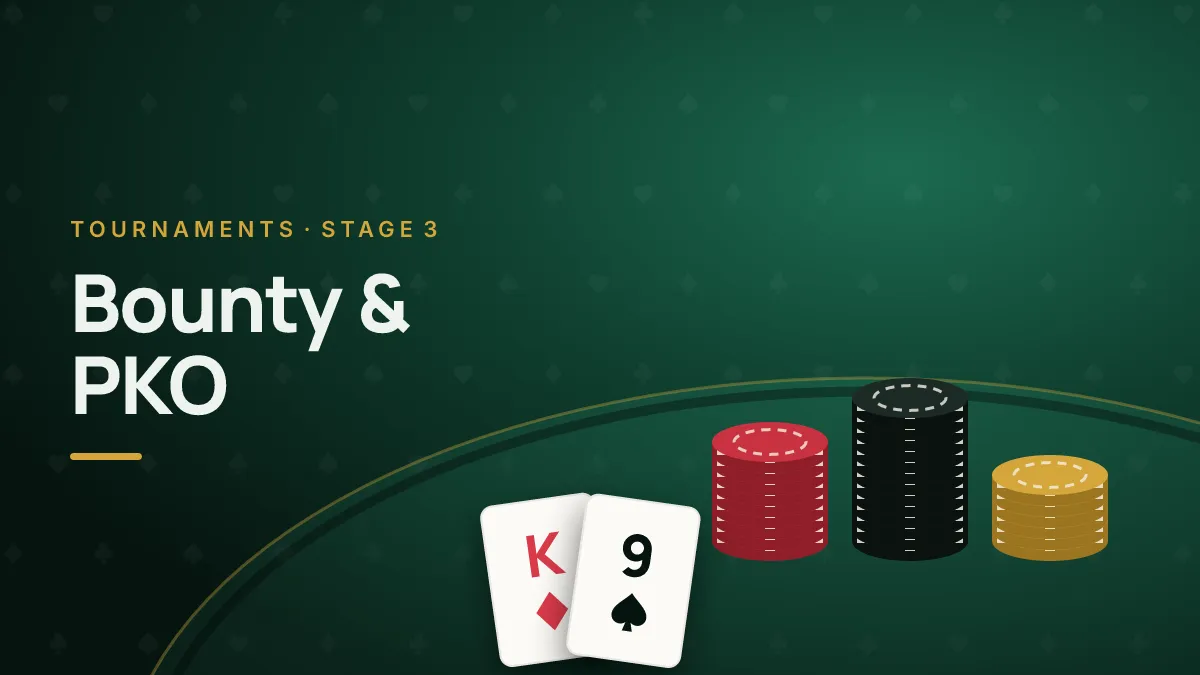
In a bounty tournament, part of every buy-in is a prize on each player’s head. Knock someone out and you win their bounty straight away. In a progressive knockout (PKO), part of that bounty is added to your head, so bounties grow as the tournament goes on. Bounties change the maths of calling all-ins — sometimes dramatically — and players who ignore them leave a lot of money on the table.
Key takeaways
- A bounty is extra money in the pot, available only if you eliminate the player.
- Add the bounty's value to the pot when working out the equity you need to call.
- You can only win a bounty from a player you cover (have more chips than).
- In PKOs, bounties grow; late in the event they can be worth more than the chips at stake.
- Bounties widen calling ranges and make short stacks with big bounties prime targets.
How the formats work
| Format | What happens when you knock someone out |
|---|---|
| Regular bounty (knockout) | You win a fixed bounty, e.g. a fixed amount per player |
| Progressive knockout (PKO) | You win half of their current bounty in cash; the other half is added to your own bounty |
| Mystery bounty | Bounties are revealed at random from a prize pool, usually in the later stages |
A typical PKO splits each buy-in roughly in half: half to the normal prize pool, half to bounties. That means bounties can be about half of all the money in the event.
Adding the bounty to your pot odds
A bounty is simply extra money you win if you win the hand and the player busts. So add its value to the pot.
Example. You’re in the big blind with 40bb (you’ve posted the big blind and a big blind ante). A 20bb player shoves from the button; the small blind folds.
- Pot before your decision: 20 + 0.5 + 1 + 1 = 22.5bb
- You call 19bb more, so the final pot is 41.5bb
Without a bounty: required equity = 19 ÷ 41.5 ≈ 46%
Now suppose the cash you’d win from the button’s bounty is worth about 10bb in chip terms:
With the bounty: 19 ÷ (41.5 + 10) ≈ 37%
The bounty lowers the equity you need by about 9 percentage points. Many hands that were folds become calls.
Covering matters
You can only win a bounty if you eliminate the player — so you must have at least as many chips as they do. Two consequences:
- When you cover someone, call wider: the bounty is in play.
- When someone covers you, they have the bounty incentive and will call your shoves wider. Shove tighter against big stacks, and remember that your own bounty makes you a target.
How bounties change strategy
- Calling ranges widen against short stacks whose bounty you can win.
- Big stacks play more hands, because they cover everyone.
- Short stacks get called more, so their shoving ranges should tighten a little — and become more value-heavy.
- Early in a PKO, bounties are small compared with stacks; play close to normal.
- Late in a PKO, bounties can be huge. A player with a big bounty and a short stack is worth attacking — even with modest hands.
A bounty-driven call
PKO · 60bb effective for Hero · big blind ante
Preflop
Pot 2.5bb
- Button (12bb, bounty worth about 15bb) shoves
- SB folds
- Hero calls 11bb more for a final pot of 25.5bb (12 + 12 + 0.5 + the 1bb ante): about 43% needed without the bounty, but only about 27% with it (11 ÷ 40.5)
- K-9 has well over 40% against a wide button shove: an easy call
Combining bounties and ICM
Near the money and at final tables, ICM makes you call tighter while bounties make you call wider. The two partly cancel out. A good rule of thumb: in PKOs, the later the stage and the bigger the bounties, the more the bounty side wins — except right on the money bubble, where survival still dominates.
Next up: the format where survival is everything — Satellites.
Finished this lesson?
Mark it complete to track your MTT · Stage 3 progress.
Practise with a free tool
Keep going
Ready for the next level?
Up next in MTT · Stage 3 — Final Tables & Special Formats:
Satellite Strategy: When Survival Is EverythingGet the weekly level-up
One short email a week: a new lesson, a hand to think about and a tool tip. No spam, unsubscribe any time.
By subscribing you agree to our privacy policy.
Related lessons
Final Table Strategy: Pay Jumps and Stack Dynamics
How to play a tournament final table: pay jumps, ICM with a six-handed worked example, strategy for big, medium and short stacks, and how to think about deals.
Satellite Strategy: When Survival Is Everything
How satellite tournaments work, why every seat is worth the same, the extreme ICM near the bubble with a worked example, and when folding aces can be correct.
Heads-Up Play: Winning the Title
How to play heads-up for a tournament win: why ranges become so wide, button and big blind strategy, push-fold heads-up, and adjusting to your last opponent.