
Defending the Big Blind in Tournaments
Why the big blind ante makes defending so cheap in tournaments, which hands to call and 3-bet, how stack sizes change your defence and how to play after the flop.
By PokerLevelUp Team,
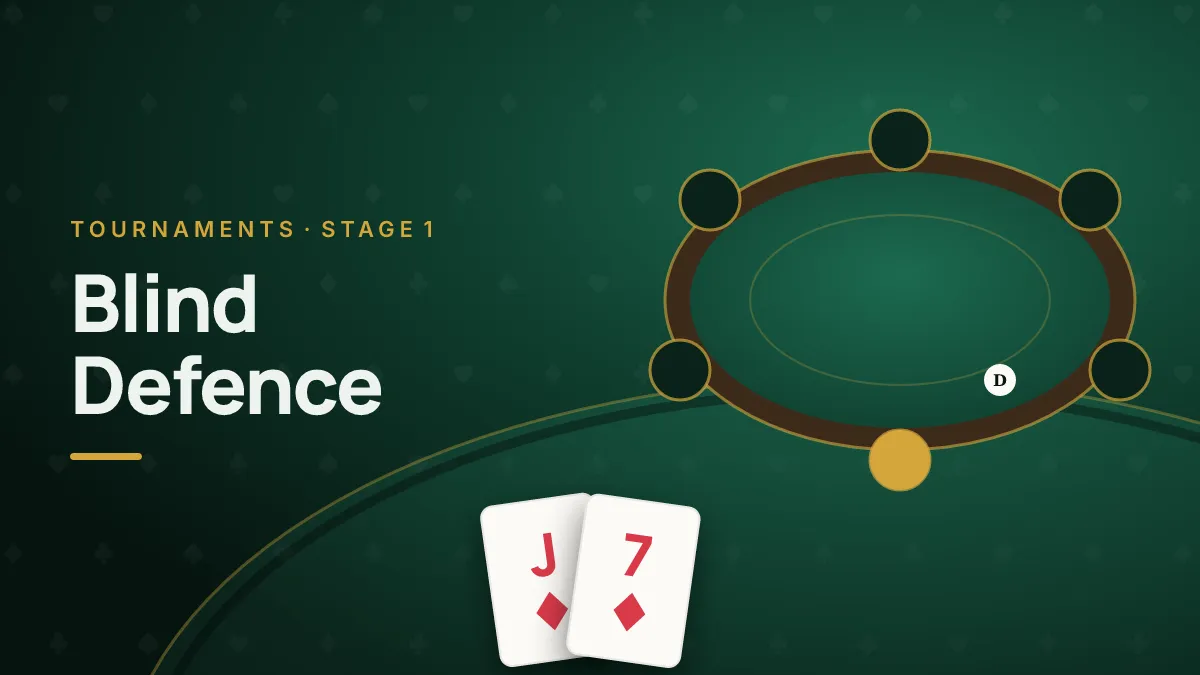
Every steal from the button has a target: you, in the big blind. With a big blind ante, you pay the most of anyone at the table every orbit — so letting it go without a fight is expensive. The good news is that tournament structures give the big blind an excellent price to defend. Players who defend correctly lose far less in the blinds and punish opponents who steal too often.
Key takeaways
- Facing a 2bb open with a big blind ante, the big blind needs only about 18% equity to call.
- That price means defending a wide range — often half or more of your hands against a button open.
- 3-bet (or 3-bet shove) more against wide stealers, especially with 15–30bb.
- Your defence depends on the opener’s seat, your stack and the stacks behind.
- After the flop, play solid, simple poker: you’ll be out of position.
The price you’re getting
With a big blind ante, the pot is 2.5bb before anyone acts. The button opens to 2bb and the small blind folds:
- Pot: 0.5 + 1 + 1 (ante) + 2 = 4.5bb
- You call 1bb more, making the final pot 5.5bb
Required equity = 1 ÷ 5.5 ≈ 18%
Compare that with a cash game without antes (about 27% against a 2.5bb open — see Check-Raising and Big Blind Defence). Nearly every hand has 18% equity against a wide button range. The question isn’t “am I getting the price?” but “can I play this hand well out of position?”
How wide to defend
A practical guide for 25–50bb stacks against a 2–2.2bb open:
| Opener | Defend roughly | Notes |
|---|---|---|
| Button | 55–70% | Widest opener, best price |
| Cutoff | 45–55% | |
| Hijack | 35–45% | |
| Early position | 25–35% | Their range is strong |
| Small blind (vs you) | 60–75% | You’ll have position after the flop |
Fold the very worst offsuit hands (like 7-2, 8-3, 9-2 offsuit). Prefer suited hands, connected hands and hands with an ace or king.
Calling vs 3-betting
With deeper stacks (40bb+), most of your defence is calls, with some 3-bets for value (big pairs, strong aces) and a few bluffs (suited aces, suited connectors).
As stacks get shorter, 3-bet shoving becomes powerful:
| Your stack | Main weapon against a late-position steal |
|---|---|
| 40bb+ | Call wide, 3-bet some strong hands and bluffs |
| 20–35bb | Call, and 3-bet all-in with strong hands plus some hands that play badly post-flop (A-x offsuit, K-Q, pairs) |
| 10–20bb | Re-shove wide; call less |
| Under 10bb | Shove or fold; calling leaves too little behind |
You’ll study reshoving ranges properly in Reshoving.
Defending with a suited hand
Tournament · 35bb · big blind ante
Preflop
Pot 2.5bb
- Folds to the button, who opens to 2bb
- SB folds
- Hero calls — J7 suited has far more than the 18% needed and plays reasonably well
Flop
Pot 5.5bb
1084- Hero checks, BTN bets 1.8bb
- Hero check-raises to 6bb with a flush draw and a gutshot — a strong semi-bluff
Playing after the flop
You’ll be out of position, so keep it simple:
- Check to the preflop raiser on most flops.
- Check-raise strong hands and good draws, particularly on low, connected boards that favour your range.
- Check-call medium pairs and weaker draws when the price is good.
- Check-fold when you miss completely and the board favours the raiser.
Don’t feel you must win every pot you defend. The goal is to lose less from the big blind than you would by folding — and to make stealing from you less attractive.
Adjusting to the situation
- Against a player who steals every button: defend wider and 3-bet more.
- Against a tight player who only opens strong hands: defend less.
- Near the bubble: a medium stack in the big blind should defend tighter against big stacks, because busting is very costly — see Bubble Play.
- When the small blind is aggressive: remember they can squeeze behind the opener too.
You’ve finished Stage 1
Take the Stage 1 quiz to earn your badge. Stage 2 covers the middle of a tournament: Middle-Stage Tournament Strategy.
Finished this lesson?
Mark it complete to track your MTT · Stage 1 progress.
Practise with a free tool
Keep going
Ready for the next level?
That’s the last lesson in MTT · Stage 1. Take the short quiz to earn your MTT · Stage 1 badge and move on to Middle Stages & the Bubble.
Get the weekly level-up
One short email a week: a new lesson, a hand to think about and a tool tip. No spam, unsubscribe any time.
By subscribing you agree to our privacy policy.
Related lessons
Stealing the Blinds and Antes in Tournaments
Why antes make stealing so valuable in tournaments, how wide to open from late position, the right open sizes and how to handle stacks and players behind you.

How Poker Tournaments Work: Structures, Blinds and Payouts
Starting stacks, blind levels, antes, late registration, re-entries and payout structures — and how each one changes the way you should play a tournament.
Early-Stage Tournament Strategy: Playing Deep
How to play the first levels of a tournament: why deep stacks favour implied odds, which hands gain and lose value, and how to exploit loose early players.